News Broadcasting
Government committed to bridging digital divide: President


NEW DELHI: Appreciating the need for empowering the citizen with modern information technology, President APJ Abdul Kalam today announced that the year 2007 will be the ‘Year of Broadband’ as the government was committed to bridging the digital divide by providing broadband coverage throughout the country.
In his address to the joint sitting of both Houses of Parliament on the opening day of the Budget session, Dr Kalam said, “Our Information Technology sector continues to develop and remain globally competitive,” adding that, “My government will take forward the National Identity Card Project under the National e-Governance Plan for nationwide roll-out in a phased manner so as to ensure better delivery of services to our citizens.”
He said the government was encouraging the growth of the electronic hardware industry and the semiconductor industry.

He also said the Right to Information Act was one means of empowering citizens, adding that it had often been said that eternal vigilance is the price of democracy.
The President said a Vision for the development of an empowered S&T base by 2015 had been prepared. Steps will be taken to attract talent, rejuvenate university research, enable women scientists to re-enter careers in science, strengthen technology business incubation processes, promote excellence in research, engage private sector in R&D and create greater science awareness and a scientific temper among the people. The financial allocation for science and technology will be increased from less than 1% of GDP to 2% of GDP.
He said that to sustain the efforts in the advanced fields of modern science and technology, there was need to increase the number of scientists and improve the quality of Indian science. The Government was deeply concerned about the inadequate enrolment of students in basic sciences and said Indian science is lagging behind other newly industrializing economies. India needs a new thrust in the field of science and technology.
The National Knowledge Commission had submitted its first report placing emphasis on the need to invest in education at all levels of the knowledge pyramid. Several new Indian Institutes of Science Education and Research, Indian Institutes of Technology and Indian Institutes of Information Technology were proposed to be set up in various parts of the country.






News Broadcasting
UDF poised to return to power in Kerala, says Manorama-CVoter survey
Massive opinion poll projects shift in Kerala politics ahead of 2026 Assembly elections.
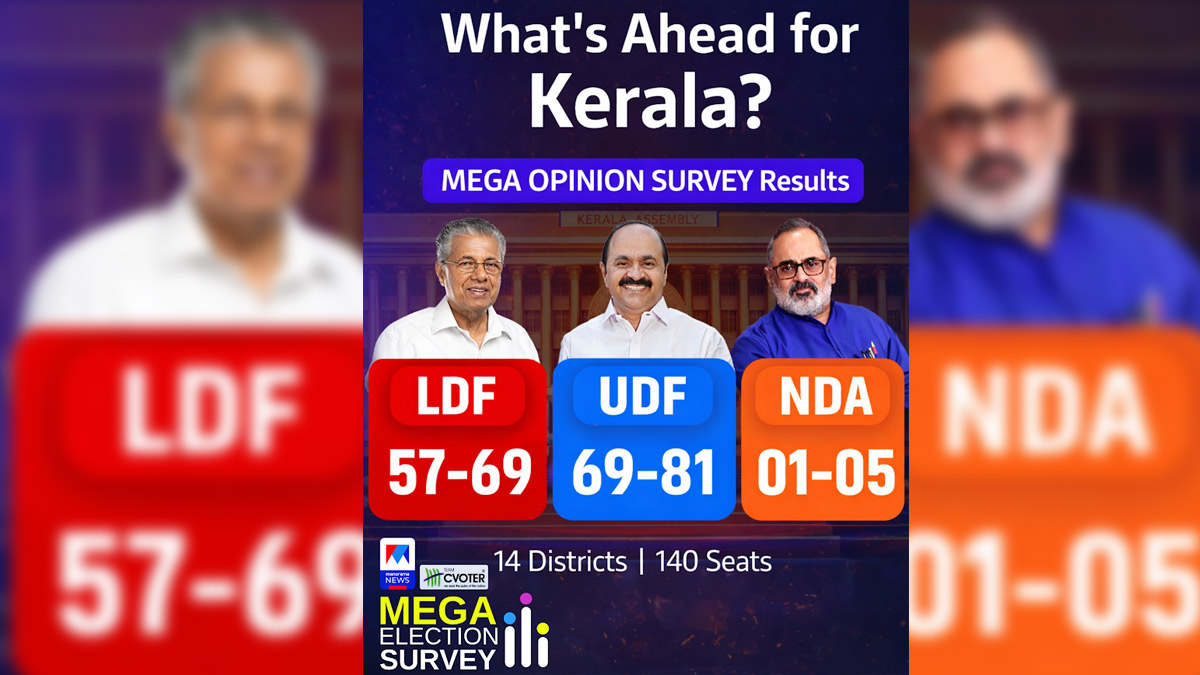
MUMBAI: The winds of change appear to be blowing through Kerala’s political landscape and this time, they seem to favour the United Democratic Front. A comprehensive mega opinion survey conducted by Manorama News in partnership with CVoter projects a potential comeback for the UDF in the upcoming Kerala Legislative Assembly Elections 2026. The survey, covering all 140 constituencies with a massive sample size of nearly 90,000 respondents, predicts the UDF could win between 69 and 81 seats.
The ruling Left Democratic Front (LDF) is expected to secure 57 to 69 seats, a significant drop from the 99 seats it won in the 2021 elections. This would mean the LDF losing 30 to 42 of its sitting seats. Meanwhile, the National Democratic Alliance (NDA), which drew a blank in 2021, is projected to open its account with 1 to 5 seats.
Region-wise, the UDF is expected to make strong gains in Malabar, winning 25 to 34 out of 48 seats, and in Central Kerala, where it could bag 29 to 33 out of 53 seats. In South Kerala, the LDF is likely to retain an edge with 21 to 25 seats, while the UDF may improve to 12 to 16 seats. The NDA could pick up 1 to 3 seats in the southern region.
The survey was conducted between 14 and 26 March 2026, with additional tracker and snap polls carried out from December 2025 to March 2026. A total of 89,693 respondents participated, ensuring representation across all demographics and social segments.
Manorama News has a strong track record of accuracy, with its previous projections closely matching the actual results of the 2019 and 2024 Lok Sabha elections as well as the 2021 Kerala Assembly polls.
In Kerala’s famously fierce political battles, this survey suggests the pendulum may be swinging back. Whether the final verdict matches these numbers or throws up another surprise, one thing is clear, the 2026 Assembly elections are shaping up to be one of the most keenly watched contests in the state’s history.






