News Broadcasting
GoM clears draft convergence bill, looks at super regulator


The group of ministers (GoM) on information technology and telecom, headed by finance minister Yashwant Sinha, on Tuesday approved the draft Communications and Convergence Bill 2001 setting in motion the process of creating a super regulator which will have the Telecom Regulatory Authority of India (TRAI) and the proposed broadcasting authority subservient to it.
Everything connected with telecommunication and broadcasting, and other communications, including all aspects of convergence in these services, would come under the commission’s purview.
The super regulator, to be called the Communications Commission of India (CCI), will be established on the lines of the Federal Communications Commission of the US, according to the Business Standard. The draft bill was based on the recommendations made by a panel led by legal expert Fali S Nariman.

The CCI will be empowered to issue all licences, including composite licences for communication facilities and services, to facilitate and regulate all aspects of telecom, broadcasting and other communication including all aspects of convergence in these services, to determine regulations, codes and technical standards, to determine and levy license fee wherever required and to determine tariff and rates for licensed services wherever necessary, the Hindu Businessline reported.
The passage of the Bill involves the repeal of at least five laws and also covers certain aspects of the Information Act 2000 that are administered by the telecom, IT and broadcasting Ministries. The proposed Bill is likely to deal with the consolidation and management of the provisions of the Indian Telegraphs Act, 1885, the Indian Wireless Telegraphy Act, 1933, the Telegraph Wire Unlawful Possession Act, 1950 and the TRAI.
It will also lead to the repeal of the Cable Television Networks (Regulation) Act, 1995, which is under the purview of the I&B Ministry.
So is the era of convergence finally at hand? Not just yet and maybe not for a while if the government’s record on the matter thus far is anything to go by.
IT Minister Pramod Mahajan has promised the bill, which has over 100 clauses, will be introduced in Parliament in the first week of May.
Before that it will first be put on the Web to get feedback from various sections of the industry.
This is supposed to happen within a week. The responses are expected to come in by 25 February. Nariman is then expected to scrutinise the responses and the GoM is to meet again in April to incorporate any changes, if required.
If there are no differences within the GoM at that stage, the bill will be placed before the cabinet in April-end and in the first week of May, it is scheduled to be introduced in Parliament. The bill will then be sent to the standing committee, and is expected to be passed either in the winter session of 2001 or in the Budget session of 2002.
Mahajan has said the bill will be implemented in its full form in early 2002. That is the schedule as of now. How the whole thing finally unravels we’ll have to wait and watch.







News Broadcasting
India Today Group sweeps top honours at Ramnath Goenka Awards
Journalists recognised for fearless investigative and civic reporting.
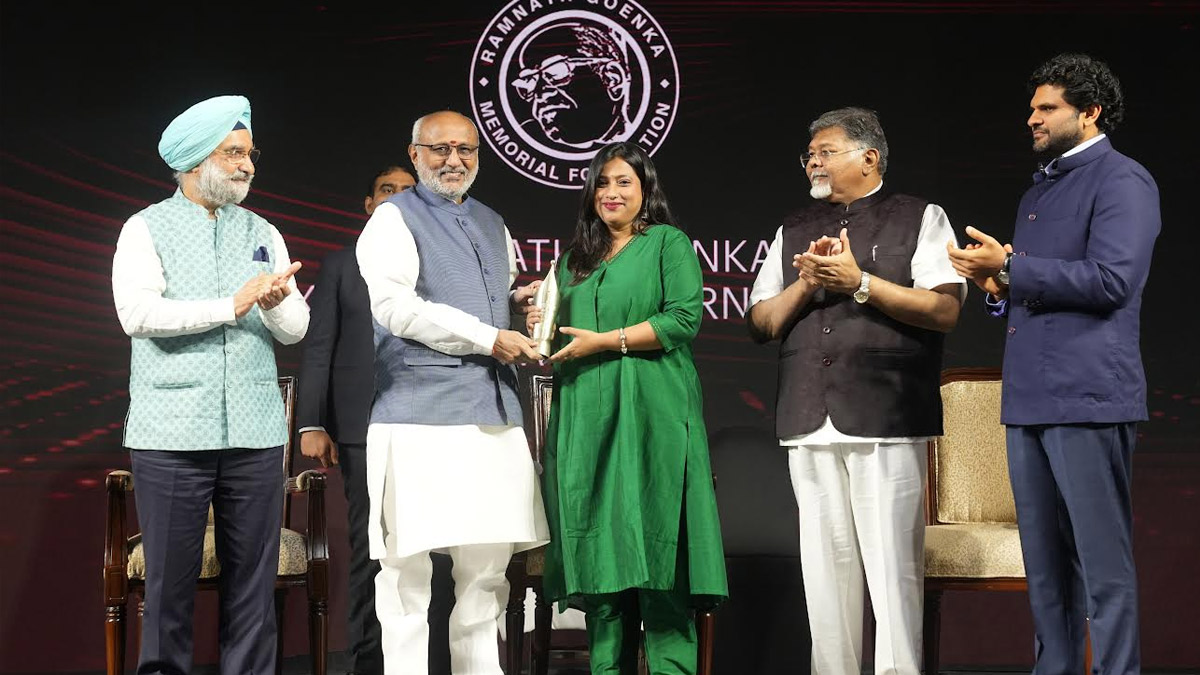
MUMBAI: India Today Group just turned the Ramnath Goenka Awards into its own trophy cabinet because when your reporters dig this deep, even the judges have to award a clean sweep. India Today Group journalists have secured multiple top honours at the latest edition of the prestigious Ramnath Goenka Excellence in Journalism Awards, reinforcing the network’s legacy as the gold standard of Indian journalism. The awards were conferred by vice president C. P. Radhakrishnan at a ceremony held on 27 March 2026.
Sreya Chatterjee won in the ‘Investigative Reporting – Broadcast’ category for her powerful India Today TV report ‘Operation Illegals: The Alarming Rise in Bangladeshi Infiltration Across India’s Fragile Eastern Frontier’. The investigation stood out for its depth, on-ground rigour and national relevance.
In the ‘Civic Journalism – Print/Digital’ category, Sreya Chatterjee along with Arvind Ojha were honoured for their indiatoday.in report on unregulated water extraction and the ‘Tanker Mafia’ in Delhi’s Bawana Industrial Area. The story exposed critical systemic gaps and environmental challenges affecting daily life.
Additionally, aajtak.in was recognised in the ‘Investigative Reporting – Print/Digital’ category for its hard-hitting exposé ‘The Surrogate Mother Market’, which highlighted the human, legal and ethical dimensions of the surrogacy ecosystem.
India Today Group emerged as the only network honoured in Investigative Journalism across both Print/Digital and Broadcast categories. The wins reflect the strength of its multi-platform newsroom and its unwavering commitment to credible, high-impact reporting that informs public discourse and drives accountability.
In an era when speed often trumps substance, these awards remind us that the most powerful stories are still the ones dug out with courage, told with clarity, and delivered with conscience, one fearless byline at a time.








