News Broadcasting
Get ready for the Budget Ballot: Vote for Growth” with CNBC-TV18

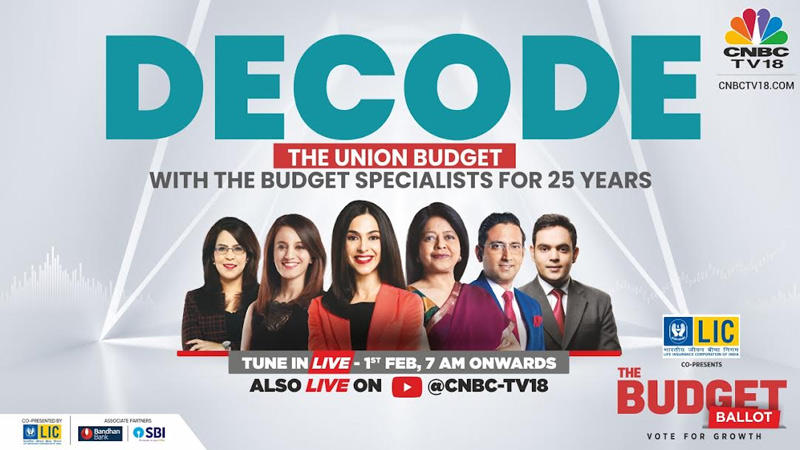
Mumbai : CNBC-TV18, English business news channel, kickstarted its exclusive Budget programming with ‘The Budget Ballot – #MyBudgetWishlist’ campaign initiative that captured the nation’s pulse and gave voice to the citizens’ expectations leading up to the interim Budget 2024.
With over 2500 entries received through the website and multiple on-ground touchpoints in Mumbai and Delhi, the campaign emerged as a significant channel for the nation to articulate its hopes and expectations from the Union Budget and the finance minister, especially as a run up to the upcoming general elections.
This engaging initiative complemented the dynamic CNBC-TV18 programming lineup dedicated to offering in-depth insights and expert analysis in the run-up to the Budget as well as decoding the implications of the announcement for the audience.

The pre-budget comprehensively addresses various facets of the Budget, featuring well-researched information and cutting-edge analysis led by CNBC-TV18’s esteemed guest Editors such as Dr K.V. Subramanian, executive director, international monetary fund and former CEA; N.K. Singh (15 Finance Commission); Sajjid Chinoy (JP Morgan); Dinesh Kanabar (Dhruva Advisors). In the ‘Budget Market Masters,’ market veterans like Raamdeo Agrawal (Motilal Oswal Financial Services); Nilesh Shah, (Kotak Mahindra AMC); S Naren (ICICI Prudential AMC); Prashant Khemka (White Oak Capital); and Ashok Wadhwa (Ambit) discuss expectations of the markets and anticipated movements because of the Budget announcement.
The comprehensive and well-rounded Budget Day reportage will include shows such as the “The FII View” where the viewers gain a perspective on foreign investments in India, featuring R innobert Sockin (CITI) and Arvind Sanger (Geosphere Capital) sharing their expertise.
Featuring the biggest voices from India Inc., leaders such as Dinesh Khara (SBI), Sanjiv Bajaj (Bajaj Finserv), Sanjiv Puri (ITC), Sunil Vachani (Dixon Technologies), Suneeta Reddy (Apollo Hospitals) will share their opinions & analysis of the Budget 2024 announcement. Through ‘Mapping the Macros’, experts such as Sajjid Chinoy (JP Morgan), Jahangir Aziz (JP Morgan), and Samiran Chakraborty (CITI India) will explain the macroeconomic landscape and in ‘The Tax Tangle’, Dinesh Kanabar (Dhruva Advisors), Rajiv Memani (EY) and Sudhir Kapadia (EY) will help decode taxation complexities.
CNBC-TV18, managing editor Shereen Bhan said,’ ‘The CNBC-TV18 Budget Ballot campaign is a powerful forum for voicing our nation’s collective hopes & dreams from the budget. We believe the citizen must be at the centre of policy making and the Budget ballot is an effort to initiate a dialogue. This is our latest effort in making the Budget accessible to viewers, an endeavour we have been committed to for the last 25 years. Our experience, expertise and understanding of the union budget will ensure our coverage comprehensively decodes the fine print of the Interim Budget 2024 and amplifies the impact of the announcements, all this live and in real time. With a stellar line up of industry leaders, economists, policymakers & global investors, CNBC-TV18 will bring you the most value-added analysis of the Union Budget”.
Network18 CEO, Business News Smriti Mehra, added, “Our dedication to being the foremost authority on business & financial news and insights is encapsulated in our programming lineup and the enthusiastic response to the #MyBudgetWishlist campaign. As Budget Day approaches, we aim to equip our audience with information that is relevant and useful to them in their financial journey.
For union budget 2024, we have partnered with some of the most renowned brands such as Life Insurance Corporation of India, along with State Bank of India and Bandhan Bank. Notably, CNBC-TV18 being a multiplatform news brand, will be going LIVE on TV, website, and YouTube, ensuring that our viewers can access real-time updates and expert analysis seamlessly across various mediums.” she added.
Tune in to CNBC-TV18 to catch the FM’s Speech LIVE on 1st Feb, 11 AM onwards. Also available LIVE on our YouTube page – @CNBCTV18.





News Broadcasting
News TV viewership jumps 33 per cent as West Asia war draws audiences
BARC Week 8 data shows news share rising to 8 per cent despite T20 World Cup
NEW DELHI: Even as individual television news channel ratings remain under a temporary pause, the genre itself is seeing a clear surge in audience attention.
According to the latest data from Broadcast Audience Research Council India, television news recorded a 33 per cent jump in genre share in Week 8 of 2026, covering February 28 to March 6.
The news genre accounted for 8 per cent of total television viewership during the week, up from 6 per cent the previous week. The spike in attention coincided with escalating geopolitical tensions involving the United States, Israel and Iran, which have kept global headlines firmly fixed on West Asia.
The rise is notable because it came at a time when cricket was dominating television screens. The high-stakes stages of the ICC Men’s T20 World Cup, including the Super 8 fixtures and semi-finals, were being broadcast during the same period.
Despite the cricket frenzy, viewers appeared to be toggling between sport and global affairs, boosting the overall share of news programming.
The surge in genre share comes even as the government has enforced a one-month pause on publishing ratings for individual news channels. The move followed regulatory scrutiny of the television ratings ecosystem.
While channel-level rankings remain temporarily out of sight, the genre-level data suggests that when global tensions escalate, audiences continue to turn to television news for real-time updates.







