News Broadcasting
GBN to dilute close to 15% in IPO, valuation pegged at Rs 6.5-7 billion

MUMBAI: Global Broadcast News Ltd (GBN), which owns and operates English news channel CNN-IBN, will dilute close to 15 per cent in its intial public offering (IPO), pegging the valuation of the company at around Rs 6.5-7 billion.
The company, which plans to raise Rs 1.05 billion in the public float sometime in January, has yet to announce the price band. The proceeds of the issue will be used to meet the company’s growth plans, which include the completion of the acquisition of Hindi channel IBN-7.TV18 Group managing director Raghav Bahl declined to comment on the extent of dilution that the IPO would involve. “We are in the process of finalising that,” he said.
Sources, however, confirm that the company is looking at a dilution in the region of 12-15 per cent through the IPO. Indiantelevision.com had earlier reported that GBN would be raising Rs 1.05 billion.

Bahl is also aggressively eyeing the regional news space. “We realise it is an important growth segment. But we are still examining it. We will be taking a final decision on this quickly,” he said.
The other growth area in the broadcasting business, Bahl said, was in launching niche channels in the news space. There is no decision yet in which companies these channels will be housed.
Growth for TV18 will come from subscription business. Pay revenues in this fiscal will rest at Rs 350 million, Bahl said. “We see the lines of distribution business maturing in the coming years. It will account for a big leap in our revenues. We will also continue to register advertising growth,” he added.
TV18, which got re-listed on Wednesday after restructuring the different businesses, is expected to close this fiscal with a revenue of over Rs 2 billion and a net profit margin of around 35 per cent. The company houses two business channels, CNBC TV18 and CNBC Awaaz, a clutch of internet properties, financial wire service Crisil Marketwire (which was recently acquired) and an e-broking venture with partners which will get launched in 3-6 months. “TV18 is positioned as a full spectrum business news, information and transaction play company,” said Bahl.
On the first day of trading in its new avataar on Wednesday, TV18 opened at Rs 600 and closed at Rs 618.35. This was much higher than the market expectation of a debut listing in the range of Rs 450.
“The market is giving value to the internet properties. Bahl has created a perception where he will be a clear leader in this space,” an analyst at a broking firm said.
Bahl may decide to list these internet properties (including flagship moneycontrol.com, commoditescontrol, ibnlive, compareindia, cricketnext) which are sitting inside TV18 overseas. He will be adding more sites through a string of acquisitions as well as growing them organically. “We are bullish on our internet properties. We are giving it a balance sheet and a capital structure. We will unlock value for the shareholders at the right time as they reach critical size. This can mean revenues or even critical traffic into these portals,” he said.
Interestingly, the TV18 scrip (before the restructuring) saw a surge in quick time by Rs 300 to hover over Rs 900 on the back of the IPO floated by Naukri.com (Info Edge). Bahl has created internet assets that can rake in money as he scales up these verticals.
TV18 shareholders will also enjoy the GBN value which will come to them via the Network18 route. Network18, which has 51 per cent stakes in both TV18 and GBN, is likely to be listed within 2-3 weeks.
TV18 will be raising capital up to Rs 3 billion to fund its various expansion requirements. “We have made some investments in acquisitions and other areas through internal accruals and debt. We have a capital raising programme,” says Bahl.
TV18 had earlier mandated HSBC to raise Rs 1 billion. “We will sit with them again and decide how much and when we need to raise capital,” said Bahl.
Besides being the holding company, Network18 will also house Studio18 and Shop18. “It is positioned as a full play media company. In Studio18, we will have a presence in the movie business across the value chain of distribution, production, acquisition and content syndication. We will roll out our products in the next fiscal. We also have ambitious plans for Shop18,” says Bahl.







News Broadcasting
UDF poised to return to power in Kerala, says Manorama-CVoter survey
Massive opinion poll projects shift in Kerala politics ahead of 2026 Assembly elections.
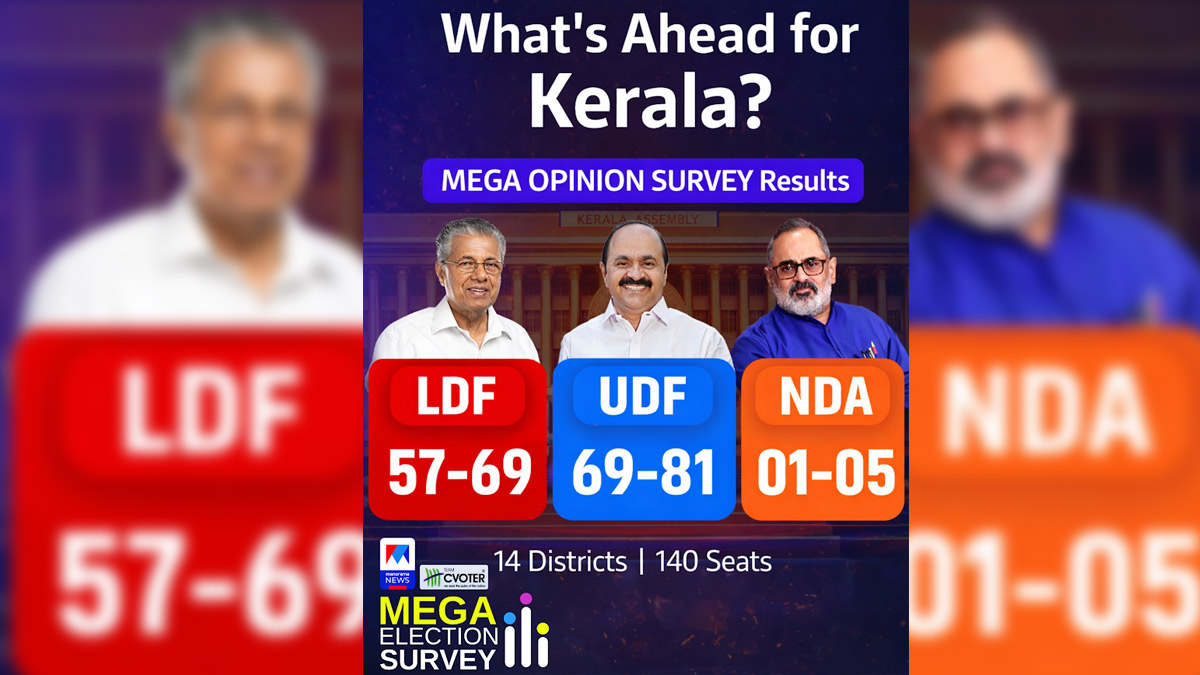
MUMBAI: The winds of change appear to be blowing through Kerala’s political landscape and this time, they seem to favour the United Democratic Front. A comprehensive mega opinion survey conducted by Manorama News in partnership with CVoter projects a potential comeback for the UDF in the upcoming Kerala Legislative Assembly Elections 2026. The survey, covering all 140 constituencies with a massive sample size of nearly 90,000 respondents, predicts the UDF could win between 69 and 81 seats.
The ruling Left Democratic Front (LDF) is expected to secure 57 to 69 seats, a significant drop from the 99 seats it won in the 2021 elections. This would mean the LDF losing 30 to 42 of its sitting seats. Meanwhile, the National Democratic Alliance (NDA), which drew a blank in 2021, is projected to open its account with 1 to 5 seats.
Region-wise, the UDF is expected to make strong gains in Malabar, winning 25 to 34 out of 48 seats, and in Central Kerala, where it could bag 29 to 33 out of 53 seats. In South Kerala, the LDF is likely to retain an edge with 21 to 25 seats, while the UDF may improve to 12 to 16 seats. The NDA could pick up 1 to 3 seats in the southern region.
The survey was conducted between 14 and 26 March 2026, with additional tracker and snap polls carried out from December 2025 to March 2026. A total of 89,693 respondents participated, ensuring representation across all demographics and social segments.
Manorama News has a strong track record of accuracy, with its previous projections closely matching the actual results of the 2019 and 2024 Lok Sabha elections as well as the 2021 Kerala Assembly polls.
In Kerala’s famously fierce political battles, this survey suggests the pendulum may be swinging back. Whether the final verdict matches these numbers or throws up another surprise, one thing is clear, the 2026 Assembly elections are shaping up to be one of the most keenly watched contests in the state’s history.






