GECs
Future will belong to those who can create compelling content: Raj Nayak

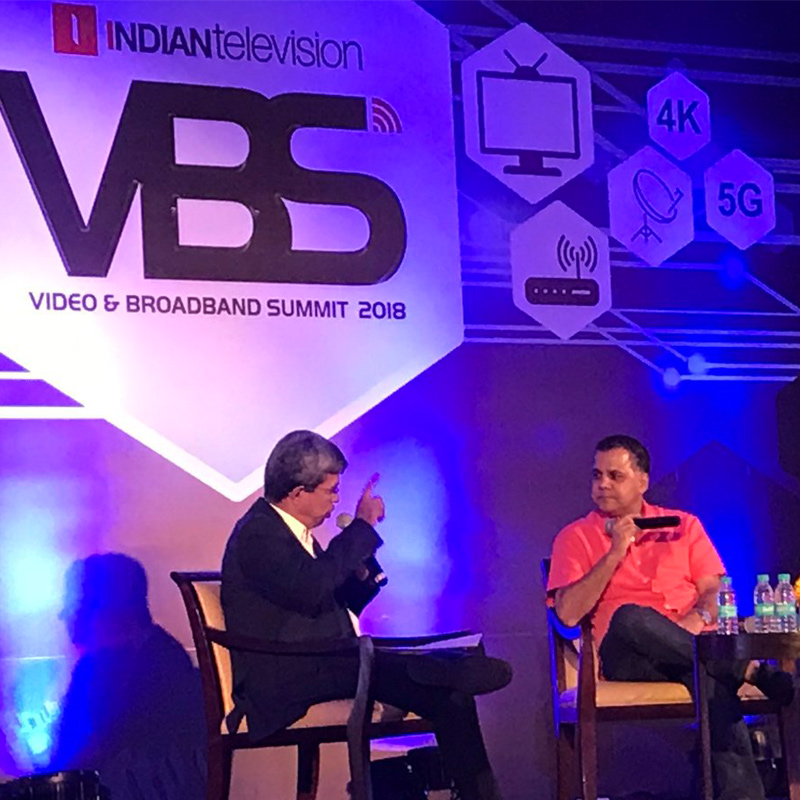
GOA: He’s known as the risk taker who has never been afraid to experiment. After thirty years in the media industry out of which a whopping 26 years have been dedicated to the TV broadcast sector, exiting Viacom18 COO Raj Nayak is grateful to the media business for where he finds himself in life at the moment. Speaking at Indiantelevision.com’s Video and Broadband Summit 2018 in a freewheeling chat, Nayak revisited key chapters of his journey, his best memories at Viacom18, and commented on the nature of today’s media industry and its future.
In a fireside chat with Indiantelevision.com founder, CEO and editor-in-chief Anil Wanvari, Nayak in his usual witty and cheerful demeanour captivated the audience with insights and learning from his stellar career. The media maven described his rollercoaster ride from Star TV to NDTV and then the shift into entrepreneurship to finally settling into the corporate world of Viacom18 as exciting.
Answering Wanvari’s question about his evolution as a professional, Nayak shared how exciting it was to join satellite television from print media back in the 90s. He considers himself lucky to be at the right place at the right time. However, joining the TV industry then was considered a wasted opportunity until the satellite boom, he added.

He further went on to say that the future will belong to those who can create content that is compelling because the challenge on the distribution front will eventually disappear. So, everybody will find a way to get their product out but there will be a taker at the end of the pipe only if it is compelling.
The experienced professional said broadcasters got so used to making same patterned shows at Rs 8-10 lakh budget that it took Amazon and Netflix to come to change that habit. The quality of content has to go up now, he feels.
According to him, linear TV has to change its style of narration and content. He cited the example of how ratings and viewership for individual shows are going witnessing a decline despite the increase in overall viewership. However, he is quick to add that the change is happening faster.
“Content cost is going up, it’s not going down, it’s going up across broadcasters. I know of a broadcaster who tried to change that by restricting producers’ budgets but they lasted for not more than six months and now they are spending money more than ever,” Nayak said.
The admirer of “Subhash ji” (Essel Group chairman Subhash Chandra) while talking about distribution repeats what Chandra said 20 years ago that if the content is king then distribution is God.
While his seven and a half years at Viacom18 comprised of several landmark moments, he shared the ones closest to his heart with the audience. Nayak spoke about 24 which was a trendsetting show, Naagin and changing the time slot of Bigg Boss to 10.30 pm as defining moments of his tenure.
“One of the things I was very happy to do and had the freedom and opportunity to do is a variety of content. We are the only channel in India who did so, where nobody expected to do we did the recordings of Yuvraj Singh when he was in cancer and Zindagi Abhi Baaki Hai,” he added.
“Whatever I have achieved is because of this industry. If you don’t give back to the industry that has given you so much, I think you are doing a disservice,” the passionate veteran commented. He also named Star’s Uday Shankar and ZEEL’s Punit Goenka as leaders who he admires.
Nayak says he draws motivation from the media industry and how it has evolved, given birth to so many entrepreneurs, created millions of jobs and helped individuals build glorious careers. The entry of Facebook and YouTube has made the system more democratic creating more opportunities, Nayak believes. Although, the absence of a common industry voice upsets him.
“I can guarantee no one of you has watched more than three per cent of Netflix content yet you subscribe. House of Cards changed the trajectory of the game for the streaming service. Sacred Games increased the subscribers. All you need is 2-3 golden nuggets and that’s enough to change the whole dynamics of your business,” Nayak said.
Sharing his vision for the industry in the next five years, he is certain that OTT will go big. But he also adds that from an ad sales model, monetisation will be a challenge so companies need to promote the SVoD model. Nayak also feels that TV will also continue to grow as big screen experience is never going to lose its charm. TV will turn into a box with Facebook, Google and everything available on it, Nayak predicted.






GECs
Sahara One reports financial results, notes director exit and business realignment
Muted revenues, steady expenses and strategic adjustments shape company’s current phase
MUMBAI: In a tale where the sands seem to be slipping faster than they can be gathered, Sahara One Media and Entertainment Limited has reported another quarter of wafer-thin income and widening losses, even as a boardroom exit adds to the unease.
The company informed the Bombay Stock Exchange that its board, in a meeting held on April 4, approved its unaudited financial results for the quarter ended September 30, 2025. The numbers paint a stark picture. Total income for the quarter stood at just Rs 0.13 lakh, unchanged sequentially and sharply down from Rs 0.26 lakh a year earlier.
Losses, meanwhile, deepened. The company posted a net loss of Rs 24.16 lakh for the quarter, compared to Rs 18.81 lakh in the June quarter and Rs 39.69 lakh in the same period last year. For the six months ended September 2025, the cumulative loss stood at Rs 39.69 lakh, while the full-year loss for FY25 was reported at Rs 60.72 lakh.
Expenses continued to outweigh income by a wide margin. Total expenses for the quarter came in at Rs 24.30 lakh, led by employee benefit costs of Rs 6.51 lakh and other expenses of Rs 17.78 lakh. Earnings per share remained in the red at Rs (0.11) for the quarter.
The balance sheet reflects a company with significant assets on paper but limited operational momentum. Total assets stood at Rs 23,065.57 lakh as of September 30, 2025, broadly unchanged from March 2025. Equity share capital remained steady at Rs 2,152.50 lakh, while total equity was reported at Rs 18,004.85 lakh.
Cash and cash equivalents saw a modest uptick to Rs 6.75 lakh from Rs 4.68 lakh earlier, supported by a positive operating cash flow of Rs 180.01 lakh for the period.
Yet, beneath these numbers lies a more complex narrative. The company’s auditors flagged their inability to obtain sufficient evidence to form a conclusion on the financial statements, citing lack of access to records. They also raised concerns over the company’s ability to continue as a going concern, pointing to insufficient funds, delayed recoveries, and stalled content investments.
Adding to the governance overhang, the company disclosed that Rana Zia has resigned as whole-time director, effective October 16, 2025, citing other professional commitments. The resignation, noted and accepted by the board, also brings an end to her role across company committees.
Regulatory pressures continue to loom large. The Securities and Exchange Board of India has already initiated penal actions for non-compliance with listing norms, with trading in the company’s shares remaining suspended. There is also a risk of promoter demat accounts being frozen.
Legacy legal issues remain unresolved. A substantial deposit of Rs 694,027.88 thousand linked to the long-running OFCD dispute involving Sahara group entities is still under the purview of the Supreme Court of India. Restrictions on asset disposal continue to weigh on the company’s financial flexibility.
Operationally, challenges persist across multiple fronts. Advances worth Rs 1,92,916 thousand given for film content remain stuck, with delays in project completion and uncertain recoverability. The company’s YouTube channel, despite being operational, has generated no revenue for over three years due to compliance lapses. In a further twist, management has indicated that revenues may have been fraudulently diverted through unauthorised changes to its AdSense account, with a police complaint in the works.
There are also missed revenue opportunities. Television content rights continue to be used by a related party despite the expiry of the licence agreement, with fresh negotiations still underway.
For now, Sahara One Media and Entertainment Limited appears caught between legacy disputes and present-day operational hurdles. As losses linger and governance questions mount, the road to recovery looks less like a sprint and more like a slow trudge through shifting sands.






