News Headline
Future looks promising with more linear TV users planning to adopt CTV in the next year: Group M’s Kantar report

Mumbai: If convenience is driving audiences towards connected TV, addressability is driving advertisers to connected TV. India’s CTV ad spend will touch $395 million by 2027. It will grow at a CAGR (compound annual growth rate) of 47 per cent. CTV adoption has been rapidly evolving in the last two years, and the future looks promising with more linear TV users planning to adopt CTV in the next year.
GroupM’s division Finecast, which offers addressable TV solutions, and Kantar have released a study on the “Changing Landscape of Indian Television.” This is a study of the addressable TV advertising transformation. The opportunity lies in the fact that today there are 20–22 million addressable TV homes in India. More than 10 per cent of TV homes are addressable today. There will be 40 million addressable TV homes in India by 2025. Growth is being driven by content on OTT apps, smart TV sales, and broadband connections. India’s smart TV shipment volume grew 38 per cent year-on-year (YoY) in Q3 2022.
Prior to the pandemic, subscriber growth in the broadband space was modest, but the pace has picked up post-pandemic. On OTT, there has been steady growth in the user base and time spent. A 42 per cent increase in OTT users is expected by 2025.

GroupM CEO South Asia Prasanth Kumar said, “Since its arrival, television advertising has become one of the most popular means of business advertising. It has a unique impact on society that is much stronger than others’. The biggest positive that television currently has in advertising is the creation of a growing number of branding opportunities for brands and businesses of all sizes. It is also important to recall that in the future, TV advertising will permit the viewers to get involved not only by personalising their experience but also by getting involved with the ads.”
“Given the increased user involvement and the technological shift, it is certain to expect conversion rates to go up as well. The future of TV in terms of advertising looks bright as the emergence of new technologies like CTV creates even more room for customisations. CTV is a big new opportunity in the digital advertising industry and a trending topic on which ad tech companies can seek to capitalise,” he added. Contemporary audiences like to engage in interactive campaigns, so it will be critical to support television as a global marketing tool as it offers unique opportunities and derives trust from the audience.
“In partnership with Kantar, GroupM Finecast has done in-depth research on what TV viewers consume and what their preferred choices are. The report will be extremely useful to marketers and advertisers in understanding the trends in TV consumption. This would help them to create new and effective campaigns by understanding the behaviour of their audiences,” he elaborated further.
“Addressable TV strategies can supercharge the marketing mix by using data-driven precision to target households. Messaging can now be bespoke and activated in relevant locations – providing a much better experience for both viewers and advertisers,” said Mindshare CEO South Asia Amin Lakhani.
There was a study done. The only requirement was that respondents own a television (smart or otherwise). They watch any type of content on TV for a minimum of five hours a week. NCCS A (79 per cent) and B (21 per cent). They are 21–50 years old. There was a mix of joint and nuclear families.
One in two customers has a dual connection to TV content; multiple connections aid flexibility and choice of content. 61 per cent of respondents said they have multiple connections, and within those connections, 62 per cent have smart TVs. The main benefits of having multiple connections are that it allows consumers to watch content on their preferred connection while also allowing other family members to watch different content.
Two out of every three households prefer to access TV content via connected TV, with streaming being the most popular method. According to respondents, connected TV (smart TVs, devices such as Firestick, and internet-enabled set-top boxes) is the preferred connection at 65 per cent, compared to 35 per cent for linear (cable + DTH). Even though they have multiple connections for accessing TV, there is a preference for which access point they prefer most.
78 per cent of LTV respondents intend to switch to CTV in the next year. 2.45 per cent of respondents intend to use CTV in the next six months, despite the fact that the majority of CTV users began using it within the last year. Only six per cent remain undecided. When compared to other zones, the East has a relatively longer time horizon to adopt CTV.
“The need for reaching out to cord cutters and cord ‘nevers’ is becoming more important as these are hard-to-reach and highly engaging audiences. CTV today can increase brand impact on these audiences by not only measuring results in real time but also optimising the campaigns across various KPIs,” said Mediacom CEO of South Asia Navin Khemka.
Among the respondents, there is no significant difference in preference for connected TV or linear TV by NCCS A and B categories, or metro vs. non-metro. However, there is a skew in the West towards a preference for connected TV users, whereas the East prefers linear TV. CTV users have more premium lifestyle preferences. CTV households earn 1.2 times more than LTV households and are twice as likely to own smartphones costing more than Rs 40,000.
As compared to linear TV respondents, connected TV users were more likely to spend time with friends, family, and on social media. They like to go out more frequently and binge-watch TV on weekends when they have time. These users are more brand-conscious too. While CTV users prefer to discover new content by searching manually for it on TV or their phones, they are also likely to take suggestions from ads on social media and recommendations from friends, family, and relatives. In terms of preferred languages, CTV respondents skewed more towards content in Hindi and English.
CTV users perceive connected TV as more suitable to their needs because it has more content options and is easier to search for content.
Linear TV users see connected TV as offering uninterrupted content and fewer ads. The probability of ads on connected TV being watched is higher than on linear TV.
The majority of users of CTV are aware of personalised ads and QR codes. 84 per cent of TV respondents believe that TV ads have a major impact on purchase decisions. 63 per cent of connected TV users think the ads shown to them are more personalised on TV.
What do advertisers make of CTV? Dell Technologies marketing director Mayuri Saikia said, “100 per cent viewability, non-skip ads, the ability to get incremental reach, precise targeting, and real-time reporting are some of the key reasons why we use connected TV in our media mix.”
Britannia head of media investment and strategy Riya Joseph said, “TV drives awareness and aids in building a loyal consumer base. Fragmenting TV audiences makes it challenging to build reach. Addressable TV can help bridge this gap by allowing for precision targeting, the use of 1P and 3P data to identify relevant audiences, and real-time measurement.”
Rebel Foods VP of marketing Pragati Dalal added, “Rebel Foods operates in the cloud kitchen category. We have a host of brands offering a variety of cuisines. We are extremely ROI focused, and we closely monitor incremental orders generated through our TV advertising. With connected TV (CTV), the challenges that linear TV poses can be addressed. With the growth of CTV in metro areas, which is our core market, CTV media is a very lucrative and smarter choice, which we will be experimenting with for some of our brands. There’s also nothing like seeing drool-worthy delicacies on a big screen!”

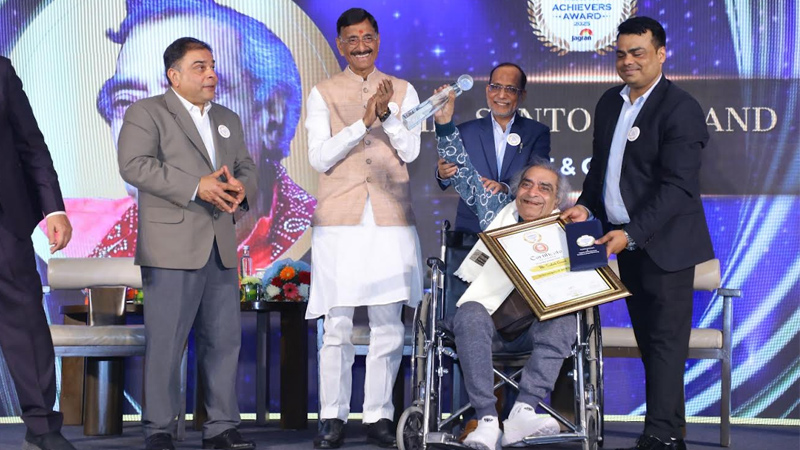
NEW DELHI: Hamdard Laboratories gathered a cross-section of India’s achievers in New Delhi on Friday, handing out the Hakeem Abdul Hameed Excellence Awards to figures who have left their mark across healthcare, education, sport, public service and the arts.
The ceremony, attended by minister of state for defence Sanjay Seth and senior officials from the ministry of Ayush, celebrated individuals whose work blends professional success with a sense of public purpose. It was as much a roll call of achievement as it was a reminder that influence is not measured only in profits or podiums, but in people reached and lives improved.
Among the headline awardees was Alakh Pandey, founder and chief executive of PhysicsWallah, recognised for turning affordable digital learning into a mass movement. On the sporting front, Arjuna Awardee and kabaddi player Sakshi Puniya was honoured for her contribution to the game and for pushing women’s participation onto bigger stages.
The cultural spotlight fell on veteran lyricist and poet Santosh Anand, whose songs have echoed across generations of Hindi cinema. At 97, Anand accepted the honour with characteristic humility, reflecting on a life shaped by perseverance and hope.
Healthcare honours spanned both modern and traditional systems. Manoj N. Nesari was recognised for strengthening Ayurveda’s place in national and global health frameworks. Padma shri Mohammed Abdul Waheed was honoured for his research-backed work in Unani medicine, while padma shri Mohsin Wali received recognition for his long-standing contribution to patient-centred care.
Education and social development also featured prominently. Padma shri Zahir Ishaq Kazi was honoured for decades of work in education, while former Meghalaya superintendent of Police T. C. Chacko was recognised for public service. Goonj founder Anshu Gupta received an award for his dignity-centred rural development initiatives, and the Hunar Shakti Foundation was honoured for empowering women and young girls through skill development.
The Lifetime Achievement Award went to former IAS officer Shailaja Chandra for her long career in public healthcare and governance, particularly in the traditional systems under Ayush.
Speaking at the event, Hamdard chairman Abdul Majeed said the awards were a tribute to those who combine excellence with empathy. “These awardees reflect Hakeem Sahib’s belief that healthcare, education and public service must ultimately serve humanity,” he said.
Minister Seth struck a forward-looking note, saying India’s young population gives the country a unique opportunity to become a global destination for learning, health and wellness by 2047.
The ceremony also featured the trailer launch of Unani Ki Kahaani, an upcoming documentary starring actor Jim Sarbh, set to premiere on Discovery on 11 February.
Instituted in memory of Unani scholar and educationist Hakeem Abdul Hameed, the awards have grown into a national platform that celebrates those building a more inclusive and resilient India. For one evening at least, the spotlight was not just on success, but on service with substance.