News Broadcasting
Fox takes on NBC; launches boxing reality show


MUMBAI: While on Indian shores, reality is still all about glamour hunts, the sports reality genre is heating up on the American television, this summer.
Close on the heels of NBC announcing its boxing reality show – The Contender with Sly Stallone as the ‘ring master’, broadcaster Fox is all geared to launch its own boxing reality TV series in partnership with boxer Oscar De La Hoya.
Tentatively titled The Next Great Champ, the show will have a dozen aspiring prize fighters from across the US, battling it out on the ring for fame and fortune. With boxing champ Oscar De La Hoya as its host, the show based in New York will seek out young boxers and follow them as they train and fight each other.

The winner gets a possible shot at the title fight, a professional contract with De La Hoya’s Golden Boy promotions and ofcourse, a large cash prize.
Produced by reality TV heavyweight Endemol in partnership with Oscar De La Hoya’s Golden Boy promotions, the show will hold casting calls in cities across the country for fighters between 130 pounds (59.1 kg) and 170 pounds (77.3 kg) who are either amateurs or have fought in pro fights of four rounds or less, say media reports.
The reports suggest that both the CNN and Fox reality shows (still to be put into development) have similar concepts, hence both shows are likely compete with each other in terms of ratings. That is exactly where the behind-the-scenes battle heating up between the rival producers.
NBC’s The Contender featuring Sylvester Stallone, Sugar Ray Leonard and George Forman is produced by Apprentice creator Mark Burnett and co-produced by Jeffery Katzenberg.
The reports suggest that a detailed pitch for The Contender was initially offered to De La Hoya a few months ago. De La Hoya reportedly turned down the offer, saying he is not keen on reality programming.
Announced in late February, The Contender was tentatively scheduled to debut in January 2005 but with The Next Great Champ readying for autumn (04) launch, it is now expected to brought forward. The 16 fighters in that series will compete for a $1 million prize.
As for The Next Great Champ, the producers have just indicated a “large cash prize” for the winner along with a possible title fight and a contract with Golden Boy. Reports indicate that each fighter will be accompanied on the series by their “cornerman,” a person Fox said would be drawn from their personal lives.
While both the broadcaster are lacing up their gloves, lets hope the action packed reality drama can translate into a reality show on the local soils with focus on the ‘akhadas’ (local gyms).







News Broadcasting
UDF poised to return to power in Kerala, says Manorama-CVoter survey
Massive opinion poll projects shift in Kerala politics ahead of 2026 Assembly elections.
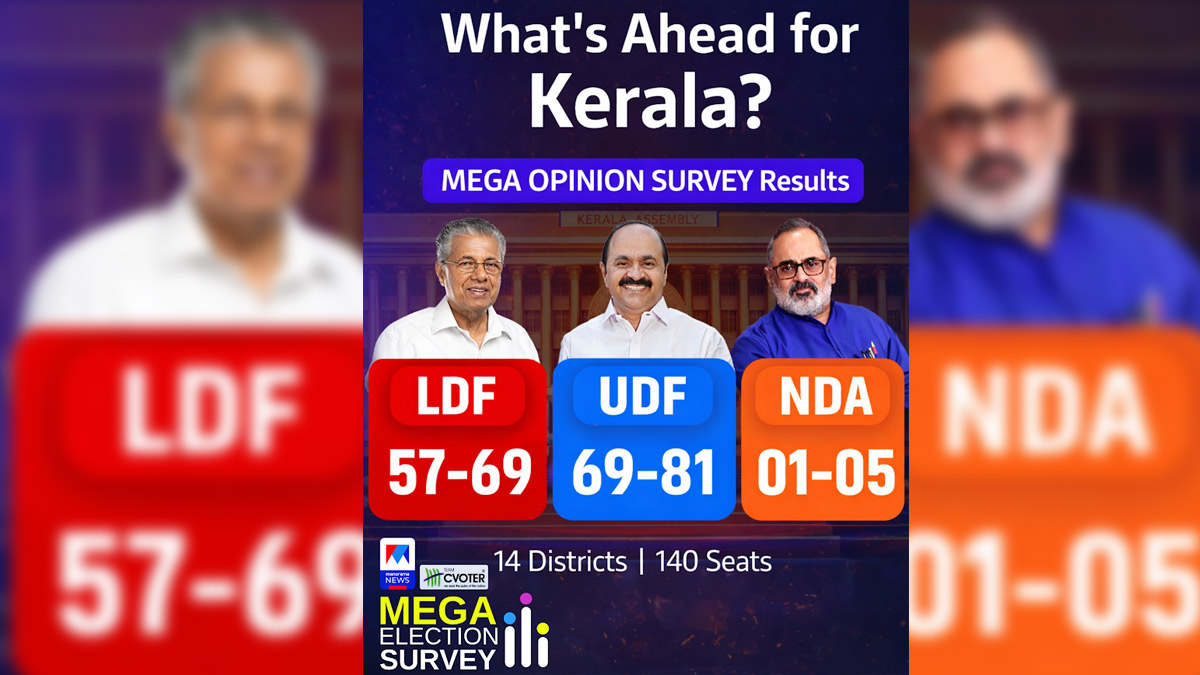
MUMBAI: The winds of change appear to be blowing through Kerala’s political landscape and this time, they seem to favour the United Democratic Front. A comprehensive mega opinion survey conducted by Manorama News in partnership with CVoter projects a potential comeback for the UDF in the upcoming Kerala Legislative Assembly Elections 2026. The survey, covering all 140 constituencies with a massive sample size of nearly 90,000 respondents, predicts the UDF could win between 69 and 81 seats.
The ruling Left Democratic Front (LDF) is expected to secure 57 to 69 seats, a significant drop from the 99 seats it won in the 2021 elections. This would mean the LDF losing 30 to 42 of its sitting seats. Meanwhile, the National Democratic Alliance (NDA), which drew a blank in 2021, is projected to open its account with 1 to 5 seats.
Region-wise, the UDF is expected to make strong gains in Malabar, winning 25 to 34 out of 48 seats, and in Central Kerala, where it could bag 29 to 33 out of 53 seats. In South Kerala, the LDF is likely to retain an edge with 21 to 25 seats, while the UDF may improve to 12 to 16 seats. The NDA could pick up 1 to 3 seats in the southern region.
The survey was conducted between 14 and 26 March 2026, with additional tracker and snap polls carried out from December 2025 to March 2026. A total of 89,693 respondents participated, ensuring representation across all demographics and social segments.
Manorama News has a strong track record of accuracy, with its previous projections closely matching the actual results of the 2019 and 2024 Lok Sabha elections as well as the 2021 Kerala Assembly polls.
In Kerala’s famously fierce political battles, this survey suggests the pendulum may be swinging back. Whether the final verdict matches these numbers or throws up another surprise, one thing is clear, the 2026 Assembly elections are shaping up to be one of the most keenly watched contests in the state’s history.






