News Broadcasting
Fortune Star, Triage Entertainment and DreamWorks Television hatch alliance for television series


Fortune Star a wholly owned subsidiary of the Star Group, Triage Entertainment and West End Stories have joined forces to produce “Hong Kong Caf”. This is an original one-hour series highlighting Hong Kong action movies and martial arts in the US. The series will be distributed in America by DreamWorks Television and in Asia by Fortune Star.
An official release informs that the series features Hong Kong action films’ greatest scenes on a high-tech set. It will be offered for broadcasting to major U.S. TV networks and stations in the coming weeks. Production is scheduled to begin later this month in Los Angeles.
The series has access to more than 600 classic Hong Kong action films. This has been made possible by an extensive clip licensing agreement between Triage and Fortune STAR. It will feature legendary action films starring crossover martial arts stars such as Jackie Chan, Bruce Lee, Chow Yun-fat.

The high-tech caf set is reminiscent of the bar/restaurant locale frequently seen in Hong Kong films, and will be frequented by rising stars. These series regulars will provide interstitial conversation along with comedy, fashion and music elements. Fortune STAR is the content arm of Star for distribution, production and commissioning of its programming content.




News Broadcasting
Network18 channels lead YouTube news viewership in March 2026
CNN-News18, News18 India and CNBC channels top categories with record views
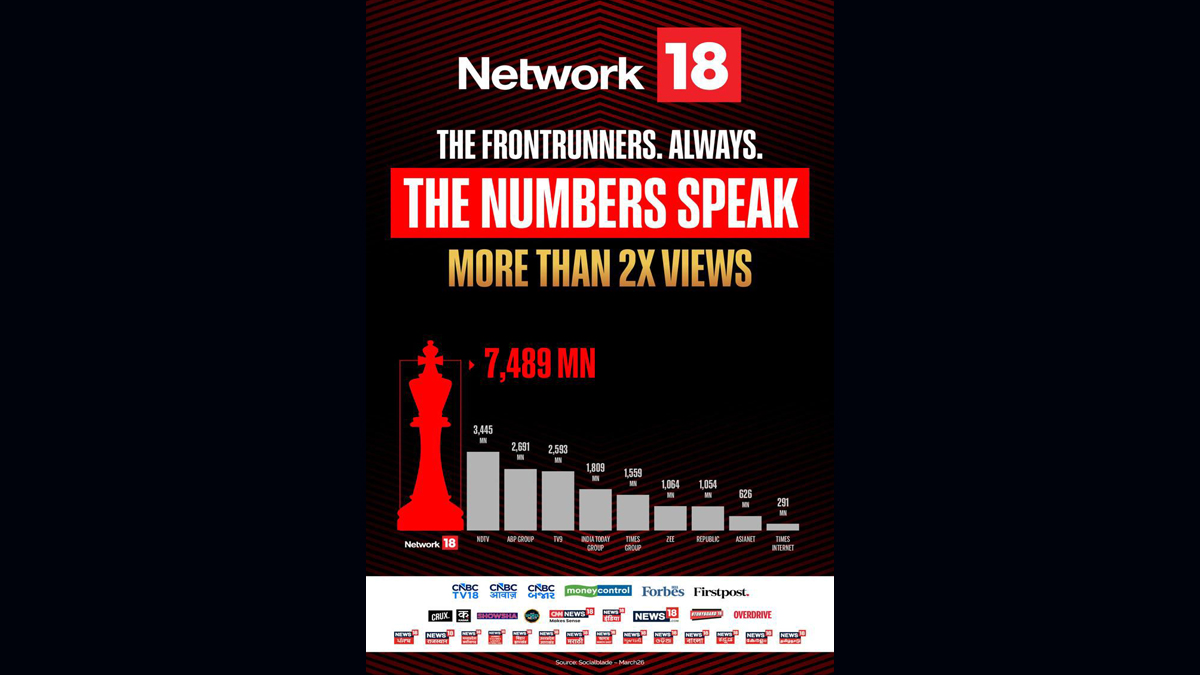
MUMBAI: When the world hit refresh on breaking news, Network18’s channels were already streaming ahead. As geopolitical tensions and war-driven headlines fuelled a surge in global news consumption, the network’s digital playbook delivered big clocking record Youtube viewership across English, Hindi and business news categories in March 2026.
At the forefront was CNN-News18, which emerged as the clear leader in the English news segment with 130 million live and video-on-demand views. The channel edged past competitors such as Times of India (126.5 million), Times Now (101.1 million), India Today (88.2 million) and NDTV (77.5 million), according to Databeings data for March.
In the Hindi news arena, News18 India delivered a commanding performance, racking up a staggering 3,297 million views on YouTube. The channel comfortably outpaced NDTV India, which recorded 3,119 million views, underlining its deep reach and consistent engagement with mass audiences, as per Playboard data.
The network’s dominance wasn’t confined to general news. In the Hindi business segment, CNBC Awaaz topped the charts with 92 million views, narrowly ahead of Zee Business (90 million) and well ahead of ET Now Swadesh (57 million). Meanwhile, its English counterpart CNBC-TV18 posted a strong 58 million views, reinforcing the network’s cross-category strength.
The spike in viewership reflects a broader shift in audience behaviour, with viewers increasingly turning to digital platforms particularly Youtube for real-time updates and in-depth coverage during high-intensity news cycles. For Network18, the numbers signal more than just scale; they underline the effectiveness of a multi-platform strategy that blends speed, credibility and continuous coverage.
In a month where the news never paused, it seems viewers chose to stay tuned where the stream never stopped.






