News Broadcasting
Formula One needs to increase appeal in the Far East


MUMBAI: In the future one of the main challenges that Fomula One will face will be to increase its appeal in the Far East without losing viewers in its core markets, i.e. Europe and South America. This will enable it to grab a larger slice of the sports viewing share on television.
This information is contained in a study conducted by research agency Intiative.
In 2004, the global cumulative average audience was 800 million. This audience is distributed across the globe, but is concentrated in those markets with most F1 and motor sport heritage. Europe alone accounts for 75 per cent of the global audience.

Sponsors activity centers on these markets that deliver the greatest audience numbers. Consequently, adding new Grands Prix to the race calendar to boost audiences in the sports periphery, for example in the Far East, is not necessarily the answer to F1s attempts to rejuvenate the sport. Although the season audience rose by six per cent in 2004 versus 2003 as the number of races was increased from 16 in 2003 to 18 in 2004, the global average TV audience per race declined by six per cent.
Sport viewership is driven by national pride and Formula One is no exception. The success of driver Fernando Alonso has caused Spanish audiences to boom. Spain is now the fifth biggest F1 TV market in the world, when average audiences are expressed in millions. Other examples in the 2004 season include the positive effect on viewing of Zsolt Baumgartner on Hungarian audiences, and Takuma Sato on Japanese viewers.
While the Bahrain Grand Prix was the second most popular race of the season, with 55 million individuals, the Chinese Grand Prix was the second least popular, with only 32 million viewers. The relative performance of F1s two newest races was largely a function of time zones the Bahrain race is effectively a European Grand Prix in terms of its start time, whereas the Shanghai race took place early on a Sunday morning in the core European markets. The Chinese Grand Prix attracted particularly small audiences in Europe as a result.




News Broadcasting
Network18 channels lead YouTube news viewership in March 2026
CNN-News18, News18 India and CNBC channels top categories with record views
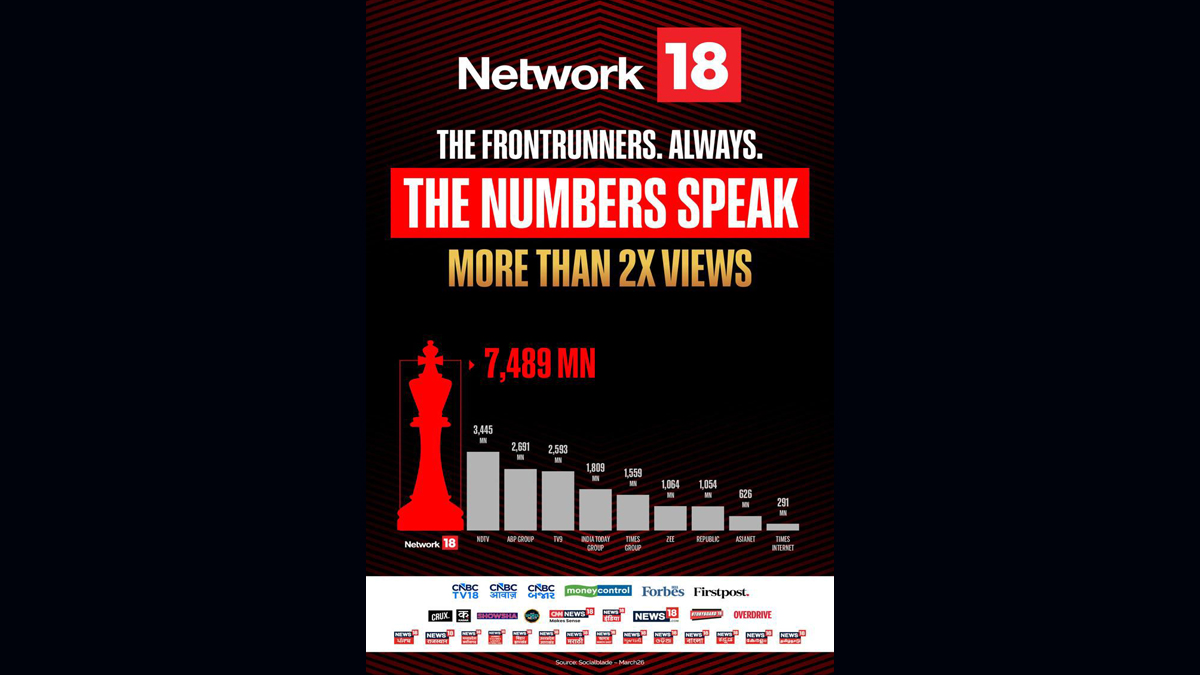
MUMBAI: When the world hit refresh on breaking news, Network18’s channels were already streaming ahead. As geopolitical tensions and war-driven headlines fuelled a surge in global news consumption, the network’s digital playbook delivered big clocking record Youtube viewership across English, Hindi and business news categories in March 2026.
At the forefront was CNN-News18, which emerged as the clear leader in the English news segment with 130 million live and video-on-demand views. The channel edged past competitors such as Times of India (126.5 million), Times Now (101.1 million), India Today (88.2 million) and NDTV (77.5 million), according to Databeings data for March.
In the Hindi news arena, News18 India delivered a commanding performance, racking up a staggering 3,297 million views on YouTube. The channel comfortably outpaced NDTV India, which recorded 3,119 million views, underlining its deep reach and consistent engagement with mass audiences, as per Playboard data.
The network’s dominance wasn’t confined to general news. In the Hindi business segment, CNBC Awaaz topped the charts with 92 million views, narrowly ahead of Zee Business (90 million) and well ahead of ET Now Swadesh (57 million). Meanwhile, its English counterpart CNBC-TV18 posted a strong 58 million views, reinforcing the network’s cross-category strength.
The spike in viewership reflects a broader shift in audience behaviour, with viewers increasingly turning to digital platforms particularly Youtube for real-time updates and in-depth coverage during high-intensity news cycles. For Network18, the numbers signal more than just scale; they underline the effectiveness of a multi-platform strategy that blends speed, credibility and continuous coverage.
In a month where the news never paused, it seems viewers chose to stay tuned where the stream never stopped.






