News Broadcasting
For ‘networked generation’, internet central in media consumption

MUMBAI: British media regulator Ofcom has just released its annual Communications Market Report revealing new trends in the television, radio, telecommunications and wireless communications industries.
The key finding of the report is that there is a radical shift in media consumption happening, particularly among what it describes as a new ‘networked generation’.
This generation, comprising mainly 16-24 year olds, is turning away from television, radio and newspapers in favour of online services, including downloadable content – used on multiple devices such as iPods and mobile phones – and actively participating in online communities.

According to the report, television is of declining interest to many of this age group; on average they watch television for one hour less per day than the average television viewer. Of the television they do watch, an even smaller proportion of their time is spent viewing public service broadcasting channels, down from 74 per cent of total viewing among this age group in 2001 to 58 per cent today. Instead, the internet plays a central role in daily life; more than 70 per cent of 16-24 year old internet users use social networking websites (compared to 41 per cent of all UK internet users) and 37 per cent of 18-24 year olds have contributed to a blog or website message board (compared to 14 per cent of all UK internet users).
The same group also uses mobile phones extensively, on average making seven more calls and sending 42 more texts per week than the wider UK population.
Extensive use of the internet has also influenced 15-24 year olds’ consumption of other media. Their radio listening is lower, by an average of 15 minutes a day compared to the wider population; additionally, 27 per cent of those surveyed said they read newspapers less as a consequence of their online usage.
TELEVISION
In an important change in habits, viewers in Freeview households now spend more time watching digital-only channels than any one of the five main public service broadcasting channels BBC1, BBC2, ITV1, Channel 4 and five. However, the public service broadcasters’ own digital-only channels (such as BBC3, ITV2 and More4) continue to grow their audience share, gaining nearly 6 percentage points of total viewing between 2001 and 2005.
Subscription revenue remains the largest source of funding for commercial television, with 2005 revenues up by 8.5% to £3.9 billion for all pay TV services, £343 million more than total net television advertising revenues for the same period. Overall, television industry revenues increased by 4% year on year to more than £10.6 billion.
ONLINE
Online advertising continues to grow in importance as a mass marketing medium, attracting significant revenues away from other media.
Total online advertising revenues have increased almost eight-fold in real terms between 2001 and 2005 (from £0.17 billion to £1.3 billion per year). Online advertising revenue is now almost three times greater than radio advertising revenue (at around £0.5 billion, unchanged since 2001 in real terms) and over one-third that of television advertising revenue (£3.8 billion in 2005, up from £3.5 billion in 2001).
Broadband continues to demonstrate significant growth. Of the 11.1 million UK homes and small businesses with broadband connections, more than three million were cable and eight million were DSL – the latter up from five million in 2004. Industry revenues from broadband access were up 70% year on year to £1.9 billion.
These trends are likely to continue as new technology and new products expand choice and availability. Unbundled local loop services – where competing providers take responsibility for the customer’s line to provide telephone, broadband, voice and television over the internet and video on demand services – are now available to 44% of the population, up from to 34% in 2005. The number of Wi-Fi hotspots across the UK also almost doubled over the year to June 2006, up from 8,500 to 14,600.
TELECOMS
Mobile phones play an increasingly important role in consumers’ daily lives. As many UK households now have a mobile phone as have a landline phone; and for the first time, the proportion of households relying on mobile phones exclusively (10%) is the same as the proportion who only use landline phones.
Mobiles are becoming the preferred means of making calls in many households, including those with both mobile and landline phones. Some 31% of consumers surveyed now consider their mobile to be their main telephone, up from 21% in 2004. For the first time, none of those surveyed said they relied on public payphones for their main means of making and receiving calls, compared to 2% of consumers surveyed in 2004.
Mobile industry revenues grew by 9.7% year on year to £13.1 billion, while traditional landline revenue fell by 7.5% to £10.1 billion.
Consumers are increasingly willing to switch phone companies; nearly 34% of consumers now use a phone company other than BT for some or all of their landline services. As of March 2006 6.1 million lines used a carrier pre-selection provider for their calls (up from 4.9 million in March 2005). Of these, 2.9 million were Wholesale Line Rental customers (up from 1 million in March 2005) who no longer have a billing relationship with BT but instead pay an alternative provider for both line rental and calls. Additionally 4.5 million consumers use cable networks for their phone services.
Ofcom Chief Operating Officer Ed Richards said: “Our research reveals dramatic and accelerating changes across all communications industries.”
“The sector is being transformed by greater competition, falling prices and the erosion of traditional revenues and audiences. A new generation of consumers is emerging for whom online is the lead medium and convergence is instinctive.”




News Broadcasting
Rising Bharat Summit 2026 spotlights India’s global ascent
PM Modi keynotes two-day event with ministers, diplomats and icons in New Delhi.
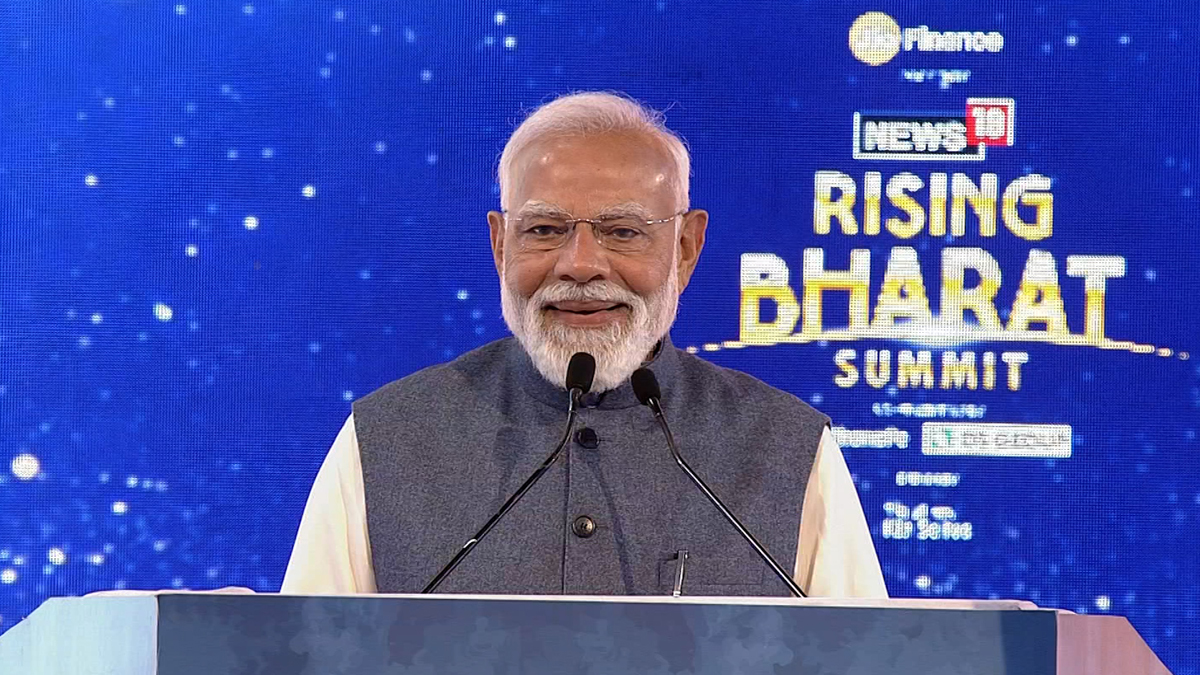
MUMBAI: India didn’t just host a summit, it threw a coming-out party for a nation ready to own the global stage. The News18 Rising Bharat Summit 2026, held on 27–28 February in New Delhi, emerged as a high-octane platform for ideas, vision and strategic dialogue, uniting national leadership, global policymakers, industry titans, defence strategists and cultural icons under the theme “Strength Within”.
Prime minister Narendra Modi set the tone with a keynote that framed India’s resurgence as a reclaiming of lost potential built over generations. “In previous industrial revolutions, India and the Global South were merely followers,” he said. “But in the era of Artificial Intelligence, India is a partner in decisions and shaping them.” He highlighted the country’s thriving AI startup ecosystem and the recent AI Impact Summit attended by over 100 nations.
Union minister Piyush Goyal (Commerce & Industry) stressed India’s readiness to scale exports and deepen manufacturing, while Ashwini Vaishnaw (Railways, I&B, Electronics & IT) positioned technology and infrastructure as twin engines of growth, especially in AI and digital trust. Jyotiraditya Scindia (Communications & North East Development) revealed India’s ambition to lead in 6G through the Bharat 6G Alliance and partnerships with over 30 countries.
Global voices added depth: former Singapore Foreign Minister George Yeo called India’s development “self-sustaining” and strategically vital; ex-UK Chief of Defence Staff General Sir Nick Carter asserted India deserves a seat at the great powers’ table; and former US Commerce Secretary Carlos M. Gutierrez joined ambassadors from Norway, Germany and Sweden in discussions on geopolitical realignment, sustainability and defence preparedness.
Other speakers included veteran investor Ramesh Damani, World Gold Council CEO David Tait, Vianai Systems founder Dr Vishal Sikka, DeepTech Bharat Foundation co-founder Shashi Shekhar Vempati, defence experts Rajesh Kumar Singh, Sunil Ambekar, Patrick McGee, Tom Cooper and Adrian Fontanellaz, plus cultural and sporting icons Kangana Ranaut, Saina Nehwal, PR Sreejesh, Mohammed Shami, Yuzvendra Chahal, Mithali Raj, Anil Kapoor and Yami Gautam.
The summit was supported by Jio Financial Services (Presenting Partner), Phonepe and DS Group (Co-Presenting Partners), Pernod Ricard India and Kia Seltos (Powered By & Driven By), state governments of Uttar Pradesh, Chhattisgarh and Uttarakhand (State Partners), and associate partners including NSE, M3M Foundation and Reliance Industries.
Broadcast live across News18 Network, CNBC-TV18 and CNBC Awaaz, the event reinforced India’s image as a confident democracy and emerging global power proving that when strength comes from within, the world can’t help but watch.