Factual
Flipkart turns Bigg Boss house into a fashion battleground

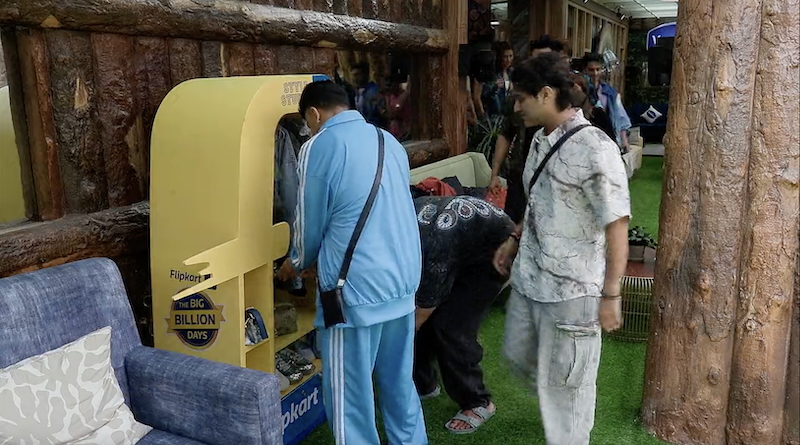
MUMBAI: They said no one dresses well inside their house. The Bigg Boss housemates begged to differ—and proved it by ransacking a Flipkart fashion rack in record time.
What unfolded inside India’s most-watched reality television house was part retail experiment, part feeding frenzy. When Flipkart installed its Fashion Studio inside the Bigg Boss residence and Salman Khan announced the Flipkart Fashion Icon contest, contestants descended upon the carefully curated collection with the urgency of shoppers at a clearance sale. Within minutes, the rack stood empty, its trendy offerings claimed, worn and paraded before millions of viewers.
The audacious collaboration, timed to coincide with Flipkart’s Big Billion Days sale bonanza, represented a watershed moment in Indian entertainment commerce. It wasn’t merely product placement or brand integration—it was retail theatre performed live, where the country’s biggest e-commerce player turned a television set into a functioning fashion outlet and contestants into unwitting style influencers.

The machinery behind this spectacle involved three distinct organisations working in concert. Flipkart deployed a team led by Pratik Shetty and Akash Jain, alongside Nikita Prakash, Pooja Sha, Sneha Narang, Vijay Sharma, Rahul Valecha and Akshay Doshi. Creative agency Essence, steered by Sunny Rangwani and Tejashree R., handled the conceptual heavy lifting. JioStar’s production apparatus, including senior supervising producer Tanya Chopra—who served as creative lead for the Bigg Boss contingent—along with Sameer Tripathy, Nandita Ramesh and Patrick Ignatious, wove the commercial proposition into the show’s narrative fabric.
The result was seamless, if slightly chaotic. As housemates draped themselves in Flipkart’s latest offerings, the boundary between entertainment and shopping dissolved entirely. Viewers watched contestants model, mix, match and compete in outfits that could be purchased with a few taps on their phones—a real-time fashion show with immediate purchase potential.
For Flipkart, the payoff extended far beyond traditional advertising metrics. This wasn’t a celebrity endorsement or a sponsored segment; it was organic consumption captured on camera, complete with genuine reactions, styling choices and the implicit endorsement that comes from watching someone actually want to wear something badly enough to compete for it.
The speed with which the Fashion Studio sold out suggested that Bigg Boss contestants, despite living under constant surveillance in a sealed environment, harbour the same fashion anxieties and aspirations as viewers watching from home. Perhaps everyone, regardless of circumstance, wants to dress well inside their house after all—especially when cameras are rolling and millions are watching.







DUBLIN: Ireland is betting big on reality television. In a move that has Hollywood scouts scrambling for their passports, Dublin has unveiled Europe’s first tax credit dedicated solely to unscripted programming—think The Traitors rather than Game of Thrones.
The scheme offers producers a juicy 20 per cent rebate on qualifying expenditure, capped at €15 million ($17.5 million) per project. It’s a cultural credit with strings attached: programmes must pass a test proving they genuinely promote Irish and European culture. No word yet on whether Love Island derivatives need apply.
Ireland tánaiste and minister for finance Simon Harris says the incentive will cement Ireland’s reputation as a “centre of excellence” for audiovisual production. His colleague, minister for culture, communications and sport Patrick O’Donovan, insists Ireland has “the talent, creativity and production expertise to lead” in unscripted television. Bold claims for a nation that has spent decades exporting scripted drama.
The timing is canny. Unscripted production costs have soared globally, making Ireland’s existing infrastructure—and now its tax breaks—increasingly attractive. Fox Entertainment Studios already churns out shows like Beat Shazam and The Floor from Irish studios. Whether these American productions will pass the cultural test remains to be seen.
Producers must secure an interim cultural certificate before filming begins, allowing them to claim credits during production rather than waiting until wrap. A final certificate follows completion. The European Commission has blessed the scheme through December 2028.
Minimum thresholds apply: productions must cost at least €250,000, with eligible expenditure above €125,000. Only one season per project can claim relief in any 12-month period, though producers can juggle multiple projects.
Britain, take note. The UK industry has clamoured for similar support for 18 months, but Westminster has dithered. India’s ministry of information and broadcasting pay heed. Its incentive scheme for co-productions excludes unscripted television. To what end, no one knows! Ireland, meanwhile, is already rolling out the red carpet—or should that be green?
The message from Dublin is clear: when it comes to backing reality TV, Ireland isn’t messing about. Lights, camera, tax action.






