News Broadcasting
Fix basic tier rate above Rs 100: Cable ops to Trai


MUMBAI: The basic tier monthly rate of Rs 77 (excluding taxes) in conditional access system (CAS) areas is unrealistic and should not be below Rs 100, cable TV operators told the Telecom Regulatory Authority of India (TRAI).
Six stakeholders have posted their views to the broadcast and cable regulator. Trai had sought views from the industry on the draft tariff amendment order notification for fixing the basic tier rate.
The common argument laid down by the cable operators was that the price for the 30 FTA channels did not take into account the distribution cost through franchisee operators.

According to clause 3B in the Telecommunication (Broadcasting and Cable) Services (Second) Tariff Order, 2004 (6 of 2004), “The maximum amount, which a cable operator may demand from a subscriber for receiving the programmes transmitted in the ‘basic service tier’ provided by such cable operator shall not exceed Rs 77 per month exclusive of taxes, for a minimum of 30 FTA channels. Free-to-air channels, over and above the basic service tier, would also be made available to the subscribers within the maximum amount mentioned above.”
The views posted by New Delhi-based Cable Operators Federation of India (COFI) said, “Only one multi-system operator (MSO) headend was considered and not the distribution cost through franchisee operators who maintain their own offices, technical maintenance staff, collection staff etc. Quality of service was not considered while calculating number of subscribers and the number of subscribers was based on extended network of the MSO prevailing at that time.”
“The cost of FTA channels has to be reworked. Even as per our calculations submitted to the Ministry in 2003 the cost was Rs.180. One option is to use the benchmark of Rs 125, which was the charge for 15 to 20 channels in 1994 when there were no pay channels.”
Pointing out the need for reworking the cost of FTA channels, the Federation said, “Even as per our calculations submitted to the Ministry in 2003 the cost was Rs.180. One option is to use the benchmark of Rs 125, which was the charge for 15 to 20 channels in 1994 when there were no pay channels.”
A minimum of Rs 150 should be charged for the basic tier considering the fact that TRAI does not want last mile operators to pay for the FTA package to the MSOs. An amount of Rs 30 to Rs 50 is being paid at present to MSOs, the Federation added..
Hathway Cable and Datacom has suggested a basic tier price of Rs 100 per month (excluding taxes). This will work out to not less than Rs 150 a month.
“The cost of materials like cable, amplifier, and electronics have gone up significantly. And other components such as power and fuel in delivery of the services have also risen sharply in the last one to two years,” the MSO expressed to Trai.
According to cable TV industry observer Col V.C Khare, “The rate was arrived at for a network spectrum 47-550 MHz transporting 62 channels, with a customer base of 32000 and a radius of operation of 7.5 kms on coaxial cable.”
“Technically, head ends using 500 series trunk cable over 47-862 M Hz and transporting 90 channels cannot deliver signal quality per IS 13420 beyond 4.8 kms cable length, with a cascading limit of 16 amplifiers. The subscriber base of 32000 was high as independent head ends were having 18000 subscribers on an average. On the other hand, networks have consolidated with fiber, 120 digitally compressed signals, encryption and SMS hardware installed. If the upward and downward adjustment in cost for the above factors is taken into account the cost of Rs.72 as prorated would give at least a minimum cost of Rs.100 (exclusive of taxes),” he argued.
National Cable & Telecommunications Association (NCTA) president Vikki Choudhry has suggested a monthly subscription rate of Rs 180. “A price below this level will result in deficiency in quality of service for the consumers, non-conformity with the provisions of CAS and Standards of BIS, no investment in network upgradation or maintenance, loss of employment, incentives most broadcasters to keep (or convert) their channels into pay, loss of revenue to the Indian Government and encourage under declaration by the cable service providers of FTA subscribers.”






News Broadcasting
UDF poised to return to power in Kerala, says Manorama-CVoter survey
Massive opinion poll projects shift in Kerala politics ahead of 2026 Assembly elections.
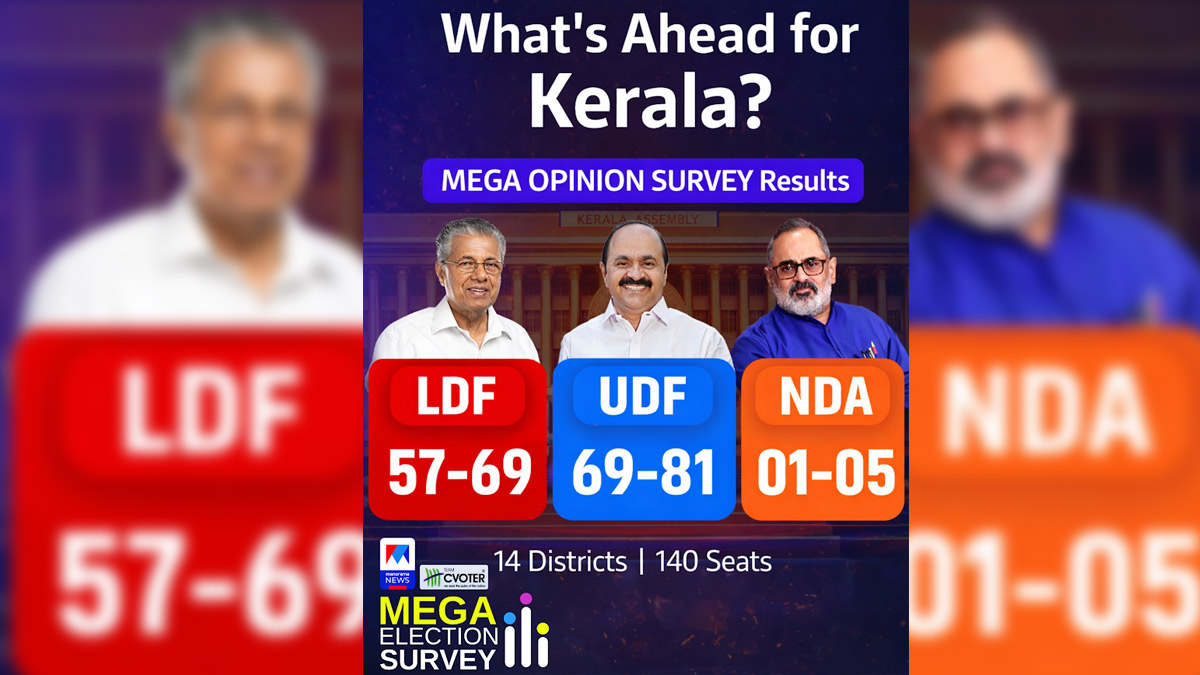
MUMBAI: The winds of change appear to be blowing through Kerala’s political landscape and this time, they seem to favour the United Democratic Front. A comprehensive mega opinion survey conducted by Manorama News in partnership with CVoter projects a potential comeback for the UDF in the upcoming Kerala Legislative Assembly Elections 2026. The survey, covering all 140 constituencies with a massive sample size of nearly 90,000 respondents, predicts the UDF could win between 69 and 81 seats.
The ruling Left Democratic Front (LDF) is expected to secure 57 to 69 seats, a significant drop from the 99 seats it won in the 2021 elections. This would mean the LDF losing 30 to 42 of its sitting seats. Meanwhile, the National Democratic Alliance (NDA), which drew a blank in 2021, is projected to open its account with 1 to 5 seats.
Region-wise, the UDF is expected to make strong gains in Malabar, winning 25 to 34 out of 48 seats, and in Central Kerala, where it could bag 29 to 33 out of 53 seats. In South Kerala, the LDF is likely to retain an edge with 21 to 25 seats, while the UDF may improve to 12 to 16 seats. The NDA could pick up 1 to 3 seats in the southern region.
The survey was conducted between 14 and 26 March 2026, with additional tracker and snap polls carried out from December 2025 to March 2026. A total of 89,693 respondents participated, ensuring representation across all demographics and social segments.
Manorama News has a strong track record of accuracy, with its previous projections closely matching the actual results of the 2019 and 2024 Lok Sabha elections as well as the 2021 Kerala Assembly polls.
In Kerala’s famously fierce political battles, this survey suggests the pendulum may be swinging back. Whether the final verdict matches these numbers or throws up another surprise, one thing is clear, the 2026 Assembly elections are shaping up to be one of the most keenly watched contests in the state’s history.






