News Broadcasting
Fitch downgrades TV18


MUMBAI: Credit ratings agency Fitch has downgraded TV18, raising concerns over the company’s financial profile over the nine-month period of the current fiscal and deployment of large cash balances to support subsidiaries and group companies.
TV18’s operating loss in FY’09 on a consolidated basis has been primarily due to the significant launch expenses and development costs of Web 18, and to some extent due to expenses related to its print media businesses including one time charges.
Also disturbing is the pressure on profitability on TV18’s core news operations business due to a significant slowdown in the renewal of advertising contracts.

“The company has utilised a substantial portion of its liquid balances (around Rs 6.76 billion as of FY’08 and Rs 2.6 billion as of 9-month period of FY’09) in investments in group companies, primarily in Infomedia18 and direct investments into other group companies,” Fitch said.
Fitch has downgraded the rating to ‘BBB’ from ‘A.’ It has also lowered its rating outlook to negative from stable.
Fitch ratings on the following instruments
Rs 1.25 billion long-term loan – Downgraded to BBB (from A)
Rs 670.1 million term-loan – Downgraded to BBB (from A)
Rs 850 million fund-based working capital limits – Downgraded to BBB/F2 (from A/F1)
Rs 70 million non fund-based working capital limits – Downgraded to F2 (from F1)
Rs 250 million commercial paper/short-term debt programme – Downgraded to F2 (from F1)
TV18 has raised fresh debt to meet the increased requirement of working capital and support its investments. “Net debt levels increased substantially to Rs 6.6 billion at the 9-month period of FY’09 compared to negative net debt levels at FY’08,” Fitch said.
On the positive note, however, is the possible gain of advertising revenues from the upcoming elections and the budget coverage after the new government is formed.
“TV18 has also been actively undertaking cost cutting measures across its businesses, which along with the one-time nature of some of Web18’s losses due to initial launch expenses and charging off development costs, could help stem operating losses. In addition, TV18 has put on hold its earlier investment/expansion plans into new businesses such as print media, which could reduce the extent of negative free cash flows to be funded through FY’10,” Fitch said.
“Realisation of benefits from the company’s ongoing operational initiatives, coupled with a revival in advertising revenues materially benefiting credit metrics could lead to the outlook being revised back to stable, as could material reductions in net debt levels through equity infusions and/or monetisation of equity stakes in subsidiaries/group companies,” the ratings agency added.





News Broadcasting
Network18 channels lead YouTube news viewership in March 2026
CNN-News18, News18 India and CNBC channels top categories with record views
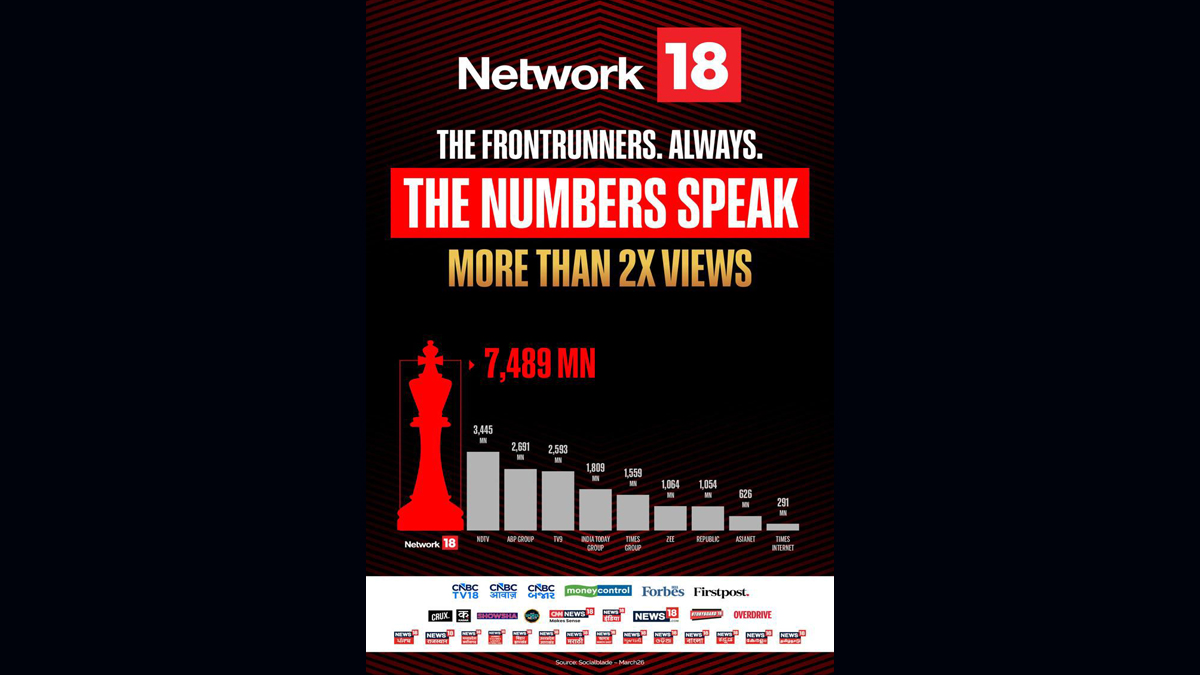
MUMBAI: When the world hit refresh on breaking news, Network18’s channels were already streaming ahead. As geopolitical tensions and war-driven headlines fuelled a surge in global news consumption, the network’s digital playbook delivered big clocking record Youtube viewership across English, Hindi and business news categories in March 2026.
At the forefront was CNN-News18, which emerged as the clear leader in the English news segment with 130 million live and video-on-demand views. The channel edged past competitors such as Times of India (126.5 million), Times Now (101.1 million), India Today (88.2 million) and NDTV (77.5 million), according to Databeings data for March.
In the Hindi news arena, News18 India delivered a commanding performance, racking up a staggering 3,297 million views on YouTube. The channel comfortably outpaced NDTV India, which recorded 3,119 million views, underlining its deep reach and consistent engagement with mass audiences, as per Playboard data.
The network’s dominance wasn’t confined to general news. In the Hindi business segment, CNBC Awaaz topped the charts with 92 million views, narrowly ahead of Zee Business (90 million) and well ahead of ET Now Swadesh (57 million). Meanwhile, its English counterpart CNBC-TV18 posted a strong 58 million views, reinforcing the network’s cross-category strength.
The spike in viewership reflects a broader shift in audience behaviour, with viewers increasingly turning to digital platforms particularly Youtube for real-time updates and in-depth coverage during high-intensity news cycles. For Network18, the numbers signal more than just scale; they underline the effectiveness of a multi-platform strategy that blends speed, credibility and continuous coverage.
In a month where the news never paused, it seems viewers chose to stay tuned where the stream never stopped.






