News Broadcasting
Fingerprint Pictures acquires remake rights to ‘A Better Tomorrow’ from Fortune Star


MUMBAI: Fingerprint Pictures, a production company set up by producer Park Hyung Jun has acquired the remake rights to multi award winning film A Better Tomorrow (originally directed by John Woo, starring Chow Yun Fat) from Fortune Star Entertainment, the distribution division of Star Group.
Fingerprint Pictures is currently recruiting scriptwriters and a director for the Korean remake, which is planned for production in 2007. Fingerprint Pictures is also working with Fortune Star Entertainment to bring in a high profile producer for the project.
Fingerprint Pictures together with Fortune Star Entertainment will handle the international distribution of the remake outside of Korea.

“We are delighted to work with Fingerprint Pictures, a renowned production company, to remake this classic title from our library, A Better Tomorrow. We are especially excited about the prospect of bringing this incredible story back to a new generation of viewers in Asia as well as the rest of the world,” said Fortune Star Entertainment general manager Peter E. Poon.
Hyung Jun added, “We are thrilled and honored to have acquired the rights to remake one of the most prestigious films in Hong Kong’s history. This remake represents a landmark cooperation between the film industries of Hong Kong and Korea, and we look very much forward to bringing this wonderful story to new audiences everywhere.”
A Better Tomorrow tells the story of two brothers: one a successful counterfeiter and the younger a fledgling police academy graduate. The plot revolves around the conflict caused by the younger sibling learning about his brother’s criminal lifestyle. Meanwhile, the older sibling is struggling to change his evil ways. Along the way are a number of action-packed heists, double-crosses and shootouts.
In 1986, A Better Tomorrow won awards for Best Film and Best Actor (Chow Yun Fat) at the 6th Annual Hong Kong Film Awards and for Best Director (John Woo), Best Actor (Ti Lung), Best Cinematography (Horace Wong Wing Hang) and Best Sound Recording at the 23rd Annual Golden Horse Awards.




News Broadcasting
Network18 channels lead YouTube news viewership in March 2026
CNN-News18, News18 India and CNBC channels top categories with record views
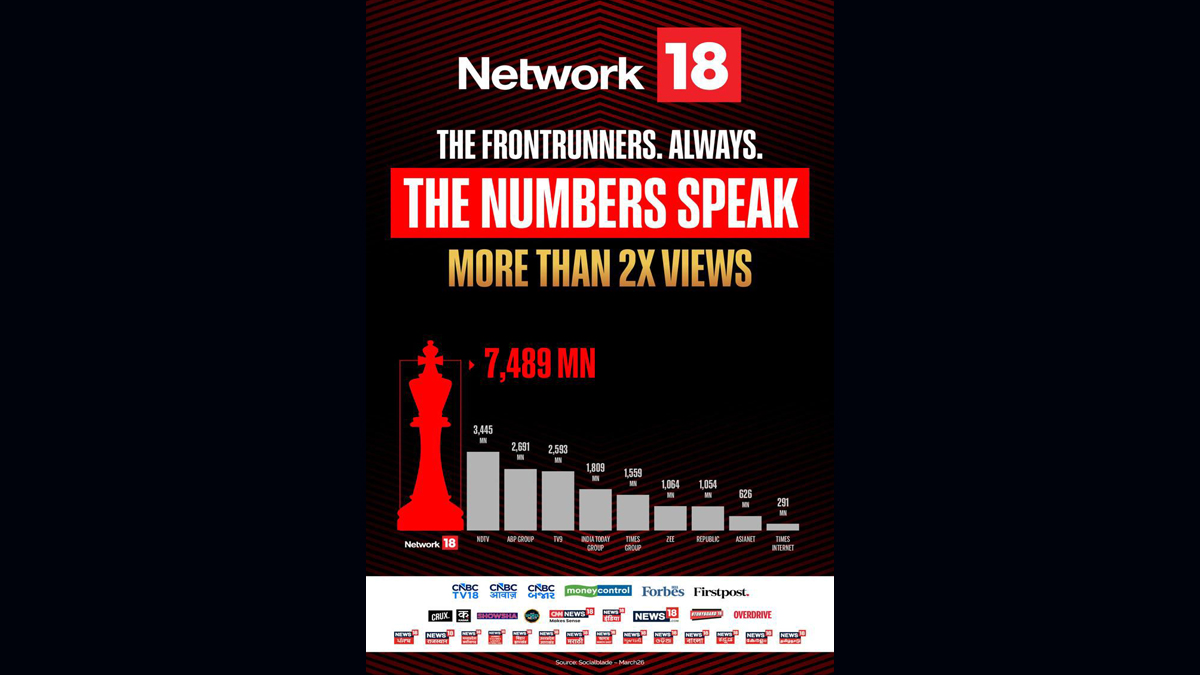
MUMBAI: When the world hit refresh on breaking news, Network18’s channels were already streaming ahead. As geopolitical tensions and war-driven headlines fuelled a surge in global news consumption, the network’s digital playbook delivered big clocking record Youtube viewership across English, Hindi and business news categories in March 2026.
At the forefront was CNN-News18, which emerged as the clear leader in the English news segment with 130 million live and video-on-demand views. The channel edged past competitors such as Times of India (126.5 million), Times Now (101.1 million), India Today (88.2 million) and NDTV (77.5 million), according to Databeings data for March.
In the Hindi news arena, News18 India delivered a commanding performance, racking up a staggering 3,297 million views on YouTube. The channel comfortably outpaced NDTV India, which recorded 3,119 million views, underlining its deep reach and consistent engagement with mass audiences, as per Playboard data.
The network’s dominance wasn’t confined to general news. In the Hindi business segment, CNBC Awaaz topped the charts with 92 million views, narrowly ahead of Zee Business (90 million) and well ahead of ET Now Swadesh (57 million). Meanwhile, its English counterpart CNBC-TV18 posted a strong 58 million views, reinforcing the network’s cross-category strength.
The spike in viewership reflects a broader shift in audience behaviour, with viewers increasingly turning to digital platforms particularly Youtube for real-time updates and in-depth coverage during high-intensity news cycles. For Network18, the numbers signal more than just scale; they underline the effectiveness of a multi-platform strategy that blends speed, credibility and continuous coverage.
In a month where the news never paused, it seems viewers chose to stay tuned where the stream never stopped.






