Hindi
Film industry split on stopping work on 23 February

NEW DELHI: Fissures have started appearing amongst the film fraternity on the issue of striking tomorrow to protest the 10.3 per cent service tax, with the Film Federation of India, the apex body of the film industry, reiterating that the plans remain unchanged and the Film and TV Producers Guild wanting that the strike should be deferred.
FFI President Vinod K Lamba told indiantelevision that he did not give any credence to statements being made by some filmmakers in Mumbai that the strike had been called off, and also regretted that some TV news channels had been playing up these statements. He also questioned the locus standii of the persons who had been saying that the strike had been called off.
However, Guild Vice-President Mukesh Bhatt told indiantelevision.com in Mumbai that he wished the best to Lamba, but “let me tell you more than 90 per cent of film folks including the film associations across India and the Multiplex Owners Association are with us and will not take part in the strike tomorrow”.
Lamba said the FFI was an umbrella body comprising various industry associations including exhibitors, distributors, producers and single screen cinemas, and had taken a unanimous decision to go ahead with the strike. “The result would be there for everyone to see day after tomorrow. My only plea to people not participating in the strike is that they should not sabotage the protest.”
He said though Finance Minister Pranab Mukherjee had given a patient hearing in a meeting over the weekend, he had declined to give any assurances. However, Bhatt was categorical that Mukherjee had wanted the film industry to wait till after the Budget before taking any decision.
A Guild spokesperson also said messages had been received to the effect that some states like Andhra Pradesh would not be joining the strike. Eminent Tamil filmmaker and FFI Committee member L Suresh is also understood to have advised deferment.
Earlier yesterday after a day-long meeting chaired by Lamba, it had been announced that it was necessary for all film bodies to join the protest to voice their anger to the government.
Lamba had told a press meet that apart from Mukherjee, the Information and Broadcasting Minister Ambika Soni had also met representatives of the industry over the weekend but both had been non-committal.
Apart from the fact that the industry is already over-burdened by other taxes like the Entertainment Tax, the Show Tax, and the state-imposed taxes, it has to fight the menace of video piracy, he added.
The FFI has been asking the Government to waive the tax. But Lamba said: “To its utter distress, the Finance Ministry through a circular of 13th December 2011 clarified that the tax was applicable under Finance Act.”
He said that imposition of the service tax would amount to double taxation since the states imposed their own. In any case, taxation was a state subject and, therefore, the imposition of any tax by the centre was unconstitutional.
Lamba said the strike had the full support of all organisations including Indian Motion Pictures Producers Association, organisations of distributors, exhibitors and even exporters. There will be a complete shut down of theatres, and shooting studios on that day all over the country.
Others who attended the meet included South India Film Chamber Secretary Ravi Kottarakara, Arijit Dutta and R S Khemka of the East India Motion Picture Association, A R Raju of the Karnataka Film Chamber, Kalyan of the Andhra Pradesh Film Chamber, Hirachand Dand who is Vice President of the Indian Film Exporters Association, and T P Aggarwal who is Vice President of FFI.
Lamba said that the service tax is generally levied only on the end user, but this was not possible since the rate of admission tickets in cinemas was already very high because of various taxes.
Kottarakara, who is also Convener of the Sub-Committee set up for the strike, said it was unfortunate that the film industry was equated by the government to shopping or gambling with taxes imposed on normal industries, whereas this was a creative field.
It was pointed out that at a time when the number of theatres had come down to under 11,000 for a population of over a billion people, the government should have helped to help build more theatres.
The negative list concept of service tax and the definition of ‘service’ therein intend to consider ‘right to enter any premises’ as an activity liable to service tax. This endangers the box office collection to be eligible to service tax of 10.3 per cent which is already taxed by high rates of entertainment tax. The new approach of negative list continues to consider film distribution rights as liable to service tax.
The power to levy taxes on luxuries, including entertainment has been exclusively granted to state governments under entry 62 of the State List of the Constitution. The Empowered Committee of the State Finance Ministers on 9 and 10 January 2012 had suggested that all items mentioned in the State List of the Constitution (including entertainment tax) should be included in the negative list so the Centre cannot impose tax on them. Thus, even state governments agree that service tax should not be made applicable on right to enter any premises.




Hindi
Remembering Gyan Sahay, the lens behind film, television and advertising
From a puppet rabbit selling poppadums to Hindi cinema, he framed it all.
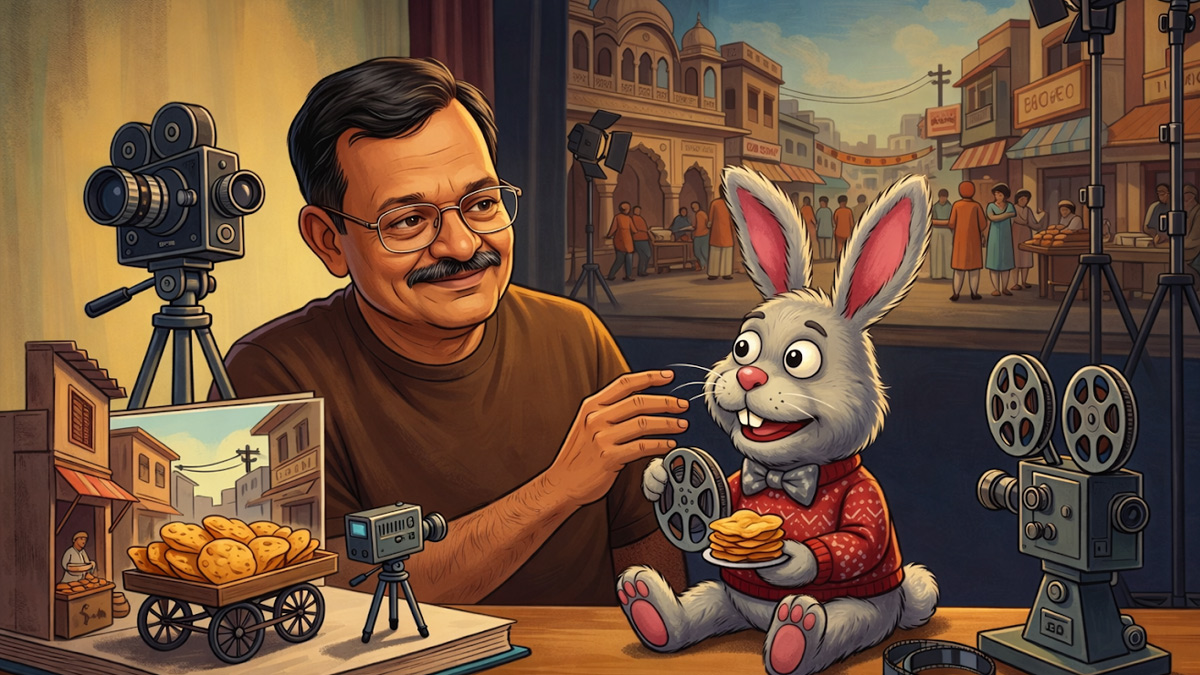
MUMBAI: There are careers, and then there are canvases. Gyan Sahay, the veteran cinematographer, director, and producer who passed away on 10 March 2026 in Mumbai, had one of the latter. Over several decades in the Indian film and television industry, he turned lenses, lights, and the occasional puppet rabbit into something approaching art.
A graduate of the Film and Television Institute of India (FTII) in Pune, Sahay built his reputation as a director of photography across a career that stretched from the early 1970s all the way to the digital age. He was the kind of craftsman who understood that a well-composed shot is not merely a technical achievement but a quiet act of storytelling.
For most Indians of a certain age, however, Sahay will forever be the man behind the rabbit. His direction of the iconic long-running television commercial for Lijjat Papad, featuring its now-legendary puppet bunny, gave the country one of its most cheerfully persistent advertising images. It was the sort of work that sneaks into the national subconscious and takes up permanent residence.

His big-screen credits as cinematographer include Anokhi Pehchan (1972), Pagli (1974), Pas de Deux (1981), and Hum Farishte Nahin (1988). In 1999, he stepped behind a different kind of camera altogether, making his directorial debut with Sar Ankhon Par, a drama that featured Vikas Bhalla and Shruti Ulfat, with a cameo by Shah Rukh Khan for good measure.
On television, Sahay was particularly prized for his command of multi-camera production setups, a skill that made him a go-to technician for large-scale shows and reality programmes. In an industry that has never been especially patient with complexity, he was the calm hand on the rig.
In later life, Sahay turned teacher. He participated regularly in masterclasses and Digi-Talks, often hosted by organisations such as Bharatiya Chitra Sadhna, sharing hard-won wisdom on cinematography, the comedy of timing in a shot, and the sweeping changes brought by the shift from celluloid to digital. He was also said to have been involved in a project concerning a biographical film on Infosys co-founder N.R. Narayana Murthy.
Tributes from the film industry poured in following the news of his passing, with colleagues remembering him as a senior cameraman who served as a rare bridge between two entirely different eras of Indian cinema. That is, perhaps, the finest thing one can say of any craftsman: he kept up, and he brought others along with him.