News Broadcasting
FIFA World Cup Mania on CNN-IBN, IBN7 & IBN Lokmat


NEW DELHI: CNN-IBN, IBN7 and IBN Lokmat have lined up an exciting programming line-up to capture the latest happenings and the action from the football field during the 2010 FIFA World Cup.
The special programming A Beautiful Game on CNN-IBN and Goal on IBN7 will provide a 360 degree perspective of the tournament. A panel of experts will add their analytical perspective to the game through special preview and review shows of each match played and an indepth examination of the players’ performance in the tournament. The experts include renowned former Moroccan football player and India’s No.1 football coach, Karim Bencherifa and the country’s top football analyst and commentator Novy Kapadia. They will provide the viewers with all the vital highlights and analysis of the matches and cover all aspects of FIFA World Cup 2010.
On IBN Lokmat, the special programming Kick Football Chi with Sunandan Lele, Consultant Editor, IBN Lokmat will consist of daily bulletins focusing on match reviews and previews. While the morning bulletins will focus on reviewing the matches which have been played, the evening bulletin will examine the various teams’ preparations for the matches ahead.

During the tournament, CNN-IBN and IBN7 will take a comprehensive look at the entire tournament with match reviews and previews, profiles, in-depth analysis and panel discussions. While on IBN7, Senior Anchor Darain Shahidi will be seen in conversation with Novy Kapadia who will provide viewers with rare insights into the game; on CNN-IBN, host Sanjeeb Mukherjea along with Novy Kapadia, Karim Bencherifa and some of the celebrity football fans will discuss the teams’ performances and strategies for the important matches. The special programming on the channels will go on-air as per the following schedule
On CNN-IBN, there will be a special one hour show focusing on who could win the FIFA World Cup at 7:00PM (with repeat telecast at 10:00 pm) on 10 June. The programming will also include a one and half hour special on 11 June at 6.00 pm. This interactive programme will lead up to the kick off of the FIFA World Cup 2010 at 7:30 PM IST and will bring live feeds from CNN-IBN correspondents across the country as they interact with soccer fans in the build up to the inauguration of the tournament. Additionally the programme will also feature reactions from football fans across the globe as they prepare to launch themselves into FIFA Fever. The daily programming will be telecast at 7.30 am, 7.30 pm and 10.30 pm till the tournament ends.
On IBN7, daily programming will be telecast at 8 am and 6.30 pm throughout the tournament and on IBN Lokmat, the programming will go on air at 7.30 am (with a repeat at 11.30 am) and 6.30 pm during the length of the tournament.




News Broadcasting
UDF poised to return to power in Kerala, says Manorama-CVoter survey
Massive opinion poll projects shift in Kerala politics ahead of 2026 Assembly elections.
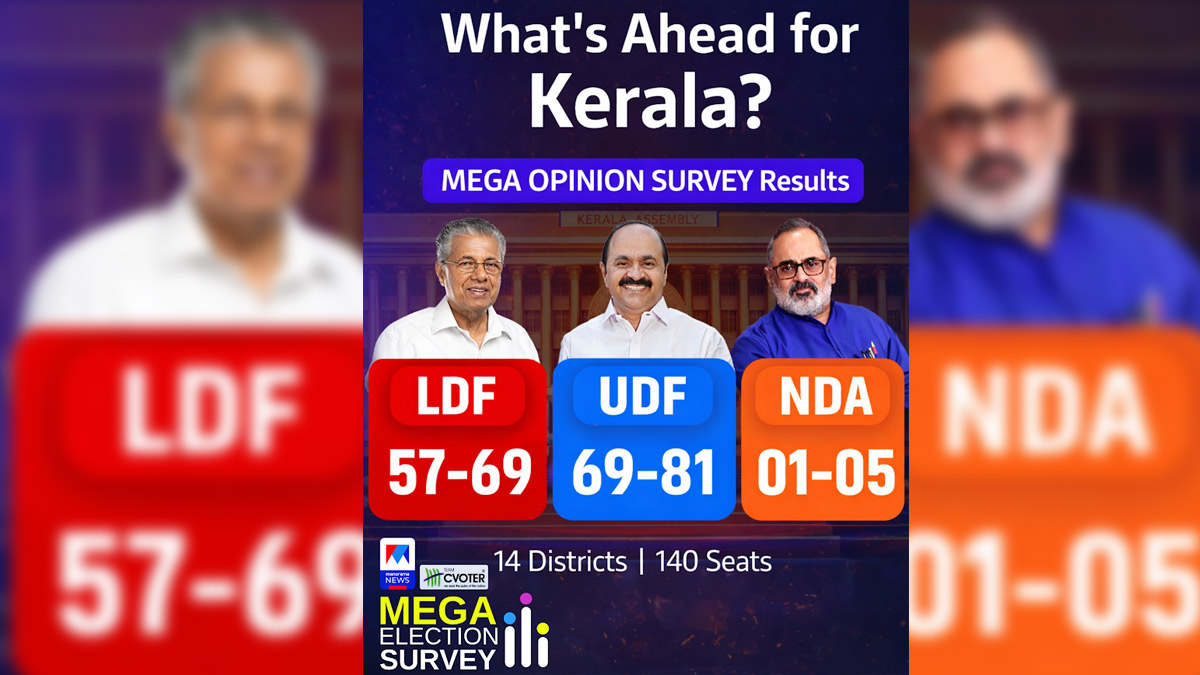
MUMBAI: The winds of change appear to be blowing through Kerala’s political landscape and this time, they seem to favour the United Democratic Front. A comprehensive mega opinion survey conducted by Manorama News in partnership with CVoter projects a potential comeback for the UDF in the upcoming Kerala Legislative Assembly Elections 2026. The survey, covering all 140 constituencies with a massive sample size of nearly 90,000 respondents, predicts the UDF could win between 69 and 81 seats.
The ruling Left Democratic Front (LDF) is expected to secure 57 to 69 seats, a significant drop from the 99 seats it won in the 2021 elections. This would mean the LDF losing 30 to 42 of its sitting seats. Meanwhile, the National Democratic Alliance (NDA), which drew a blank in 2021, is projected to open its account with 1 to 5 seats.
Region-wise, the UDF is expected to make strong gains in Malabar, winning 25 to 34 out of 48 seats, and in Central Kerala, where it could bag 29 to 33 out of 53 seats. In South Kerala, the LDF is likely to retain an edge with 21 to 25 seats, while the UDF may improve to 12 to 16 seats. The NDA could pick up 1 to 3 seats in the southern region.
The survey was conducted between 14 and 26 March 2026, with additional tracker and snap polls carried out from December 2025 to March 2026. A total of 89,693 respondents participated, ensuring representation across all demographics and social segments.
Manorama News has a strong track record of accuracy, with its previous projections closely matching the actual results of the 2019 and 2024 Lok Sabha elections as well as the 2021 Kerala Assembly polls.
In Kerala’s famously fierce political battles, this survey suggests the pendulum may be swinging back. Whether the final verdict matches these numbers or throws up another surprise, one thing is clear, the 2026 Assembly elections are shaping up to be one of the most keenly watched contests in the state’s history.






