News Broadcasting
Ficci seeks reduced excise, customs duty and service tax


MUMBAI: With Budget 2003-4 just three days away, various sections of the entertainment industry are ready with their own wish lists, hoping for a bigger pie of subsidy and a lower share of tax.
Ficci has asked that customs duty on specified capital equipment for the electronic industry be reduced to five per cent and that the list of specified capital equipment needs to be expanded to include items like
1. DVD 9 replication line or DVD production equipment comprising of two injection moulding machines

2. one or two metallizers and
3. one UV bonding station and one inspection unit
Ficci has also asked that the levy of excise duty on black and white TV sets and analogue audio (low priced) sets be withdrawn. The levy of eight per cent excise duty in Budget 2002 had resulted in negative growth of the industry as also in a flourishing grey market in B&W TV and analogue audio industry, Ficci claims.
While Ficci supports the imposition of excise duty, it says there is a need to treat entertainment software differently from other manufactured articles and similar to IT software. “There is a strong case to remove excise duty on CDs, as CDs too are a medium for carrying software”, says the Federation.
As regards the telecom cable industry, Ficci says that the industry is facing a recession due to anomalies in customs duty especially with high duties on raw materials. Major raw materials like polyethylene, copper, steel tap, polyster yarn and optic fibre face peak customs duty resulting in high prices to the industry. However finished products attract lower duties (15 per cent for telecom cables). “As per the basic policy, there has to be duty differential between raw materials and the imported finished products and raw material should attract lowest rate of duty”, the Ficci report notes.
As regards service tax, Ficci notes that unlike most industries, entertainment is a unique combination of skill, talent, technology and infrastructure. “The creation of a product like a film involves several stages of production, distribution and exhibition. These various stages, inter alia, produce a product which is comprehensible only at the final stage. In the system in vogue, the same product will be taxed at multiple points which obviously cannot be the intention of the government.”
As regards advertising and brand building, Ficci observes that investment in these sectors in India is one of the lowest in the world. “Since advertising budgets of the corporates and others are broadly inflexible/fixed and additional levy of five per cent would lead to reduction in media revenues particularly of electronic media as the attempt would be to absorb the tax within the existing budgets.”
A tax on advertising ‘non VATable tax – does not exist anywhere else in the world’ and such a levy at this juncture would send contrary signals to the rest of the world. “It is widely felt that one more tax on consumer goods industry’s critical inputs like advertising will make their products even more expensive and thereby reduce demand further.”
Ficci has also asked that CENVAT credit be given for service tax on this industry as well, and that service tax not be levied in case of technical know how fee.






News Broadcasting
Network18 channels lead YouTube news viewership in March 2026
CNN-News18, News18 India and CNBC channels top categories with record views
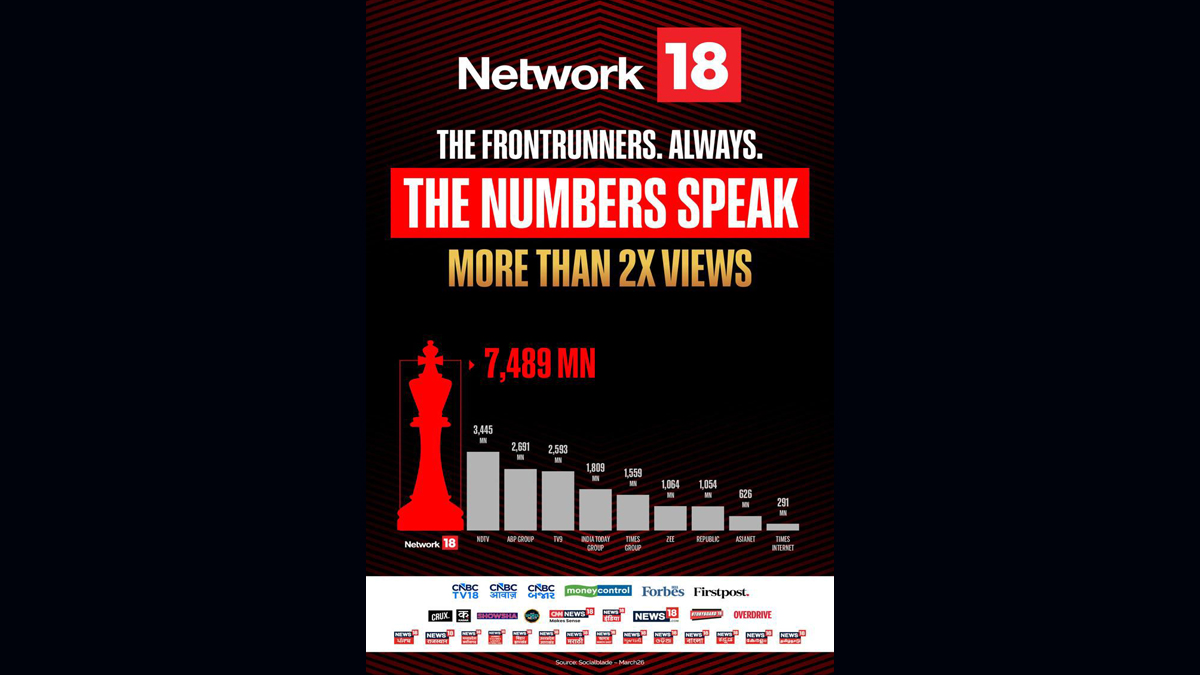
MUMBAI: When the world hit refresh on breaking news, Network18’s channels were already streaming ahead. As geopolitical tensions and war-driven headlines fuelled a surge in global news consumption, the network’s digital playbook delivered big clocking record Youtube viewership across English, Hindi and business news categories in March 2026.
At the forefront was CNN-News18, which emerged as the clear leader in the English news segment with 130 million live and video-on-demand views. The channel edged past competitors such as Times of India (126.5 million), Times Now (101.1 million), India Today (88.2 million) and NDTV (77.5 million), according to Databeings data for March.
In the Hindi news arena, News18 India delivered a commanding performance, racking up a staggering 3,297 million views on YouTube. The channel comfortably outpaced NDTV India, which recorded 3,119 million views, underlining its deep reach and consistent engagement with mass audiences, as per Playboard data.
The network’s dominance wasn’t confined to general news. In the Hindi business segment, CNBC Awaaz topped the charts with 92 million views, narrowly ahead of Zee Business (90 million) and well ahead of ET Now Swadesh (57 million). Meanwhile, its English counterpart CNBC-TV18 posted a strong 58 million views, reinforcing the network’s cross-category strength.
The spike in viewership reflects a broader shift in audience behaviour, with viewers increasingly turning to digital platforms particularly Youtube for real-time updates and in-depth coverage during high-intensity news cycles. For Network18, the numbers signal more than just scale; they underline the effectiveness of a multi-platform strategy that blends speed, credibility and continuous coverage.
In a month where the news never paused, it seems viewers chose to stay tuned where the stream never stopped.






