News Broadcasting
Europe, ME, SA offer satellite ops ray of hope


CALIFORNIA: Amidst unfavourable economic conditions and the melt down in the telecommunications industry, the satellite transponder capacity leasing market in Europe, the Middle East and Africa represents a ray of hope, as it continues to experience consistent growth and significant profits.
New analysis from Frost & Sullivan Commercial Geostationary Satellite Transponder Markets for Europe, the Middle East and Africa – ‘Opportunities for growth in an uncertain world’, reveals that revenues in this industry totaled $3.79 billion in 2002 and are projected to reach $4.88 billion by 2009.
However, satellite operators face numerous challenges that threaten to obstruct their path to greater profitability. Optimistic demand growth projections that led many operators to launch new transponders failed to materialise, leaving them with excess capacity and compelling them to reduce lease rates.

Further compounding this problem is the migration of video broadcasting from analog to digital signals. Increased efficiency allows for more content to be broadcast per transponder.
This cuts into the demand for new capacity. Moreover, the merger of major capacity lessors such as in the direct-to-home television sector is negatively affecting the demand for transponder capacity to relay programming.
Operators must squarely address these issues or face the risk of significant price competition as market participants stoop to any means to get their transponders sold.
While operators must compete with terrestrial networks to increase the use of satellites in fast growing networking applications, they must not lose sight of their biggest revenue generator, namely, video applications. Locking in the key video market is more important for long-term success than overemphasising the networking market.
Frost & Sullivan claims to be a global leader in strategic growth consulting. This ongoing growth opportunity analysis is part of the Satellite Communications Subscription, which also includes market insights on Latin American DTH Satellite Television Services and World Ka-band Satellite Broadband Services.







News Broadcasting
Network18 channels lead YouTube news viewership in March 2026
CNN-News18, News18 India and CNBC channels top categories with record views
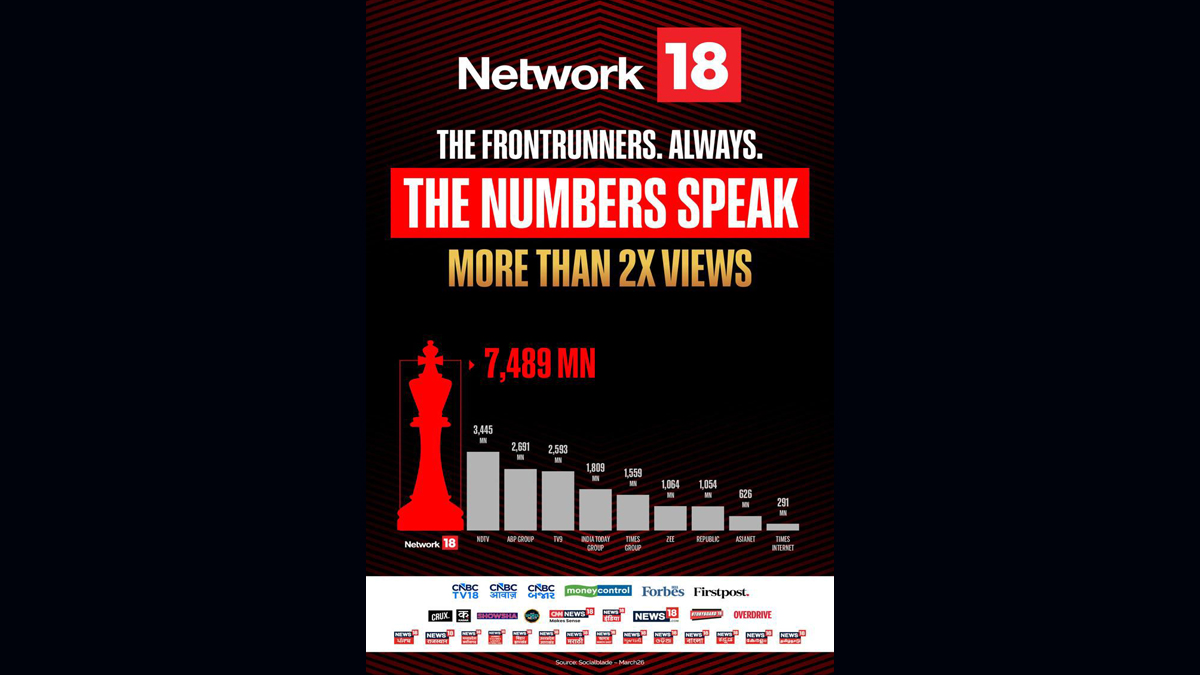
MUMBAI: When the world hit refresh on breaking news, Network18’s channels were already streaming ahead. As geopolitical tensions and war-driven headlines fuelled a surge in global news consumption, the network’s digital playbook delivered big clocking record Youtube viewership across English, Hindi and business news categories in March 2026.
At the forefront was CNN-News18, which emerged as the clear leader in the English news segment with 130 million live and video-on-demand views. The channel edged past competitors such as Times of India (126.5 million), Times Now (101.1 million), India Today (88.2 million) and NDTV (77.5 million), according to Databeings data for March.
In the Hindi news arena, News18 India delivered a commanding performance, racking up a staggering 3,297 million views on YouTube. The channel comfortably outpaced NDTV India, which recorded 3,119 million views, underlining its deep reach and consistent engagement with mass audiences, as per Playboard data.
The network’s dominance wasn’t confined to general news. In the Hindi business segment, CNBC Awaaz topped the charts with 92 million views, narrowly ahead of Zee Business (90 million) and well ahead of ET Now Swadesh (57 million). Meanwhile, its English counterpart CNBC-TV18 posted a strong 58 million views, reinforcing the network’s cross-category strength.
The spike in viewership reflects a broader shift in audience behaviour, with viewers increasingly turning to digital platforms particularly Youtube for real-time updates and in-depth coverage during high-intensity news cycles. For Network18, the numbers signal more than just scale; they underline the effectiveness of a multi-platform strategy that blends speed, credibility and continuous coverage.
In a month where the news never paused, it seems viewers chose to stay tuned where the stream never stopped.






