News Broadcasting
ESS partners with Special Olympics


MUMBAI: ESPN Star Sports (ESS) has announced a partnership with the Special Olympics, the international non-profit organisation dedicated to improving the lives of people with intellectual disabilities.
ESS says that it is well-positioned to deliver the Special Olympics message across Asia, including calling upon the services of sporting legends who have built a relationship with the network over the years.
Among the media programmes lined up by ESS is the television production and broadcast of the 1st Special Olympics International Cricket Cup which will be held in Mumbai from 6-13 November 2006. 12 men’s and three women’s teams will take part in the inaugural competition, involving 272 athletes and over 600 volunteers, coaches and officials. The countries taking part in this inaugural event are India, Afghanistan, Australia, Bangladesh, England, Nepal, Pakistan, Sri Lanka, West Indies. Female teams from India and Pakistan will also take part in this event.

Special Olympics International chairman Timothy P. Shriver said, “We have been expanding and developing many programmes in the Asia Pacific region recently and have always had the goal to reach out to significantly many more people with intellectual disabilities worldwide. We have just reached two million athletes participating in 150 countries. Yet there are nearly 170 million more waiting. In addition, our message has to extend to the mass public in a much more powerful and significant way. ESPN Star Sports can make that happen.”
Among the sporting stars who have stepped forward to lend their support to ESS’ commitment to Special Olympics are legendary batsman Sunil Gavaskar, skipper Rahul Dravid, Irfan Pathan and Mohammad Kaif. Tailor-made public service announcements have been created by ESS featuring these Indian cricket legends.
Special Olympics Asia Pacific MD Troy Greisen, says, “We are absolutely thrilled about this partnership with ESPN Star Sports as it is a great opportunity for us to spread the word and inspire people throughout Asia to get involved and support Special Olympics. ESPN Star Sports is the most powerful medium for us to achieve this as the premier sports network in Asia. Not only does ESPN Star Sports reach millions of viewers whose lives can be touched by our message and hopefully become supporters, it is also a great platform to showcase the ability of our Special Olympics athletes alongside other world class athletes.”
ESS Asia MD Jamie Davis said, “Special Olympics is indeed a very special organisation. Its ideals are something we are very attracted to and something we want to fully support. Nothing will be more satisfying than to be able to play a small part in changing the lives of these special athletes.
“ESPN Star Sports’ commitment will not stop at producing and broadcasting the flagship events of Special Olympics, which will start with the cricket tournament in Mumbai. ESPN and Star Sports will also run public service announcements to increase the awareness of people with intellectual disabilities and it’s staff will actively work with the Special Olympics athletes through volunteer coaching programmes”.
ESS India MD RC Venkateish said, “Our network has a huge presence in India and we are looking forward to achieving something very important for Special Olympics in Asia. The continent has its own special athletes and through the powerful mediums of sports and television, we can help Asia play a more important role in helping people with intellectual disabilities.”
Gavaskar said, “As a sportsman, getting involved in a cause as big as this, especially since it is about speaking for a group of athletes and promoting their cause throughout Asia, is perhaps one of main highlights of my career. If I am able to help achieve the goals that Special Olympics are looking for, then, it will perhaps even surpass what I have ever achieved in cricket.”




News Broadcasting
Network18 channels lead YouTube news viewership in March 2026
CNN-News18, News18 India and CNBC channels top categories with record views
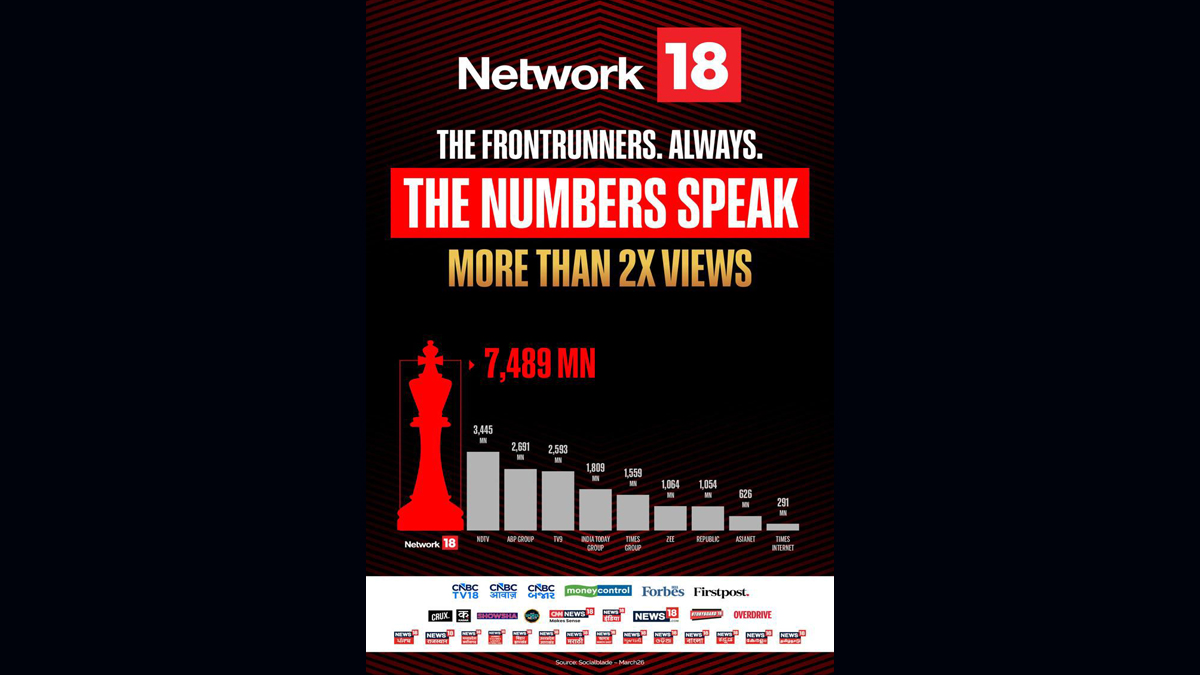
MUMBAI: When the world hit refresh on breaking news, Network18’s channels were already streaming ahead. As geopolitical tensions and war-driven headlines fuelled a surge in global news consumption, the network’s digital playbook delivered big clocking record Youtube viewership across English, Hindi and business news categories in March 2026.
At the forefront was CNN-News18, which emerged as the clear leader in the English news segment with 130 million live and video-on-demand views. The channel edged past competitors such as Times of India (126.5 million), Times Now (101.1 million), India Today (88.2 million) and NDTV (77.5 million), according to Databeings data for March.
In the Hindi news arena, News18 India delivered a commanding performance, racking up a staggering 3,297 million views on YouTube. The channel comfortably outpaced NDTV India, which recorded 3,119 million views, underlining its deep reach and consistent engagement with mass audiences, as per Playboard data.
The network’s dominance wasn’t confined to general news. In the Hindi business segment, CNBC Awaaz topped the charts with 92 million views, narrowly ahead of Zee Business (90 million) and well ahead of ET Now Swadesh (57 million). Meanwhile, its English counterpart CNBC-TV18 posted a strong 58 million views, reinforcing the network’s cross-category strength.
The spike in viewership reflects a broader shift in audience behaviour, with viewers increasingly turning to digital platforms particularly Youtube for real-time updates and in-depth coverage during high-intensity news cycles. For Network18, the numbers signal more than just scale; they underline the effectiveness of a multi-platform strategy that blends speed, credibility and continuous coverage.
In a month where the news never paused, it seems viewers chose to stay tuned where the stream never stopped.






