eNews
ESPNcricinfo launches ‘Insights’ to strengthen its content offering

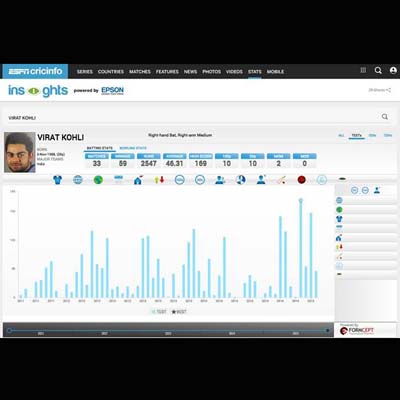
MUMBAI: ESPNcricinfo has launched Insights, the go-to destination for fans looking for all kinds of statistics and analysis around World Cup Cricket tournament. A first of its kind, Insights leverages the in-depth coverage and data analysis of cricket happenings across the globe and allows fans to interact with statistics and numbers in an easy and engaging manner.
ESPNcricinfo Insights uses more than two decades worth of world cricketing data points and statistics, mapped at the data and analytics hub in Bangalore, to create a suite of products that aim to engage fans in this multi-screen era. ESPNcricinfo’s data operations, which tracks various data points around a cricket match, has built various levels of analytics suite to interpret captured data and add a qualitative perspective to the analytics thus providing an insightful cricketing analysis based on ‘Big Data.’

The data operations map close to 25 variables for every ball bowled during a match that is put through an extensive analytics process that is supplemented by historical data as well as the resident cricketing intelligence of the global ESPNcricinfo editorial team. ESPNcricinfo has tied up with partners like Formcept India for some of these analytics.
Fans will be able to play around with interesting cricket statistics like player versus player comparisons, across game formats and take into account factors like venue, opposition and results of matches for the previous and current Cricket World Cup.
ESPN Digital Media India and ESPNcricinfo head Ramesh Kumar said, “At ESPNcricinfo, we endeavour to constantly innovate and provide cricket fans newer and exciting ways to consume content and engage with game action. We are delighted to announce the launch of ESPNcricinfo Insights, a flagship feature that is poised to deliver the best cricket insights based on cricket data of all cricket matches, the rigour and robustness of our global cricket data operations, decades of cricket analysis expertise and sound analytics offering built around them. It is a pioneering initiative in the cricket coverage space and is sure to delight fans during the upcoming cricketing season. It will be of interest not just to cricket fans but also various other stakeholders in cricket like players, coaches, analysts.”
ESPNcricinfo, Epson India senior general manager, brand & communication Tushad Talati added, “When it comes to the most comprehensive coverage of online cricket, ESPNcricinfo is the first choice for most Indians. This World Cup, more than any so far, promises to have a strong following online, given not just the increase in internet audiences but also that the timings are not exactly conducive to television viewing in India. The Insight’s center on ESPNcricinfo is expected to be the go-to place for all cricket buffs keen to get all the information and stats around the World Cup. At Epson we felt that our presence on Cricinfo during this World Cup made imminent sense and would drive visibility for key products, especially our fantastic InkTank Printers and Home Theatre projectors.”






eNews
Paisabazaar launches Credit Premier League 2.0
Nationwide campaign rewards highest credit scores with Rs 1 lakh top prize.

MUMBAI: When credit scores become a national league, even your CIBIL report starts feeling like it’s playing in the IPL and Paisabazaar has just kicked off the second season. Paisabazaar, India’s leading marketplace for financial products and the country’s largest free credit score platform, has announced the return of the Credit Premier League (CPL) 2.0, a fun, nationwide initiative to recognise and reward individuals with the highest credit scores.
Building on the success of the first edition, CPL 2.0 introduces higher rewards and broader participation. The individual(s) with the highest credit score in the country will win Rs 1 lakh, while state champions will each receive Rs 10,000. Additionally, all participants from the winning state, the one with the highest average credit score will also be rewarded.
All winnings will be credited directly to winners’ PB Wallet, allowing them to pay credit card bills, recharge mobiles, or settle utility bills seamlessly on the Paisabazaar platform.
Paisabazaar CEO Santosh Agarwal said the campaign aims to make credit awareness more engaging and mainstream. “With CPL, we are bringing together engagement, gamification and rewards to make conversations around credit scores more mainstream,” he noted. “Our focus remains on building a financially aware and credit-healthy Bharat.”
The first edition of CPL saw over 5.5 million participants, with the highest individual score touching 861. Delhi recorded the highest average credit score of 746.
Consumers can participate simply by checking their free credit score on the Paisabazaar platform or app. The CPL leaderboard and rankings will be available exclusively on the Paisabazaar App.
In a country where financial dreams are serious business, Paisabazaar has found a smart way to turn credit scores into an exciting game – because when your financial health gets rewarded, everyone wants to play.






