News Broadcasting
ESPN School Quiz 2002 concludes with a winner in DPS-Farakka


One of ESPN Star Sports’ most successful on ground initiatives to get closer to the younger generation – ESPN School Quiz 2002 – has just completed a hugely successful run. DPS Farakka walked off with the coveted trophy. DPS Farakka won both the first and the second National finals respectively to emerge All-India winners of the ESPN School Quiz 2002. The team from DPS Farakka walked away with a grand cash prize of Rs 500,000.
While this cash prize will be used by the school to improve the sporting facilities in the school, the team members Suvojit Chakraborty and Rahul Mukherjee will enjoy a once-in-a-lifetime opportunity from ESPN Star Sports in recognition of their quizzing talent. They will be flown to any major international sporting event of their choice from events featured on either ESPN or Star Sports!
In both the National finals DPS Farakka beat Loyola School from Trivandrum and Mt.St.Mary’s School from Delhi quite easily. In the first National final while Mt.St.Mary’s could muster a paltry 5-point tally, Loyola did not disturb the scorekeepers! In the second National final Mt.St.Mery’s scored 23 and Loyola scored 35.

Hosted by popular presenter Harsha Bhogle, The ESPN School Quiz 2002 showcased the best of sports quizzing talent from around the country. As many as 108 schools came through a tough selection process to feature on this unique TV show. To start with, over 2000 teams from 17 cities had to get past a written test. Cities and towns like Bhilai, Bhopal, Darjeeling, Dehradun, Farakka, Gangtok, Indore, Mangalore, Nasik, Siliguri, Shimla, Surat, Tezpur, Vijayawada and Udhagamandalam were represented for the first time. On-ground quizzes were also conducted in 6 cities in the search for the best.
The 27 top teams from each of the four zones – North, South, East and West – were selected for the final phase of ‘On-Air,’ quizzing, giving every one of the 216 students a chance to test their knowledge of sports against the best competition in the country.
Manu Sawhney, managing director, ESPN Software India Ltd, said: “We at ESPN Star Sports are committed to promoting sporting excellence in India and School Quiz 2002 further exemplifies our effort in this direction. This show provided a unique opportunity for the sports-loving students to pit their knowledge against the best talent across the country and bring pride and glory to their institution.”
Apart from the Grand First Prize, the other prizes were as follows —
The teams winning the National Semi Finals won Rs. 200,000 each (Team Prize)
Zonal Final Winners from each zone won a Trophy (Team Prize) Both team members of all the 12 Zonal Semi-Final Winners received an ESPN Kit each (Individual Prize)
Winners of the Preliminary Rounds from each zone won a Milo wristwatch (Individual Prize)
All participants will received ESPN Certificates Of Excellence







News Broadcasting
UDF poised to return to power in Kerala, says Manorama-CVoter survey
Massive opinion poll projects shift in Kerala politics ahead of 2026 Assembly elections.
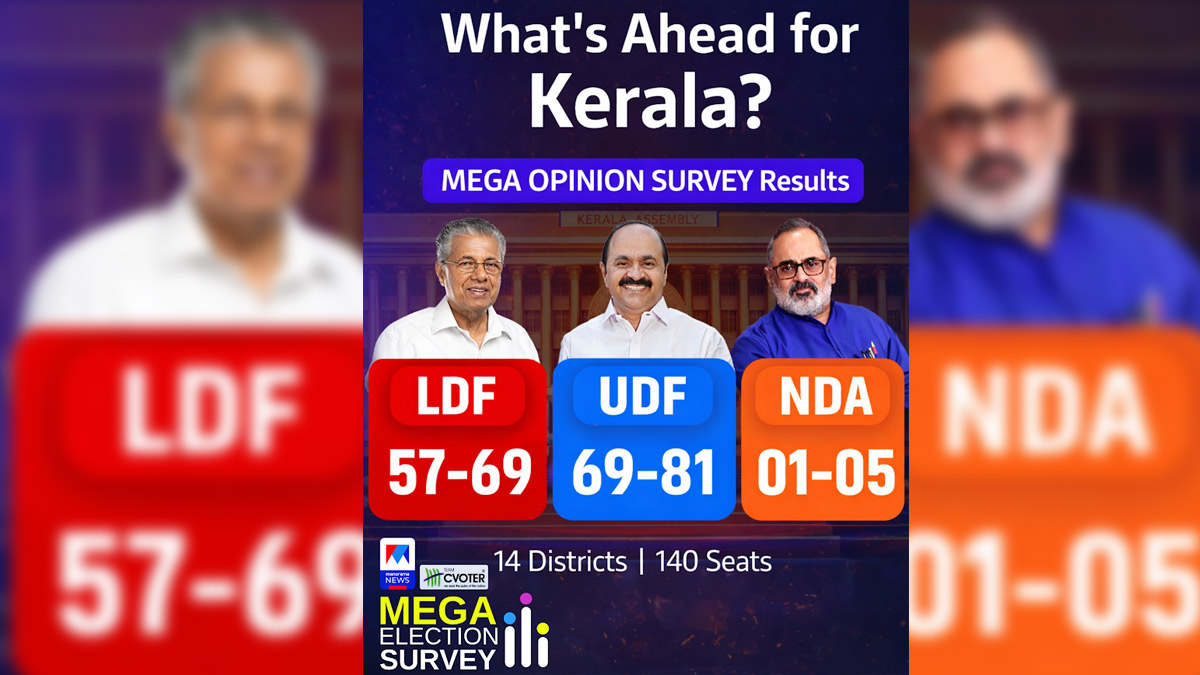
MUMBAI: The winds of change appear to be blowing through Kerala’s political landscape and this time, they seem to favour the United Democratic Front. A comprehensive mega opinion survey conducted by Manorama News in partnership with CVoter projects a potential comeback for the UDF in the upcoming Kerala Legislative Assembly Elections 2026. The survey, covering all 140 constituencies with a massive sample size of nearly 90,000 respondents, predicts the UDF could win between 69 and 81 seats.
The ruling Left Democratic Front (LDF) is expected to secure 57 to 69 seats, a significant drop from the 99 seats it won in the 2021 elections. This would mean the LDF losing 30 to 42 of its sitting seats. Meanwhile, the National Democratic Alliance (NDA), which drew a blank in 2021, is projected to open its account with 1 to 5 seats.
Region-wise, the UDF is expected to make strong gains in Malabar, winning 25 to 34 out of 48 seats, and in Central Kerala, where it could bag 29 to 33 out of 53 seats. In South Kerala, the LDF is likely to retain an edge with 21 to 25 seats, while the UDF may improve to 12 to 16 seats. The NDA could pick up 1 to 3 seats in the southern region.
The survey was conducted between 14 and 26 March 2026, with additional tracker and snap polls carried out from December 2025 to March 2026. A total of 89,693 respondents participated, ensuring representation across all demographics and social segments.
Manorama News has a strong track record of accuracy, with its previous projections closely matching the actual results of the 2019 and 2024 Lok Sabha elections as well as the 2021 Kerala Assembly polls.
In Kerala’s famously fierce political battles, this survey suggests the pendulum may be swinging back. Whether the final verdict matches these numbers or throws up another surprise, one thing is clear, the 2026 Assembly elections are shaping up to be one of the most keenly watched contests in the state’s history.






