News Headline
Entertainment industry needs a reality check in terms of economics: Venkatesh Roddam


MUMBAI: Media and entertainment firm (known for its post production and VFX capabilities) Reliance MediaWorks (RMW) CEO Venkatesh Roddam met us at the recently concluded FICCI Frames 2014. The man, who exuded a lot of positivity in his conversation infused with humour, seemed to be quite upbeat about the feat the company has just achieved of providing post production services to 400 Indian films so far.
By the end of 2011, the number was 110. Roddam doesn’t think the meteoric rise is because of him. Roddam, who became RMW CEO in 2011, feels its growth is a result of the inclusive structure that it has in place. With enough humility, he confesses that while he takes all the money and business related decisions, it’s the team that keeps RMWL ticking. “If you ask me specific questions, you will normally find me at a loss for answers,” he professes as he introduces Nishit Shetty, the company’s vice-president, operations who has a handle on what’s going on day to day.

However, taking the conversation forward, he says, “In the entertainment business, creativity is just one part; it has to be backed by economics.” He puts forward an interesting example of Life of Pi. “Even as Rhythm & Hues the company was bagging a visual effects Oscar for it, its founders had decided to go ahead with a bankruptcy filing,” he says. “That is not something that should happen. And at the end of the day the purpose of the business is to make money. The industry globally needs to have a reality check about the economics. ”
Nishit decides to dive into the conversation as he talks about the VFX studio’s initial foray into post-production in 2008 with the film Sarkar Raj. “It was a gradual process. We were taking up projects slowly,” says Nishit. RMW has worked on visual effects for several international and domestic films. Transformers 3 – The dark of the Moon, Conan the Barbarian, Expendables 2, GI Joe Retaliation, Chennai Express, Queen, and many southern and Bengali films figure on its slate. In fact, in the time to come the company is looking to tap the regional film industry even more.
Also, now Nishit says that RMW is reaching out to a new constituency: that of smaller film production houses and independent filmmakers. “There’s a lot of business potential in that segment as a lot of new filmmakers are coming up with great ideas and need better presentation,” he reveals.
“At RMW we have always believed in adding value to the film making process by keeping up to date with the latest technology and techniques which has worked in our favour,” highlights Roddam.
RMW is looking at expanding its Big Cinemas theatrical exhibition chain. “So say, if right now we have 260 total screens, we may increase that by around 50 more in the next 12 to 18 months,” he says.
“Our operating margins have continuously increased over the years. We have a distinct advantage of having a presence of screens both in semi-urban and semi-rural areas. We will continue to expand this year to offer an experience like none other to our patrons while at the same time keeping an eye for growth coupled with good profits,” remarks Roddam, adding that it doesn’t want to offer just a good cinema viewing experience to its patrons “but a holistic one with a strong focus on retail, food and beverage, gaming amongst others”.
Another big development is the building up of studios (shooting floors) at the Film City in Mumbai. The company already has two fully functional studios there since the last two years, now Roddam informs that a major studio was commissioned this month which is positioned as the “largest studio in Asia” and four other stages are to be commissioned by the end of May.
The company is also looking to expand its TV production wing – Big Synergy which is headed by the legendary Siddharth Basu – with path-breaking non-fiction programming. However, Roddam wants to keep the details for another conversation.






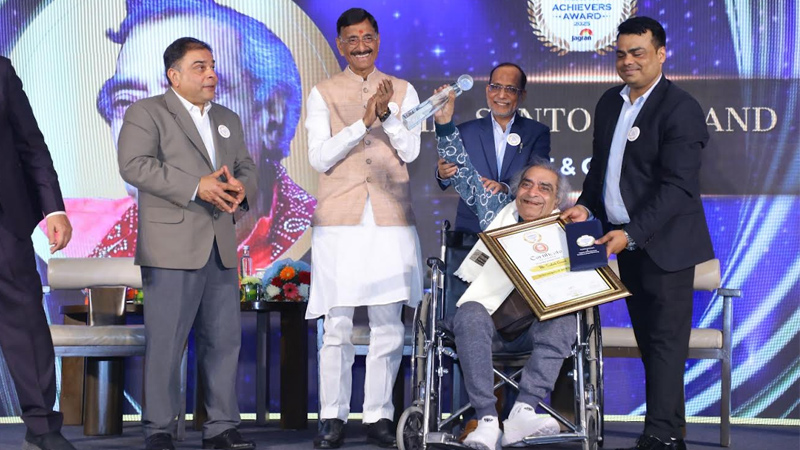
NEW DELHI: Hamdard Laboratories gathered a cross-section of India’s achievers in New Delhi on Friday, handing out the Hakeem Abdul Hameed Excellence Awards to figures who have left their mark across healthcare, education, sport, public service and the arts.
The ceremony, attended by minister of state for defence Sanjay Seth and senior officials from the ministry of Ayush, celebrated individuals whose work blends professional success with a sense of public purpose. It was as much a roll call of achievement as it was a reminder that influence is not measured only in profits or podiums, but in people reached and lives improved.
Among the headline awardees was Alakh Pandey, founder and chief executive of PhysicsWallah, recognised for turning affordable digital learning into a mass movement. On the sporting front, Arjuna Awardee and kabaddi player Sakshi Puniya was honoured for her contribution to the game and for pushing women’s participation onto bigger stages.
The cultural spotlight fell on veteran lyricist and poet Santosh Anand, whose songs have echoed across generations of Hindi cinema. At 97, Anand accepted the honour with characteristic humility, reflecting on a life shaped by perseverance and hope.
Healthcare honours spanned both modern and traditional systems. Manoj N. Nesari was recognised for strengthening Ayurveda’s place in national and global health frameworks. Padma shri Mohammed Abdul Waheed was honoured for his research-backed work in Unani medicine, while padma shri Mohsin Wali received recognition for his long-standing contribution to patient-centred care.
Education and social development also featured prominently. Padma shri Zahir Ishaq Kazi was honoured for decades of work in education, while former Meghalaya superintendent of Police T. C. Chacko was recognised for public service. Goonj founder Anshu Gupta received an award for his dignity-centred rural development initiatives, and the Hunar Shakti Foundation was honoured for empowering women and young girls through skill development.
The Lifetime Achievement Award went to former IAS officer Shailaja Chandra for her long career in public healthcare and governance, particularly in the traditional systems under Ayush.
Speaking at the event, Hamdard chairman Abdul Majeed said the awards were a tribute to those who combine excellence with empathy. “These awardees reflect Hakeem Sahib’s belief that healthcare, education and public service must ultimately serve humanity,” he said.
Minister Seth struck a forward-looking note, saying India’s young population gives the country a unique opportunity to become a global destination for learning, health and wellness by 2047.
The ceremony also featured the trailer launch of Unani Ki Kahaani, an upcoming documentary starring actor Jim Sarbh, set to premiere on Discovery on 11 February.
Instituted in memory of Unani scholar and educationist Hakeem Abdul Hameed, the awards have grown into a national platform that celebrates those building a more inclusive and resilient India. For one evening at least, the spotlight was not just on success, but on service with substance.






