International
Embark on an exciting journey with ‘PEPPA PIG’s Adventure’, brought to India by BookMyShow Live

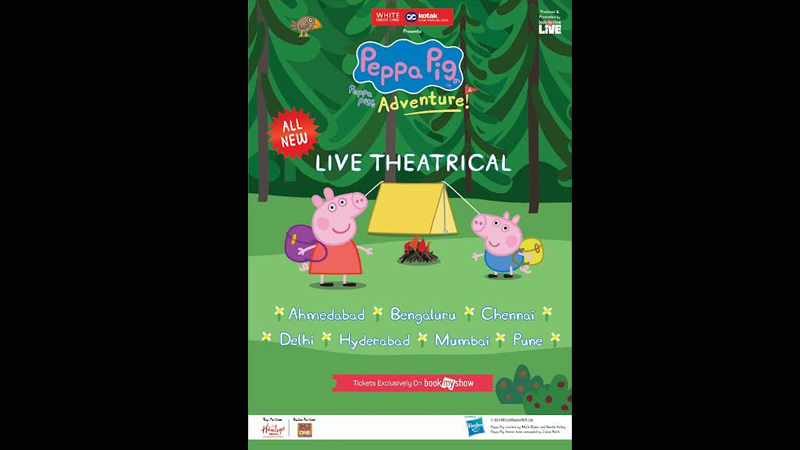
Mumbai: ‘PEPPA PIG’s Adventure’, a brand-new live stage show produced and promoted by BookMyShow Live, the live entertainment experiential division of BookMyShow, licensed from leading toy and game company, Hasbro, Inc. and presented by Kotak White Credit Card, promises to delight audiences of all ages.
Children’s favourite and one of the most charming, animated characters, Peppa Pig is coming to India for a third oink-tastic season, as she brings her friends and family on a trip, for a brand-new fun-filled season that promises a snout-standing spectacle complete with bucketful of surprises and fun.
Scheduled to go snorting out on laughter and learning across seven cities in India – Mumbai, Delhi, Bengaluru, Hyderabad, Pune, Chennai and Ahmedabad, ‘PEPPA PIG’s Adventure’ will enamour each city with six shows per weekend from 21 September 2024 onwards and this time with a brand-new script specially crafted to tickle Indian audiences pink!

Exclusive Pre-Sale of tickets for Kotak credit card customers will begin on August 23, 2024 at 12 Noon (PM) IST on BookMyShow, offering first access to tickets for this high-demand show, with special offers available for Kotak White and White Reserve credit card holders. General On-Sale of tickets for PEPPA PIG’s Adventure’ will go live starting 25 August 2024 at 12 Noon (PM) IST, exclusively on BookMyShow, India’s leading entertainment destination. Tickets for both the Pre-Sale and General On-Sale will be available for the first leg of the live show across Mumbai, Pune and Delhi. This will be followed by a phased release of ticket sales throughout the season.
Commenting on the announcement, Owen Roncon, Chief of Business – Live Events, BookMyShow, said, “Peppa Pig has captured the hearts of children and families around the world and this live stage show is a fantastic opportunity for fans to experience Peppa’s world. Following the resounding success of two previous seasons, we’re thrilled to announce the return of everyone’s favourite character to India with PEPPA PIG’s Adventure’, introducing a fresh storyline that promises to captivate audiences. This latest instalment of the beloved theatrical production aligns with our commitment to offering engaging and immersive entertainment for all ages. Not only does it spark creativity and imagination, but it also imparts valuable life lessons to children. Our goal is to create magical and transcendental shared experiences for families, forging cherished memories that will endure over time. With the overwhelming success of past editions, we are confident that ‘PEPPA PIG’s Adventure’ will continue to delight children and families alike, fostering a sense of fun and togetherness with loved ones.”
Sharing the enthusiasm, Kotak Mahindra Bank Ltd. business head – Credit Cards Frederick Dsouza said, “Kotak curates experiences for its credit card customers who appreciate premium live entertainment. Kotak is thrilled to present the globally adored PEPPA PIG’s Adventure live show to India, in partnership with BookMyShow Live. Peppa Pig is a beloved character not only for children but it also resonates with families, globally. Parents and kids can secure their tickets by booking their preferred seats during the pre-sale. We’re thrilled to create this unique offering for our credit card customers with the opportunity to have first access to tickets and we are confident the kids are in for a memorable, joyful evening.”

International
Russia-India cinematic spectacle Persimmon of My Love set for grand Moscow debut
Hindi cinema style musical revives Indo-Soviet cinema ties for today

MUMBAI: A new chapter in cross-border storytelling is set to unfold as Persimmon of My Love gears up for its premiere in Moscow on 1 April 2026, marking the first large-scale cinematic collaboration between Russia and India in decades.
Positioned as a modern nod to the cultural exchange that once brought Indian classics to Soviet audiences, the film blends Hindi cinema flair with Russian storytelling, aiming to rekindle a long-standing cinematic friendship.
Directed by Marius Weisberg, the musical comedy follows two brothers navigating a lively world of music, family and romance. The lead roles are played by Demis Karibidis and Mikhail Galustyan, with Karibidis also contributing as a screenwriter.
Shot entirely in India, the production leans heavily into Hindi cinema style spectacle. Filming took place across Mumbai studios and the cities of Udaipur and Jodhpur, whose architecture was used to create the fictional setting of Khurmada. A crew of over 350 worked on the project, with large-scale sequences featuring up to 1,000 extras.
The film also brings Indian creative talent into the mix. Dance sequences are choreographed by Jay Kumar, while music by Zurab Matua features songs in both Hindi and Russian, adding to its cross-cultural appeal.
Backed by TNT channel, MyWayStudio and the Russian Cinema Fund, the project reflects a broader push to strengthen cultural ties between the two countries.
With its mix of colour, comedy and cross-border collaboration, Persimmon of My Love is not just a film release but a reminder that cinema, much like music, travels well across borders.






