News Broadcasting
Election Commision wants minimum punishment of 2 years in cases of paid news


NEW DELHI: The Election Commission of India has asked the Centre to impose a minimum punishment of two years to anyone found guilty of indulging in the malaise of paid news.
Chief Election Commissioner SY Qureshi said during a discussion here that the Commission could only act if it was given sufficient proof. He said the Commission had set up a Media Monitoring and Media Certification Committee to keep a check on the media during elections.
He also said new guidelines had been issued for publications owned by people associated with political parties.

He said there was also a proposal to ban government-sponsored advertisements relating to its achievements at least two months before the elections.
Qureshi was speaking at a discussion on ‘Paid News’ organised by the Public Service Broadcasting Trust after the screening of the hour-long film ‘Brokering News’ by Umesh Aggarwal exposing this malaise.
The film shows examples of how news is bought and sold in both the print and the electronic media by politicians, corporate houses, sportspersons, and even film personalities. It blatantly shows the link of some of the mediapersons to Niira Radia by screening clips of the telephonically conversations, apart from showing how TV channels help the stocks of certain corporate houses to rise by the way they present the programmes. There is also an example of the same article about a politician appearing on different days in different newspapers under different names.
The film also showed the case of Kurukshetra based print mediaperson Rakesh K Sharma who had been forced by his Hindi newspaper to collect money in the name of interviews or advertisements from politicians for almost six years, but quit his job to expose cases of paid news. Both Aggarwal and Sharma were present.
Others who took part in the discussion included Mint editor R Sukumar, Prasar Bharati Chairperson and former editor of Dainik HindustanMrinal Pande, and NDTV managing editor, special projects, Pankaj Pachauri, The Hoot editor Sevanti Ninan, which is a media watchdog publication.
Initiating the discussion, PSBT Managing Trustee Rajiv Mehrotra said the Trust gave full freedom to the filmmakers and did not interfere with the films once the script was given approval.
Senior journalist Paranjoy Guha Thakurta who was one of the two-member panel of the Press Council which went into the malaise, regretted that only a five-page statement had been issued to the media on the 71-page report.
Doordarshan Director General Tripurari Sharan said this film was very important for the public service broadcaster which would telecast the film. He said this may make people realise the importance of a public service broadcaster.
Pande applauded the courage of the filmmaker and said the real problem lay in the ownership pattern of the newspapers – particularly when the proprietor was himself the editor. She said there were also cases in Hindi publications of the editor holding shares in the publication, which automatically meant his first loyalty was to the shareholders.
She said part-time journalists or stringers were crucial to the malaise of paid news since their real loyalty did not lie with the newspaper.
Pachauri admitted that self-regulation did not work, and felt cases of political paid news was worse than business paid news. The media had been hijacked by corporates and politicians, and the media had become a political party in itself. He cited the case of a sting operation run by a channel at the behest of the largest opposition party.
He felt the need of an independent Press Commission in the country to check such issues.
Though not very impressed by the film, Sukumar admitted that there were cases of paid news in the corporate sector but wanted more checks and balances. He regretted there was no law to prevent advertisements coming in the name of news, and admitted to huge advertisement pressure on business newspapers.

News Broadcasting
UDF poised to return to power in Kerala, says Manorama-CVoter survey
Massive opinion poll projects shift in Kerala politics ahead of 2026 Assembly elections.
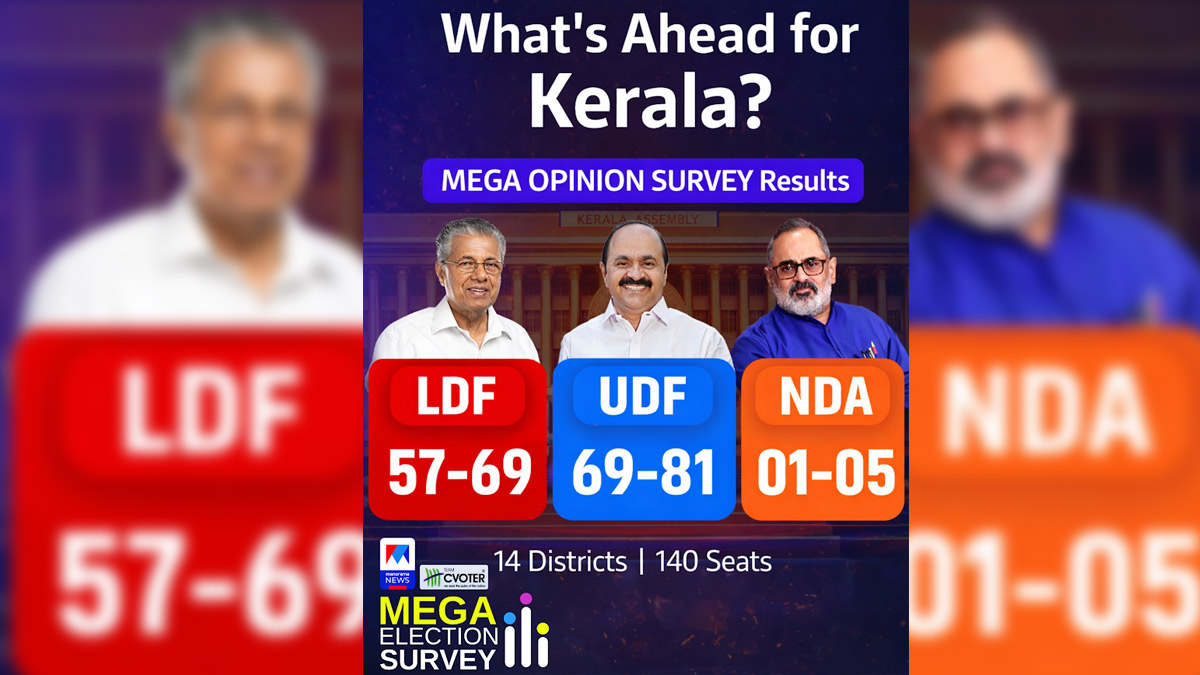
MUMBAI: The winds of change appear to be blowing through Kerala’s political landscape and this time, they seem to favour the United Democratic Front. A comprehensive mega opinion survey conducted by Manorama News in partnership with CVoter projects a potential comeback for the UDF in the upcoming Kerala Legislative Assembly Elections 2026. The survey, covering all 140 constituencies with a massive sample size of nearly 90,000 respondents, predicts the UDF could win between 69 and 81 seats.
The ruling Left Democratic Front (LDF) is expected to secure 57 to 69 seats, a significant drop from the 99 seats it won in the 2021 elections. This would mean the LDF losing 30 to 42 of its sitting seats. Meanwhile, the National Democratic Alliance (NDA), which drew a blank in 2021, is projected to open its account with 1 to 5 seats.
Region-wise, the UDF is expected to make strong gains in Malabar, winning 25 to 34 out of 48 seats, and in Central Kerala, where it could bag 29 to 33 out of 53 seats. In South Kerala, the LDF is likely to retain an edge with 21 to 25 seats, while the UDF may improve to 12 to 16 seats. The NDA could pick up 1 to 3 seats in the southern region.
The survey was conducted between 14 and 26 March 2026, with additional tracker and snap polls carried out from December 2025 to March 2026. A total of 89,693 respondents participated, ensuring representation across all demographics and social segments.
Manorama News has a strong track record of accuracy, with its previous projections closely matching the actual results of the 2019 and 2024 Lok Sabha elections as well as the 2021 Kerala Assembly polls.
In Kerala’s famously fierce political battles, this survey suggests the pendulum may be swinging back. Whether the final verdict matches these numbers or throws up another surprise, one thing is clear, the 2026 Assembly elections are shaping up to be one of the most keenly watched contests in the state’s history.






