Gaming
E-Gaming Federation urges govt to maintain 18% GST for online skill gaming sector


MUMBAI: The GST Council reconstituted a Group of Ministers (GoM) in February 2022 to study the GST rates for casinos, racecourses, and online gaming. The panel’s terms of reference stated that it will examine the valuation of services offered by casinos, racecourses, and online gaming portals, as well as the taxability of some casino transactions, all within the context of existing legal provisions and court orders. In addition, if an alternative is recommended, the GoM will investigate any changes that are required in the legal provisions and the administration of such valuation provision. The group will also assess the impact on other similar services, such as the lottery.
Earlier this month, Meghalaya Chief Minister Conrad Sangma, Convener – GoM held a meeting with other members and officials to discuss various aspects including the possible GST rates for online gaming, valuation modalities for levying the tax, and other technicalities regarding such activities.
Currently, a tax rate of 18 percent is levied on the commission (Gross Gaming Revenue or GGR) collected by the online gaming platforms for each game that does not involve betting or gambling. This rate is in line with global best practices since online gaming industry tax structures in countries such as the USA, UK, Germany, and Australia, range between 15 percent to 20 percent. In recent years, the online gaming industry has experienced significant growth. The sector generated Rs 115 billion in revenue in 2020, and it is predicted to expand at a CAGR of 38 percent to Rs 384 billion by 2025.

The contribution to the government exchequer by this industry was 15 to 20 billion in 2020, and the same is expected to reach 35 to 50 billion by 2025.
If the current taxation regime is revised and charged on stakes rather than gross gaming revenue (GGR), it will prove to be disastrous to the burgeoning potential of the Indian online gaming industry. The hike will raise the tax by over 800 percent – 900 percent and encourage illicit market operations, which will expose players to unscrupulous operators (predominantly offshore), substantially reduce tax revenues for the government, and all but wipe out a legitimate sunrise sector with the potential to generate $25 billion in annual revenues and hundreds of thousands of jobs by 2030.
E-Gaming Federation (EGF), an organisation representing top online skill gaming operators in India urges the government to consider Gross Gaming Revenues (GGR) for levying GST and keeping the service at an 18 percent slab.
EGF CEO Sameer Barde said, “A higher tax burden will make the industry unviable. The gaming platform operators will be unable to continue operations at any meaningful level. Growth, innovation, employment opportunities, government revenues and most important responsible and safe gaming will be impacted in a big way. We urge the GoM to consider the industry’s unique needs and recommend the continuance of the current practice of considering GST to be paid on GGR, with the rate remaining at 18 percent. As online gaming is different from gambling and the Supreme Court and several High Courts have reaffirmed the status of skill-based games as legitimate business activity, rational tax treatment of online skill gaming will help in creating mutually benefitting situations for all the stakeholders.”
EGF added that PM Modi endorsed India’s gaming industry as a potential world leader, emphasising on the industry’s socioeconomic and cultural importance in today’s globalised and digitised economy. The sector received further impetus after Finance Minister Nirmala Sitharaman announced the setting up of the Animation, Visual Arts, Gaming and Comics (AVGC) Task Force, in her budget speech this year. “We are witnessing the start of a new era in India’s gaming sector. The fact that the government is supporting the industry is really encouraging. The sector’s true growth story, however, will be determined by progressive and favourable policies that establish best practices and encourage responsible gaming.”






Gaming
India’s broadcasters say no to Fifa World Cup 2026
Fifa has slashed its asking price by 65 per cent but India’s broadcasters are still not buying

MUMBAI: The world’s biggest sporting event cannot find a single taker in the world’s most sports-mad nation. Fifa’s television rights for the 2026 World Cup remain unsold in India, and the clock is ticking loudly.
To shift the property, world football’s governing body has already swallowed hard and cut its asking price from $100m to $35m, bundling in the 2030 edition as a sweetener. It has not worked. Indian broadcasters have looked at the offer, done the sums and quietly walked away.
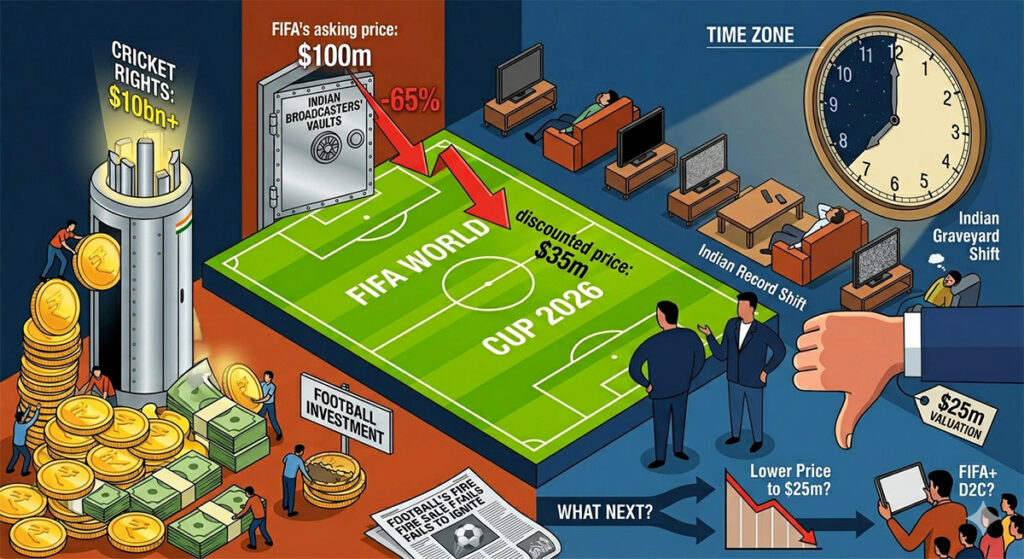
The reasons are brutally simple. The 2026 tournament, co-hosted by the United States, Canada and Mexico, kicks off in a time zone that turns India’s primetime into a graveyard shift. Most matches will air between midnight and 7am IST, a scheduling catastrophe for advertisers chasing mass reach. The 2022 Qatar edition was a gift by comparison, with matches dropping neatly into Indian evenings. North America offers no such luxury.
The market itself has also changed beyond recognition. The merger of Star India and Viacom18 into JioStar has gutted the competitive tension that once sent sports rights prices soaring. Where rival bidders once slugged it out, there is now a single dominant buyer, and it is in no hurry. JioStar has valued the rights at roughly $25m, a full $10m below Fifa’s already-discounted floor price. That gap has so far proved unbridgeable.
Broadcasters are also nursing a ferocious cricket hangover. Between 2022 and 2023, Indian media houses committed well over $10bn to cricket rights alone, covering IPL, ICC events and BCCI domestic fixtures combined. After a binge of that scale, appetite for a football package that delivers a fraction of the ratings, in the dead of night, is close to zero.
The economics of football broadcasting make the maths even harder. Cricket, with its natural breaks every few overs, is an advertiser’s paradise. Football offers a 15-minute halftime and precious little else. Recovering a nine-figure rights fee from a single half-hour ad window is a stretch at the best of times. These are not the best of times: the Indian government’s tightening grip on real-money gaming and gambling advertising has vaporised a category that once underwrote the economics of big sporting events.
Nor is the World Cup an anomaly. Indian Super League valuations have cratered. English Premier League rights have softened across successive cycles. The cooling of football as a broadcast commodity in India is structural, not cyclical.
With the tournament opening on 11th June, Fifa is running out of road. It may yet blink and meet JioStar at $25m. Or it may go direct, streaming the entire tournament on its own platform, Fifa+, or cutting a digital deal with YouTube, and hoping that a generation of Indian football fans finds its way there without a broadcaster to guide them.
Either way, the beautiful game’s Indian chapter is looking decidedly ugly.







