Hindi
Dublin’s Trinity college honour for Yash Chopra

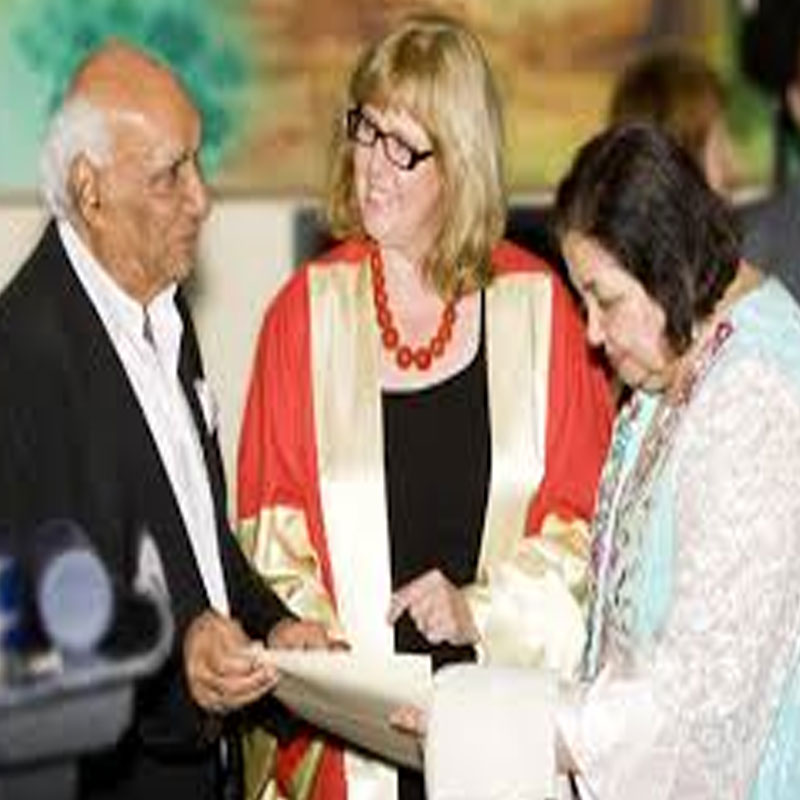
MUMBAI: Influential filmmaker and founder of Yash Raj Films, Yash Chopra, received an honorary professorship from Trinity College Dublin, the University of Dublin at a special event in Mumbai on the occasion of the 100th anniversary of Bollywood films on 14 August.
The prestigious award, which recognises Chopra‘s outstanding contribution to Indian cinema, was conferred on the veteran filmmaker by the university‘s Vice Provost for Global Relations, Professor Jane Ohlmeyer.
Accepting the honour, Chopra said, “I am humbled to receive this honour from the renowned Trinity College Dublin. In this, the hundredth year of Indian cinema, I am privileged to still be an active member of a fraternity that I have been a part of for almost 60 years. Cinema, with its global reach, has brought us all closer, and given us the opportunity to be familiar with and enjoy the varied cultures of our beautiful world.”

Commented Professor Ohlmeyer, “Yash Chopra is one of the most influential filmmakers of our time. This honorary professorship pays tribute to a dazzling career that has spanned five decades during which he has succeeded in breaking down geographical barriers by enamouring his Indian audience with overseas locations.
This award has promoted the possibility of a Bollywood module being developed for students at Trinity College Dublin‘s School of Drama, Film and Music, further strengthening Irish educational ties with India.”
Trinity College Dublin, the University of Dublin, Ireland‘s oldest and most prestigious university, is ranked 21st in Europe and 65th in the world by the 2011 QS World University rankings.
Last year, Yash Raj Films‘ Ek Tha Tiger was shot on location at Trinity College, Dublin. This was the first time that a Bollywood film was shot in Ireland.



Hindi
Hansa Entertainment launched to produce across OTT, TV and film
New venture from R K Swamy Hansa Group eyes multi-language stories for digital-first audiences.

MUMBAI: Hansa Entertainment has just stepped into the spotlight because when a legacy media house decides to script its next act, even the credits get excited. Hansa Entertainment Private Limited has been incorporated to develop and produce original programming across digital, television, OTT platforms and theatrical features. The company will create short-running series, long-running series and original films for OTT, alongside standout theatrical ventures. It will also launch a podcast platform called Hansa Spotlight and produce content for the fast-growing vertical drama format. Stories are initially planned in Hindi, Tamil, Telugu, Malayalam, Bengali and Kannada.
The venture is founded by Sruti Swamy and Siddharth Swamy, drawing on the rich legacy of Hansa Vision and the broader R K Swamy Hansa Group. Sruti brings creative expertise with a master’s in architecture, interiors and design from Milan and a postgraduate degree in business management from the Indian School of Business. Siddharth contributes a data-driven perspective, having studied data science at Imperial College London.
Sujatha Narayanan has been appointed CEO of Hansa Entertainment. With over two decades of experience in creative content curation and production across film and OTT, she is also a well-known film columnist and media entrepreneur.
R K Swamy Hansa Group executive chairman Srinivasan Swamy said, “The launch of Hansa Entertainment marks an exciting new chapter. The new entity is the brainchild of the next generation and will be independently managed by Sruti Swamy, who is the Director and the newly appointed CEO.”
Hansa Entertainment director Sruti Swamy added, “I am very optimistic about the future of Hansa Entertainment, given the content explosion and the opportunities offered by new technologies for production.”
Hansa Entertainment director Siddharth Swamy noted, “The idea is to grow a contemporary production house that creates compelling stories for today’s multi-platform audiences while drawing inspiration from the rich storytelling traditions that audiences have appreciated over the years.”
Hansa Entertainment CEO Sujatha Narayanan said, “Hansa Entertainment will evolve as a story-first, IP-driven entity. We have already put together a smart team of interesting and dynamic creators who will helm our vertical dramas, shows and films.”
In the ever-evolving world of Indian entertainment, where stories now travel faster than the scripts that birth them, Hansa Entertainment is stepping onto the stage with fresh ink and big ambitions proving that even the best legacies know when it’s time for a compelling sequel.