Hardware
Domestic STB manufactures felt the pinch of Covid since January: Amit Kharbanda


KOLKATA: The Covid2019 pandemic has hurt most businesses in India since the beginning of March. But the set top box (STB) manufacturers felt the pinch of crisis even before that, from January itself, MyBox Technologies managing director Amit Kharbanda said. Although the company ended up having six months of zero sales, it continued R&D in the interim for new products.
Kharbanda explained that there are a decent amount of components that come from China, even for normal electronics products. As China went into shutdown from January, MyBox faced a shortage in components for manufacturing. He added that it has impacted all domestic STB companies.
Furthermore, domestic STB companies have been struggling since ASEAN came into effect a couple of years ago. Big cable and DTH operators that used to buy products from domestic companies, switched to importing from ASEAN. Kharbanda emphasised that the competition in this space is not between Indian STB manufacturers but with the international players. In these challenging circumstances, MyBox has been able to survive as it tends to do R&D all the time whether it is with Google or Amazon, he stated.

While the business environment was already tough for the players, the cash flow went for a toss post-Covid, Kharbanda added. The company had to cut down on its expenses. “Bankers started questioning the business model. It took time to get that issue streamlined and convince them, finding the right way of optimising the funding and everything. Now as all of that has been settled, we are hoping from this month onwards or next month we should start shipping. At the end of this year, we should at least come back closer to our quantities which we were shipping last year,” he said. MyBox sold 40 crore boxes in FY20.
However, he mentioned that they kept up R&D during the lockdown. Some product launches including the android box, Alexa Solution have been delayed but the company has added new features during the period. Now as the business is opening up, it will release those products one by one.
“We have been working on some very interesting solutions. One of these was the Android OTT box which we have tried to make valuable for ISPs. There are a lot of small ISPs in India. They can actually utilise the OTT box and give it as a package to their consumers. There is good ARPU source they can make on,” Kharbanda added.
Talking about overall opportunities for STB manufacturers, Kharbanda said that India still has millions of TV unpenetrated households. Moreover, there is scope for old box replacements and new hybrid boxes. Even post-Covid, there has been a major demand for TV sets. But it does not translate into a huge benefit for domestic STB manufacturers as the large operators buy from international players, he rued.
Although the large DTH operators recently undertook ‘Make in India’ route for STB production, the move is more directed at getting foreign vendors here to assemble and sell rather than buying products from homegrown manufactures. However, he shared that MyBox is working closely with the government of India to push STB manufacturing here. Moreover, the ministry of commerce is also working on the issue and the ministry of information and broadcasting (MIB) is in talks with operators for boosting domestic manufacturing. Kharbanda is optimistic that these endeavours will give a much-needed nudge to the growth of STB manufacturers in India.






Hardware
India clears Rs 1.6 lakh crore semiconductor projects under Semicon India
Ten projects cleared as production begins and design ecosystem gathers pace
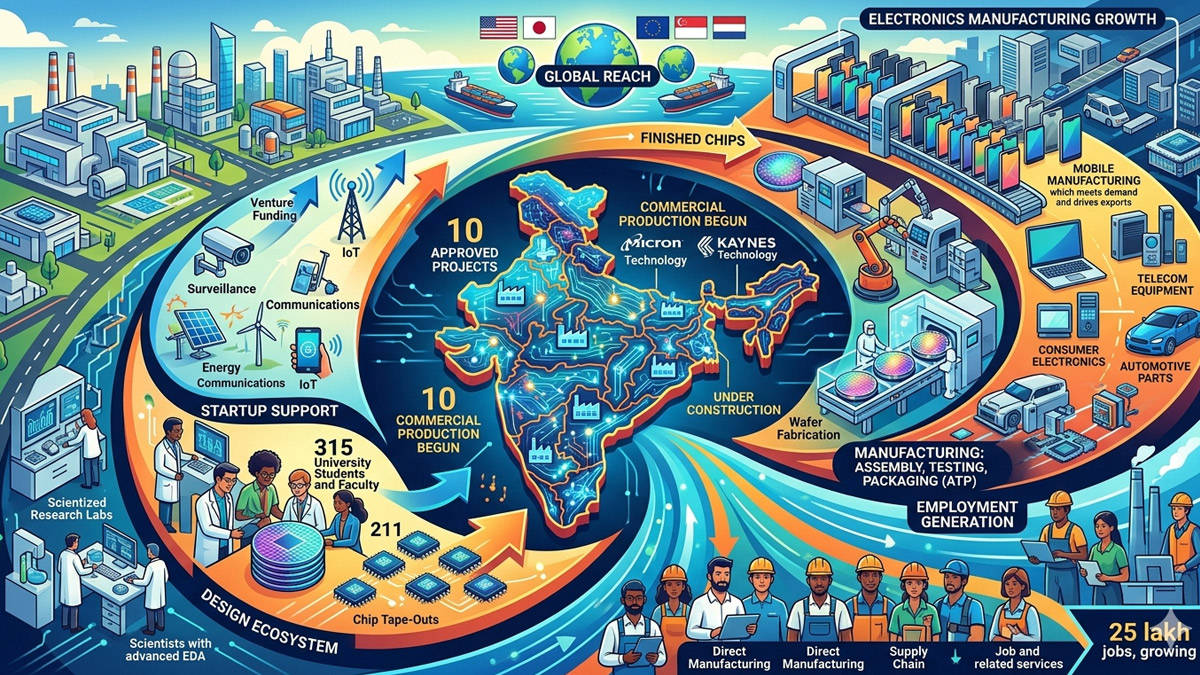
NEW DELHI: India’s push to become a global electronics powerhouse is gaining momentum, with the Semicon India Programme driving the creation of a full-fledged semiconductor ecosystem from design to manufacturing.
Launched in 2022, the programme aims to build capabilities across the entire value chain, including chip design, fabrication, assembly, testing and packaging. In just four years, the government has approved 10 semiconductor projects with a combined investment commitment of around Rs 1.6 lakh crore.
Two of these facilities have already begun commercial production, including units led by Micron Technology Inc. and Kaynes Technology India Limited. Two more plants are expected to go live later this year, signalling that India’s chip ambitions are moving from blueprint to factory floor.
The broader electronics manufacturing story has also seen sharp growth over the past decade. Production has jumped from roughly Rs 1.9 lakh crore in 2014-15 to about Rs 12 lakh crore in 2024-25, while exports have surged nearly eightfold. Mobile phone manufacturing, once heavily import-dependent, now meets almost all domestic demand and has become a major export driver.
Alongside manufacturing, the government is investing heavily in design capabilities. Through access to advanced chip design tools provided free to 315 universities, students and researchers have clocked over 200 lakh hours of usage. This effort has already resulted in 211 chip tape-outs from 75 institutions.
Support for startups is also picking up pace. Twenty-four chip design projects have been approved, targeting sectors such as surveillance, energy, communications and IoT. Of these, 14 companies have collectively raised over Rs 650 crore in venture funding, while several designs have progressed to fabrication, including at advanced nodes.
To strengthen supply chains, India has also signed semiconductor cooperation agreements with countries including the United States, Japan, the European Union, Singapore and the Netherlands. These partnerships aim to reduce global dependencies while boosting domestic capabilities.
The employment impact is equally significant. The electronics sector now supports an estimated 25 lakh jobs, with mobile manufacturing alone accounting for nearly half. As more semiconductor units come online under the India Semiconductor Mission, indirect job creation across supply chains is expected to rise further.
Sharing these updates in Parliament, Ministry of Electronics and Information Technology minister of state Jitin Prasada underscored the government’s focus on building a resilient, end-to-end semiconductor ecosystem.
With factories taking shape, designs moving to silicon and investments flowing in, India’s semiconductor story is steadily shifting gears from ambition to execution.






