I&B Ministry
Dist. National Informatics Centres to be of international standards

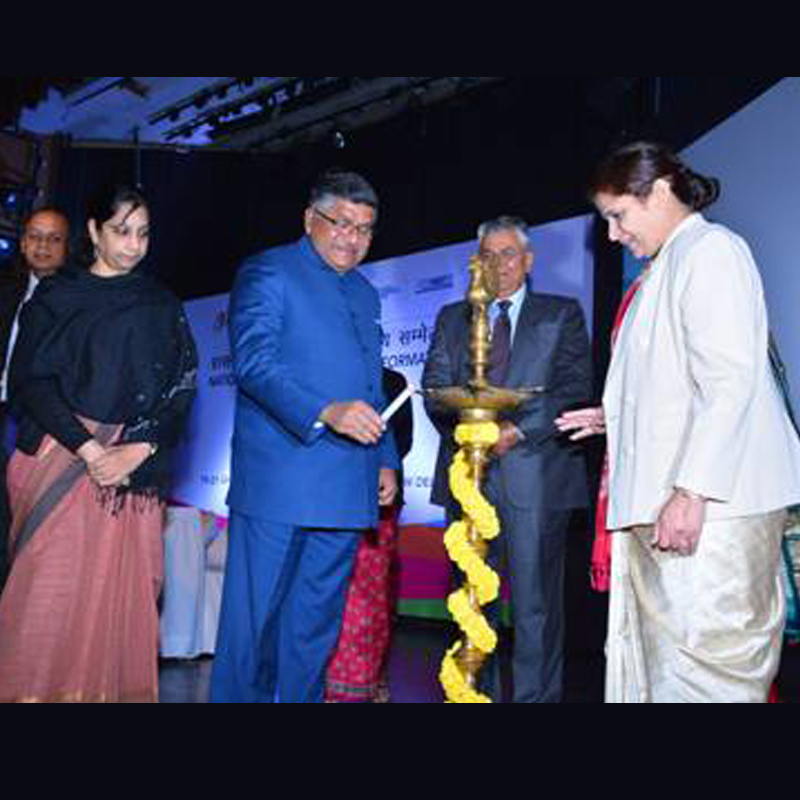
NEW DELHI: Electronics and Information and Technology Minister Ravi Shankar Prasad has said the National Informatics Centre is the “technological bridge of India and is best placed to lead the way for a Digital India”
He urged the District Information Officers (DIOs) to be innovative and proactive. NIC must adopt a transformative approach to make a difference at the grassroots level. He appealed to the NIC to connect with the Common Service Centres (CSCs), who have successfully provided training on digital payment systems to over 19.6 million of rural citizens and 6,15,000 merchants.”
He was speaking at an event where the NIC kicked off the National Meet on Grassroot Informatics – VIVID: Weaving a Digital India here.

The inauguration of the three-day event was also attended Minister of State P P Chaudhary, Secretary Ms Aruna Sundararajan, Additional Secretary Ajay Kumar, NIC DG Ms Neeta Verma, and Deputy DG Ms Rama Nagpal.
Prasad announced the Government’s plan to set up a Government Security Operation Centre and a Data Centre for Cloud in Bhopal. He also announced that the Government is going to enhance the infrastructure of district NIC offices to international standards. As a pilot project, 150 District NIC offices would be upgraded during the period 2017-18, while rest will follow soon.
He instructed the ministry to develop a training module for the NIC officials to keep pace with the ever evolving technologies. He also announced the introduction of annual awards for the DIOs of the NIC for taking up exemplary innovative approach in their respective districts. The top three best innovators will get a reward of Rs 2,00,000, Rs 1,00,000 and Rs 50,000 respectively.
Chaudhary said, “The threshold of the year 2017 will always be remembered for heralding in several transformative changes to benefit the economy as well to the citizens, amongst them the Digital India initiative has been the most significant one. I must congratulate NIC and DIOs for playing a pivotal role in preparing the country for a successful Digital transformation of our ecosystem.
NIC also introduced two new portals – District Collector’s Dashboard and NIC Service Desk, which were launched by Prasad and Chaudhary respectively.
The National Meet on Grassroots Informatics is aimed at showcasing the various initiatives of NIC in creating and enhancing the Digital Infrastructure in the country. Some of these are – setting up of ICT infrastructure, developing state of the art products to enable the government and empower the citizens, its initiatives at state and district level along the lines of Digital India initiatives along with the various awareness campaigns on Digital Payment Systems encompassing DBT, PFMS, Cashless Payment, Aadhaar etc.
The individual sessions during these three days would throw lights on NIC’s journey so far, the best practices it follows, the Digital India programme, Digital India initiatives from NIC State Units, success stories from the districts, Financial Inclusion, its technology awareness programmes and ICT Infrastructure being provided by NIC.



I&B Ministry
Digital radio, D2M tech set to reshape broadcasting and public messaging
Govt pushes next-gen delivery while TRAI tightens grip on spam ecosystem
NEW DELHI: India’s broadcasting and telecom landscape is undergoing a quiet but significant upgrade, with digital radio and Direct-to-Mobile (D2M) technologies emerging as powerful tools for mass communication, while regulators step up efforts to tackle spam calls.
According to the Ministry of Information and Broadcasting, digital radio and D2M are poised to transform how content reaches audiences by making more efficient use of spectrum. In simple terms, multiple channels can now be delivered over a single frequency, opening the door to a wider range of free-to-air content.
D2M technology takes this a step further by enabling video, audio and data to be broadcast directly to mobile handsets without relying on SIM cards or mobile data. The result is a resilient and cost-effective data pipe that can deliver everything from entertainment and education to critical emergency alerts, even in low-connectivity scenarios.
At the same time, the Telecom Regulatory Authority of India is tightening its grip on unsolicited commercial communication, better known as spam calls. The regulator has deployed a distributed ledger technology platform to bring transparency and accountability into the system.
Through this blockchain-based setup, consumers can register their preferences on receiving promotional messages, while businesses and telemarketers must also sign up and operate within defined rules. The platform also includes a complaint mechanism that allows users to report spam, with complaints shared across telecom operators for coordinated action.
The government’s broader push is being supported by infrastructure upgrades under the Broadcasting Infrastructure and Network Development scheme. Implemented through Prasar Bharati, the initiative focuses on modernising networks such as Akashvani and Doordarshan, including digitisation and adoption of next-generation broadcast equipment.
In a written reply in the Lok Sabha, Ministry of Information and Broadcasting minister of state for information and broadcasting L. Murugan said these steps are part of a larger effort to promote emerging technologies and strengthen the country’s broadcasting backbone. The response came to a query raised by member of Parliament Rao Rajendra Singh.
Together, these developments point to a dual-track strategy: expanding access to reliable, low-cost content while cleaning up the communication ecosystem. As digital pipes get smarter and spam filters sharper, India’s airwaves may soon feel a lot less noisy and far more useful.






