Kids
Disney gives 2D characters physical form

MUMBAI: Disney Research has reportedly developed a method based on cable-driven mechanisms that can help artists give physical form and motion to two-dimensional characters. It uses assemblies of joints and cables to make poses and desired motions in a character.
Cables can only exert force in one direction – by pulling – so fully actuated joints demand two cables to move in both directions, PTI reported. In using the method to design and constructing its 2D “Fighter,” US researchers showed that the mechanical character was able to achieve the desired poses with accuracy. The design for the lower body initially included 1,600 cables; the number was eventually reduced in 25 seconds to eight; further refinement took just 181 seconds to reduce the number of cables to three. The 2D gripper they designed and built was able to pick up the light objects it was designed to lift. The robotic hand, with three fingers and a thumb, demonstrated that the method could be used to combine cable drives in more than one plane.
Assemblies of joints and cables are capable of helping in achieving desired poses and motions in a character, even when artistic preferences dictate limb sizes that make it infeasible to place motors at each joint, PTI reported. The cable-driven mechanism is also suitable for devices such as robotic hands, that must be lightweight and small to function.

The Disney team, supported by researchers from the MIT (Massachusetts Institute of Technology), ETH Zurich and the University of Toronto developed the method which was presented at Symposium on Computer Animation (SCA) 2017 in Los Angeles (U.S.). The team developed a method in which a user designs a skeletal frame or other assembly of rigid hinges and links and then specifies a set of target poses for those assemblies.
Research scientist Moritz Bacher says that the advent of consumer-level 3D printing and off-the-shelf yet affordable electronic components gave artists the machinery to make physical and articulated versions of animated characters. He says his approach eliminated much of the complexity of designing those mechanisms.
US researchers from MIT demonstrated their method by designing a 2D puppet-like version of an animated character that is able to assume several desired fighting stances. They also used it to design a gripper for picking up light objects and a simple robotic hand with an opposable thumb.
Disney Research VP Markus Gross says that a number of design tools developed over the past 30 years had enabled artists to instill life into animated characters, creating expressions by posing a hierarchical batch of rigid links. In the age of animatronics and robotics, he says, one needs to give hobbyists and artists similar tools to make animated physical characters just as expressive.
The Disney team, in this case, designed devices that were not intended to interact with people. They sought to minimise the number of cables, and eventually incorporated springs into the joints to move them in the opposite direction when the cable tension was eased.
The method computes a cable network that can reproduce those poses, first generating a large set of cables – typically a thousand or more – with randomly chosen routing points. Redundant cables are then gradually removed. The routing points are then refined to take into account the path between poses, and further reduce the number of cables and the amount of force necessary to control them.
ALSO READ :
Doordarshan in talks with Disney for kiddy content in evening slots
DishTV launches Disney active service
Telly awards: Mediaboss, Discovery, Disney, Fox & Viacom among winners




Kids
Mukta Arts and Green Gold ink MOU to animate iconic film IPs
Kalicharan, Karz, Hero, Karma, Ram Lakhan to spawn animated shows plus features.
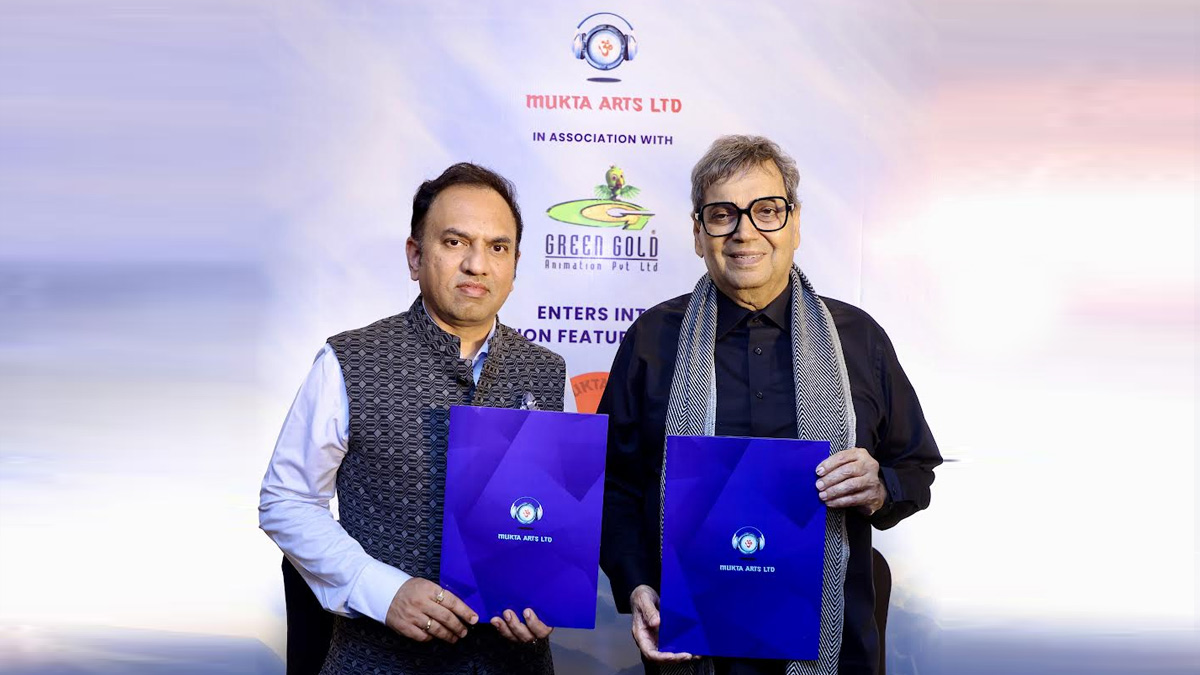
MUMBAI: When classic hindi movie meets animation, the result is a fresh reel of nostalgia with a cartoon twist. Mukta Arts Ltd. and Green Gold Animation have signed a Memorandum of Understanding (MOU) to collaborate on animated shows and feature films drawn from Mukta Arts’ four-decade treasure trove of iconic IPs. The partnership taps Mukta’s SGM Animation Studio launched in 2025 as its dedicated animation and games arm and Green Gold’s proven track record in building scalable, homegrown franchises. Creative teams from both sides have already kicked off discussions, with the first project currently in development.
The slate will draw inspiration from landmark Mukta films including Kalicharan, Karz, Hero, Karma, Ram Lakhan, Khalnayak, Saudagar and Iqbal, plus character-led spin-offs from those universes. The aim is to reimagine these stories for today’s young, global audiences while preserving their emotional core.
Green Gold Animation (home of Chhota Bheem) founder and CEO Rajiv Chilaka said, “This partnership with SGM Studios allows us to apply our experience in building long-lasting animation IPs to a truly iconic film catalogue. Together, we aim to create animated worlds that are rooted in these legendary stories, yet designed to connect with today’s young, global audiences.”
Mukta Arts Ltd. filmmaker and founder Subhash Ghai added, “Mukta Arts has always believed in creating stories with lasting emotional value. Through animation, we are extending our IP into a new medium for the next generation.”
In an industry where timeless tales never go out of fashion, this collaboration promises to bring beloved characters back to life with a modern, animated glow proving that some stories are too good to stay in live-action. Stay tuned for the first animated frame to drop.