News Headline
Digital radio broadcasting issues to be discussed under TRAI aegis in Delhi on 25 Oct

NEW DELHI: An Open House Discussion is being held later this month on the Consultation Paper issued earlier this year on Digital Radio Broadcasting by the Telecom Regulatory Authority of India.
The paer on the subject had been issued on 10 July 2017 and several responses have been received by TRAI, including a detailed reply from the Digital Radio Mondiale Consortium – India welcoming the concept and underlining various advantages of the technology for both, terrestrial and satellite radio broadcasting. The OHD will be held in Delhi on 25 October 2017, for which TRAI had posed 13 questions.
The paper had been issued even as TRAI noted that All-India Radio is active in implementation of digital radio in MW and SW bands but there is no initiative in FM radio space, either by public or private FM radio broadcasters.

Since FM is primarily used for analogue transmission, TRAI had said that it appeared as if the frequency allocations under these policy guidelines are only for analogue transmission. Analogue FM technology can provide only one channel per frequency. Therefore, existing FM radio channels provide limited services to their listeners. In addition, analogue radio broadcasting is facing competition from emerging technologies and other platforms like webcasting, podcasting and internet streaming etc.
In view of this, the TRAI had suo moto issued the consultation paper on issues related to digital radio broadcasting in India.
Late last year, TRAI had commenced a similar exercise in digital terrestrial television. Interestingly, both DTT and digital radio broadcasting have been the domain so far of the pubcaster Prasar Bharati.
At the outset, TRAI has noted that radio is a prevalent source for providing entertainment, information and education to the masses due to its wide coverage, portability, low set-up cost and affordability.
At present, terrestrial radio coverage in India is available in Frequency Modulation (FM) mode and Amplitude Modulation (AM) mode (Short Wave and Medium Wave). All India Radio (AIR) along with private sector radio broadcasters are providing terrestrial radio broadcast services throughout the country transmitting programs in AM and FM frequency bands.
AIR has 420 radio stations (AM & FM) that cover almost 92 per cent of the country by area and more than 99.20 per cent of the country’s population. Private sector radio broadcasters transmit programmes in FM mode only and presently operate through 293 radio stations. Private sector radio broadcasters are licensed to operate in FM frequency band (88-108 MHz).
In Phase-I of FM Radio, the government auctioned 108 FM radio channels in 40 cities. Out of these, only 21 FM radio channels became operational and subsequently migrated to Phase-II in 2005. Phase-II of FM Radio commenced in 2005 when a total of 337 channels were put on bid across 91 cities having population equal to or more than 300,000. Of 337 channels, 222 channels became operational. At the end of Phase-II, 243 FM Radio channels were operational in 86 cities.
In Phase-III expansion of FM radio, 966 FM radio channels are to be made available in 333 cities. In the first batch of Phase-III, 135 private FM Radio channels in 69 cities were auctioned in 2015. Out of these, 96 FM Radio channels in 55 cities have been successfully auctioned.
In the second batch of Phase-III, 266 private FM Radio channels in 92 cities were auctioned in 20162. Out of these, 66 FM Radio channels in 48 cities have been auctioned. As on 31st March 2017, 293 FM radio stations have been made operational in 84 cities by 32 private FM Radio broadcasters.
In order to encourage radio broadcasting for the specific sections of society, the government has allowed setting up of Community Radio Stations (CRS). CRS typically broadcast in FM band with low power transmitters restricting its coverage to the local community within approx 10 KM. There are 206 operational CRS at present.
Radio signals on FM are presently transmitted in analogue mode in the country. Analogue terrestrial radio broadcasting when compared with digital mode is inefficient and suffers with operational restrictions as discussed below:
Digital radio broadcasting has existed since quite sometime around the world. The International Telecommunications Union (ITU) recommendations have described four major standards for broadcast of digital radio which are DAB, ISDB-TSB, HD Radio and DRM.
In keeping with the pace of deployment of digital radio around the globe, the government in 2010 took a decisive step forward for transition from analogue radio services of AIR to digital mode of transmission. AIR conducted rigorous trials over the years and adopted the Digital Radio Mondiale (DRM) standard for low frequency band (MW and SW). It has initiated digitisation of its MW and SW radio network in three phases. It has recently concluded phase-I of digitisation of its network with deployment of 37 digital (DRM) transmitters throughout the country, which are now operational and is now in the process of launching phase-II of the DRM project by offering full features/services from these DRM transmitters and further improving service quality.
Also read: After DTT, TRAI launches exercise on digital radio broadcasting
After DTT, TRAI now launches exercise on digital radio broadcasting







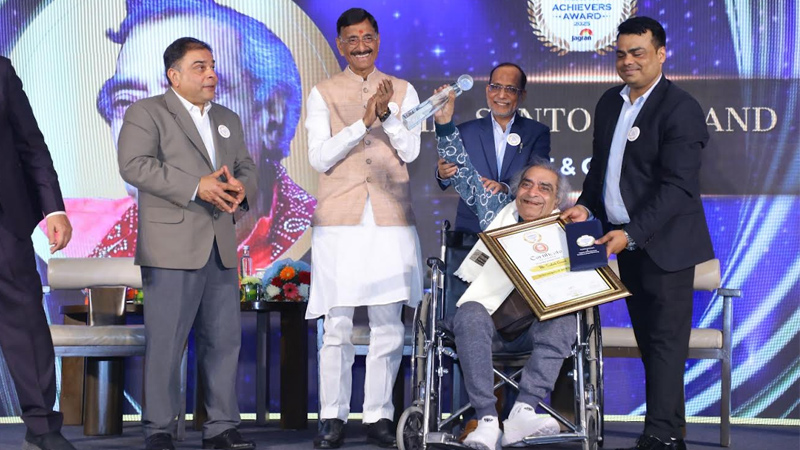
NEW DELHI: Hamdard Laboratories gathered a cross-section of India’s achievers in New Delhi on Friday, handing out the Hakeem Abdul Hameed Excellence Awards to figures who have left their mark across healthcare, education, sport, public service and the arts.
The ceremony, attended by minister of state for defence Sanjay Seth and senior officials from the ministry of Ayush, celebrated individuals whose work blends professional success with a sense of public purpose. It was as much a roll call of achievement as it was a reminder that influence is not measured only in profits or podiums, but in people reached and lives improved.
Among the headline awardees was Alakh Pandey, founder and chief executive of PhysicsWallah, recognised for turning affordable digital learning into a mass movement. On the sporting front, Arjuna Awardee and kabaddi player Sakshi Puniya was honoured for her contribution to the game and for pushing women’s participation onto bigger stages.
The cultural spotlight fell on veteran lyricist and poet Santosh Anand, whose songs have echoed across generations of Hindi cinema. At 97, Anand accepted the honour with characteristic humility, reflecting on a life shaped by perseverance and hope.
Healthcare honours spanned both modern and traditional systems. Manoj N. Nesari was recognised for strengthening Ayurveda’s place in national and global health frameworks. Padma shri Mohammed Abdul Waheed was honoured for his research-backed work in Unani medicine, while padma shri Mohsin Wali received recognition for his long-standing contribution to patient-centred care.
Education and social development also featured prominently. Padma shri Zahir Ishaq Kazi was honoured for decades of work in education, while former Meghalaya superintendent of Police T. C. Chacko was recognised for public service. Goonj founder Anshu Gupta received an award for his dignity-centred rural development initiatives, and the Hunar Shakti Foundation was honoured for empowering women and young girls through skill development.
The Lifetime Achievement Award went to former IAS officer Shailaja Chandra for her long career in public healthcare and governance, particularly in the traditional systems under Ayush.
Speaking at the event, Hamdard chairman Abdul Majeed said the awards were a tribute to those who combine excellence with empathy. “These awardees reflect Hakeem Sahib’s belief that healthcare, education and public service must ultimately serve humanity,” he said.
Minister Seth struck a forward-looking note, saying India’s young population gives the country a unique opportunity to become a global destination for learning, health and wellness by 2047.
The ceremony also featured the trailer launch of Unani Ki Kahaani, an upcoming documentary starring actor Jim Sarbh, set to premiere on Discovery on 11 February.
Instituted in memory of Unani scholar and educationist Hakeem Abdul Hameed, the awards have grown into a national platform that celebrates those building a more inclusive and resilient India. For one evening at least, the spotlight was not just on success, but on service with substance.







