Gaming
Delta Corp to merge subsidiary Deltatech Gaming with Head Digital Works


MUMBAI: The casual dating is resulting in wedding wows. Delta Corp Ltd, India’s leading listed casino and gaming company, has agreed with Head Digital Works Pvt Ltd (Head Digital) for the acquisition of Deltatech Gaming Ltd (DGL), which operates the online poker platform Adda52, by Head Digital, which runs the online rummy and poker platform A23.
The transaction, valued at approximately Rs 491 crore, will take place in two phases: an initial acquisition of a 51 per cent stake in DGL by Head Digital, followed by a merger of DGL with Head Digital.
Upon completion of the merger, Delta Corp will hold a 5.7 per cent stake in Head Digital. Adda52 is among India’s oldest online poker platforms, while Head Digital, a pioneer in online gaming, operates A23 Rummy, one of India’s largest real-money rummy platforms with over 75 million users.

Delta Corp managing director Ashish Kapadia commented: “We are excited about this journey with Deepak and his team, whose leadership has been instrumental in shaping India’s online rummy market. We believe this transaction will strengthen Adda52’s leading position in the online poker sector.”
Head Digital founder and chief executive officer Deepak Gullapalli said: “Head Digital is a pioneer in India’s online gaming industry, and we are thrilled to collaborate with one of the country’s most recognised poker brands, Adda52. This deal will enhance our poker business and help us build a leading diversified card gaming platform.”
The acquisition of 51 per cent of DGL by Head Digital is expected to be completed by 6 April 2025, at which point DGL will cease to be a subsidiary of Delta Corp. The subsequent merger of DGL with Head Digital is subject to approvals from the shareholders of both companies and the National Company Law Tribunal and is expected to be finalised by 30 June 2026.
The transaction assigns an enterprise value of approximately Rs 491.26 crore to DGL. Head Digital’s 51 per cent stake in DGL will be acquired through a combination of primary subscription and secondary acquisition from Delta Corp, for a total cash consideration of Rs 34.8 crore and an equity swap in Head Digital. Delta Corp is set to acquire approximately 2.8 per cent of Head Digital’s shareholding by 6 April 2025, increasing to 5.7 per cent upon completion of the merger.
For the financial year ending 31 March 2024, on a standalone basis, DGL reported revenue of Rs 92.93 crore, contributing 13.77 per cent of Delta Corp’s total income. On a consolidated basis, its revenue stood at Rs 92.93 crore, representing 9.46 per cent of Delta Corp’s total income. The company’s net worth stood at Rs -3.48 crore.
Head Digital reported an annual turnover of Rs 841.39 crore in FY 2023-24, with a net worth of Rs 880.99 crore. In the previous financial years, its turnover was Rs 839.13 crore in FY 2022-23 and Rs 721.89 crore in FY 2021-22.
The transaction is subject to customary conditions, including shareholder approvals. Delta Corp and Head Digital have provided mutual representations, warranties, and indemnities within agreed financial caps. Delta Corp has also agreed to a five-year non-compete and non-solicitation clause following Head Digital’s acquisition of the 51 per cent stake in DGL. As a minority shareholder in Head Digital, Delta Corp will be subject to restrictions on dealing with its shares and will receive customary minority shareholder rights.
Indium Capital Advisors acted as the exclusive investment banking advisor, with legal counsel provided by AZB & Partners for Delta Corp and Spice Route Legal for Head Digital.

Gaming
Dream Sports sees 100 plus exits after gaming ban forces overhaul
Company splits into eight units as real money gaming law hits revenue.

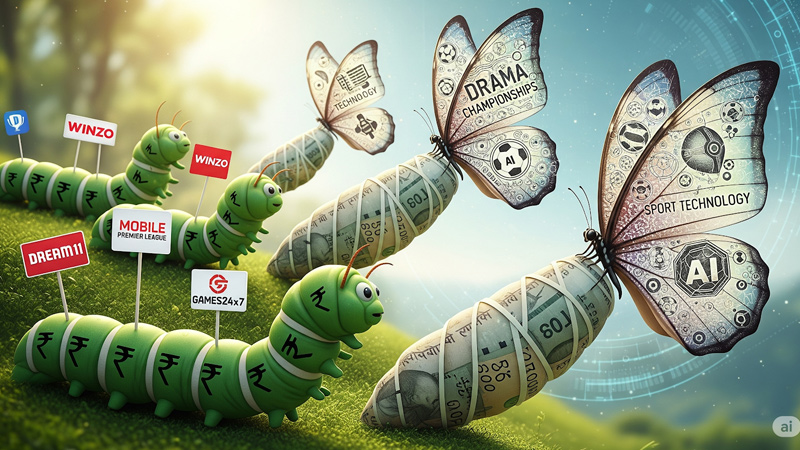
MUMBAI: For a company built on fantasy leagues, reality has suddenly rewritten the rulebook. More than 100 employees have exited Dream Sports, the parent of Dream11, after the company reorganised its operations following India’s ban on real money online gaming. The shake up came after the Promotion and Regulation of Online Gaming Act, 2025 came into force in August 2025, prohibiting games where users deposit money expecting winnings. The regulation struck at the heart of the fantasy gaming industry and dramatically affected Dream Sports’ core business, wiping out about 95 percent of its revenue and all of its profits.
In response, the Mumbai based company shifted into what chief executive officer Harsh Jain described as “startup mode”, splitting its operations into eight independent business units in December.
Around 700 employees were reassigned across these newly formed ventures based on their experience and interests. However, roughly 15 percent opted to leave the company.
A spokesperson for Dream Sports said many of those who exited were experienced professionals accustomed to running scaled businesses rather than early stage ventures.
“Since some of these employees were experienced with running high scale businesses and not startups, around 15 percent chose to leave and join other scaled companies or start ventures of their own,” the spokesperson said.
Despite the departures, the company noted that the attrition rate is only slightly higher than its earlier level of around 10 percent before the ban. Dream Sports now has close to 950 employees and is not currently hiring, choosing instead to focus on stabilising its existing workforce.
The restructuring has transformed Dream Sports from a fantasy gaming company into a broader sports entertainment platform. The eight units now operate independently, each focusing on different segments of the sports and technology ecosystem.
These include Dream11, sports streaming platform Fancode, sports travel service DreamSetGo, mobile game Dream Cricket and artificial intelligence initiative Dream Sports AI, which includes sports analytics platform Dream Play.
Other ventures include fintech product Dream Money, open source initiative Dream Horizon and the philanthropic arm Dream Sports Foundation.
As part of cost saving efforts, Dream Sports also relocated its headquarters from Bandra Kurla Complex to Worli earlier this year. The new office, called Dream Sports Stadium, brings teams from its various brands together under one roof to improve collaboration and operational efficiency.
Jain had earlier said the company removed bonus lock in timelines for employees hired in recent years, allowing those who wished to leave to exit with pro rata payouts.
“We want people who are fully into the startup mode and willing to work for it, and we will share that reward if it comes,” he said.
Founded in 2008 by Harsh Jain and Bhavit Sheth, Dream Sports was last valued at 8 billion dollars after raising 840 million dollars in 2021 from investors including Falcon Edge Capital, DST Global, D1 Capital Partners, RedBird Capital Partners, Tiger Global Management, TPG and Footpath Ventures.
The new gaming law has forced several companies in the fantasy gaming sector to either shut down or pivot their business models, signalling a significant reset for one of India’s fastest growing digital entertainment industries.