News Broadcasting
Delhi HC directs govt to respond to PIL

NEW DELHI: While the government and the industry keep grappling with the issue of CAS, a vacation bench of the Delhi High Court has asked the government to file its response by 26 December on a petition filed by consumer activist groups seeking a stay on the rollout of conditional access.
The court took up the petition filed by Consumer Co-ordination Council (CCC) and the Consumer Online Foundation today and directed that the central government, through the information and broadcasting ministry, file a response stating as to why the rollout of CAS in its present form should not be stayed.
When contacted, a ministry official told indiantelevision.com that the government would study the situation and file a response as directed by the court. The petitioners had stated that CAS in its present form is anti-consumer in Delhi and various doubtful issues persist to haunt it.
In the light of this, the rollout being implemented by the cable industry in South Delhi should be stopped.
The petitioners had also said that such a technology should be rolled out when there is a regulatory body to hear complaints from consumers as well.
The vacation bench comprised Justices V Jain and Pradeep Nandrajog. Petitioners’ counsel Rajiv Bansal argued that there was no sync between the amended and unamended provisions of the Cable TV (Network) Regulation Act, which facilitates implementation of CAS. He also contended that the portion concerned in the Act is violative of the freedom of speech and expression guaranteed to citizens of India under Article 19(1)(a) of the Constitution.
Referring to the Communication Convergence Bill introduced in the Parliament, Bansal said that once it becomes a reality and a law, the CATV Act would be subsumed in it and hence, it is almost obsolete.
The petitioners, apart from other things, had alleged that the government notification on CAS was more “coercive implementation” of set-top boxes than about consumer interest.






News Broadcasting
News18 India launches Command Centre war explainer with Arya
New show shifts from debates to decoding global conflicts and impacts
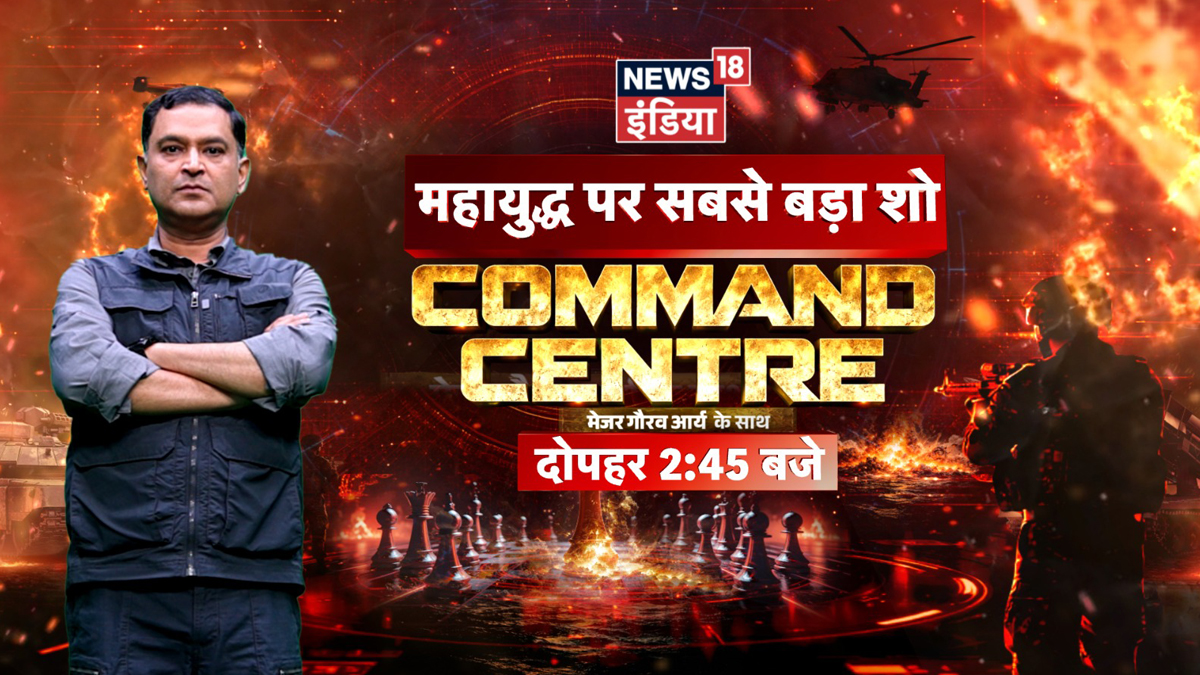
MUMBAI: News18 India has rolled out a new war-focused programme, Command Centre, featuring Gaurav Arya, as it looks to offer viewers a sharper, more grounded take on global conflicts amid rising tensions in West Asia.
Positioned as an “insider war room”, the show moves away from conventional panel debates and instead focuses on explaining military developments, decoding strategy and connecting global events to their everyday impact, from fuel prices to economic shifts.
The format leans heavily on visuals and data. The studio has been designed like a command hub, complete with large LED war maps, real-time graphics and an alert system to track developments as they unfold.

At the centre of it all is Arya, who brings his military background to simplify complex war strategies for viewers. His signature line, “Seedhi baat samjhiye”, anchors the show’s promise of clarity over noise.
News18 India managing editor Jyoti Kamal said, “Command Centre, featuring Major Gaurav Arya is designed to deliver accurate insights and a clear perspective on how evolving conflicts impact everyday life, from household budgets to national security. With expert voices analysing every development in real time, the show goes beyond headlines to decode what’s happening now, what it means, and what could come next.”
Echoing the intent, Gaurav Arya added, “In times of war, confusion is the biggest threat. With News18 India’s Command Centre, we are bringing viewers inside the war room, decoding strategies, tracking every escalation, and explaining, in the simplest terms, what it means for India and for every household. Seedhi baat samjhiye, this is where you understand not just what is happening, but what happens next.”
The weekday show will air in the afternoon slot and will also feature Gaurav Shukla, adding to its editorial depth.
With its mix of analysis, visuals and a clear focus on impact, the show reflects a broader shift in news consumption. Viewers are no longer just watching events unfold, they are looking to understand what those events mean for them.







