News Broadcasting
DD Free Dish emerged as enabler of competitiveness in M&E industry: Prasar Bharati CEO

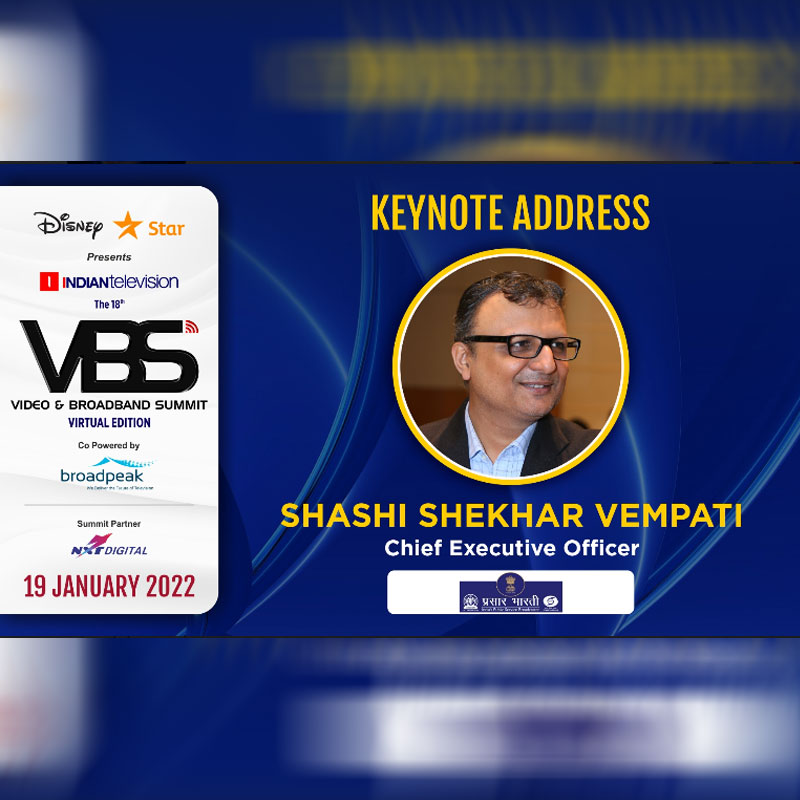
Mumbai: With a presence in over 40 million households, DD Free Dish has emerged as an enabler of competitiveness in the media and entertainment industry, said Prasar Bharati CEO Shashi Shekhar Vempati on Wednesday, highlighting the stupendous growth recorded by the platform in recent years.
Vempati delivered the keynote address at the 18th edition of the Video and Broadband Summit (VBS) organised virtually by Indiantelevision.com on Wednesday. The day-long summit was co-powered by broadpeak, with Disney Star as the presenting partner and Nxtdigital as the summit partner.
Talking about the growth of DD Free Dish, the Prasar Bharati CEO said it was present in two crore households when he joined the public broadcaster in 2017 and has since doubled its base. “It was because of the Free Dish audience that channels like Dangal and genres like Bhojpuri have come of age,” he remarked. “There have been new, upstart channels that have challenged the incumbent bigger media houses. It has created a platform for people to sample content and subscribe to whatever they want to watch.

DD Free Dish now in 40 million households
During his five-year association with the public broadcaster, Vempati shared that he has observed striking changes in the way that the TV and video viewing market has evolved. According to him, the key factors that are driving this change are regulatory interventions, the decision by the government to phase-out analog terrestrial TV and the rise of OTT and digital.
“The pandemic had a tremendous impact on the way we work,” he elaborated. When I joined the organisation, everything was paper-based but now we’ve become IT-based. The situation has forced us to think innovatively and put technology first.”
Public Broadcaster’s Digital Turnaround
Prasar Bharati’s digital growth has doubled every year with its YouTube channels clocking more than a billion views every month. The public operator which operates more than 400+ radio stations is now delivering its radio services via the News On-Air app. “While the app has several million downloads and an active listener base, it has also become a proxy for us to understand what people like to listen to on the radio,” said Vempati. “Analytics from the app gives us insights like which is the top city for online radio listening (Pune) and which streams do people prefer in every city. It also lets us know what time people are listening and which programmes they love the most.”
He added that it was astounding that India has not leveraged its strength as the biggest media market and largest English-speaking market to build a local ecosystem for technology that can support the M&E sector. “As a public broadcaster, we invest (capital spending via government grants) up to Rs 100-200 crore in technology and it is very saddening to see this infusion of funds leaving the country,” he noted.
Need for indigenous technology-development
Most of the technology requirements of the M&E industry in India are imported and royalties go to entities in other countries. “We need to build a local ecosystem of technology vendors to supply the industry with all kinds of equipment,” said Vempati. “That’s why it is important that we focus on indigenous standards development.”
For example, most of the 5G tech stack has been framed by entities in other markets. Prasar Bharati has recently signed a MoU with IIT Kanpur to develop IIndian-specific standards for 5G that allow for convergence between broadband and broadcast. This will allow for new opportunity areas such as direct-to-mobile broadcasting that will be in line with India’s unique needs to deliver content directly to mobile.
Prasar Bharati developing next generation broadcast solution
“With millions of people live streaming every event, it is going to raise the costs of the network and the pipes are going to choke. The telcos will not be able to handle so much traffic and that will lead to buffering. The way out is having the ability to offload steaming traffic to broadcast infrastructure if necessary. This benefits everyone including big OTT platforms,” he added.
Another opportunity area that Vempati sees is innovation in the supply-side economics of content. “Why is content so expensive?” he asked. “There is a need to deliver higher quality content at lower cost and India should be cost leaders in terms of creating content, seeing the enormous talent base that we have. The M&E industry in India is looking for its “Walmart moment” when it comes to bringing down the cost of content. We should find innovative means, technologies, and approaches that can bring down the cost of content.”




News Broadcasting
Network18 channels lead YouTube news viewership in March 2026
CNN-News18, News18 India and CNBC channels top categories with record views
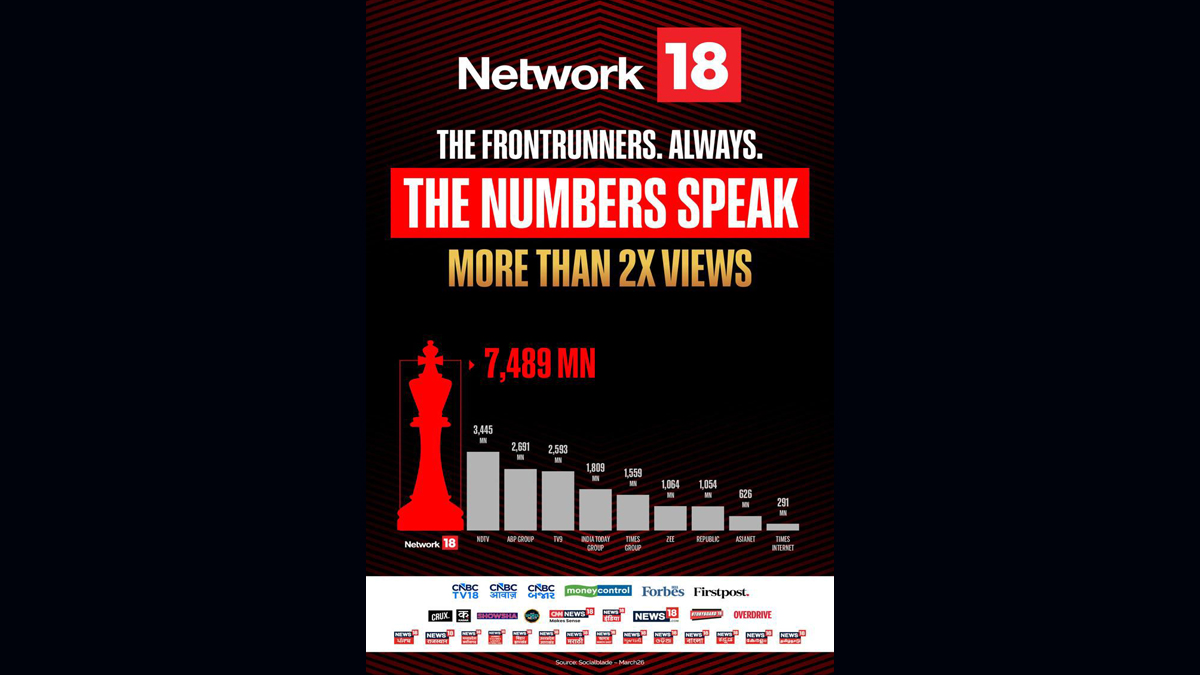
MUMBAI: When the world hit refresh on breaking news, Network18’s channels were already streaming ahead. As geopolitical tensions and war-driven headlines fuelled a surge in global news consumption, the network’s digital playbook delivered big clocking record Youtube viewership across English, Hindi and business news categories in March 2026.
At the forefront was CNN-News18, which emerged as the clear leader in the English news segment with 130 million live and video-on-demand views. The channel edged past competitors such as Times of India (126.5 million), Times Now (101.1 million), India Today (88.2 million) and NDTV (77.5 million), according to Databeings data for March.
In the Hindi news arena, News18 India delivered a commanding performance, racking up a staggering 3,297 million views on YouTube. The channel comfortably outpaced NDTV India, which recorded 3,119 million views, underlining its deep reach and consistent engagement with mass audiences, as per Playboard data.
The network’s dominance wasn’t confined to general news. In the Hindi business segment, CNBC Awaaz topped the charts with 92 million views, narrowly ahead of Zee Business (90 million) and well ahead of ET Now Swadesh (57 million). Meanwhile, its English counterpart CNBC-TV18 posted a strong 58 million views, reinforcing the network’s cross-category strength.
The spike in viewership reflects a broader shift in audience behaviour, with viewers increasingly turning to digital platforms particularly Youtube for real-time updates and in-depth coverage during high-intensity news cycles. For Network18, the numbers signal more than just scale; they underline the effectiveness of a multi-platform strategy that blends speed, credibility and continuous coverage.
In a month where the news never paused, it seems viewers chose to stay tuned where the stream never stopped.






