Applications
Dalet calls on Dalia as AI agent rewrites rules of media operations

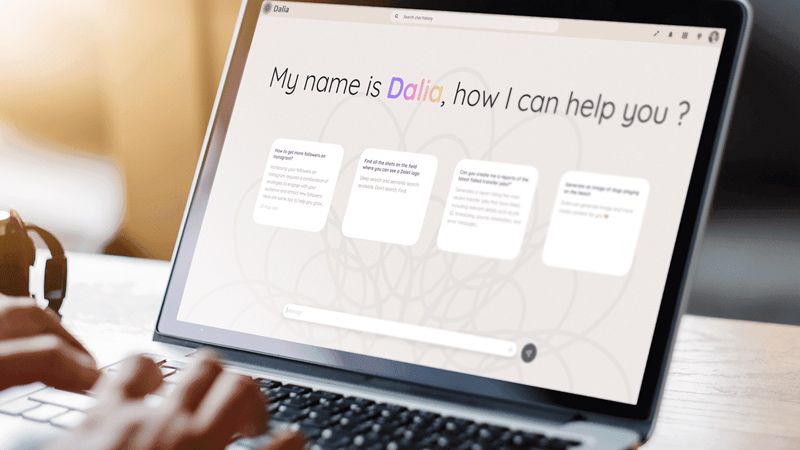
MUMBAI: In an industry where seconds can make or break a story, Dalet has decided it’s time to give newsrooms, broadcasters and content creators a smarter sidekick. Meet Dalia not just another chatbot, but the new agentic AI brain unifying the entire Dalet ecosystem.
Announced ahead of IBC 2025 (Hall 7, Stand 7.A43), Dalia sits at the heart of Dalet Flex, Pyramid, Instream, Brio and Amberfin, offering media professionals a single conversational-style interface to handle the messy sprawl of ingest, production, rights management, distribution and archiving. Think less dashboard juggling, more “just ask and it’s done.”
“From day one, we’ve pushed ourselves to deliver a truly user-centric experience,” said Dalet chief product & Technology Officer Stephen Garland. “What we’re unveiling isn’t just another tool. It’s intelligence beyond an agent, an assistant that unifies our entire ecosystem under one natural conversation.”

Unlike generic LLM chatbots, Dalia is “media aware” trained not on customer data but on Dalet’s own orchestration and media engine. That means secure, task-specific smarts: it can search, clip, transcode, package or trigger review workflows without users leaving the chat. Early trials show that complex operations once requiring multiple tools can now be executed end-to-end in a single request.
The roots of this breakthrough lie in Dalet’s in-house “Skunk Works” experiment, led by Erwan Kerfourn with Matteo De Martinis and Aaron Kroger. Operating like a startup within the company, the team moved at “breakneck speed”, turning bold ideas into a production-ready innovation without derailing day-to-day operations.
“Dalia feels less like software and more like a savvy colleague,” said Kerfourn. “It eliminates friction from workflows and gives customers new freedom to create, sell, distribute and publish faster than ever.”
The launch comes as the media sector wrestles with increasingly fragmented workflows. A recent survey found that comms and media professionals juggle an average of 11 different tools daily, with 68 per cent citing fragmentation as their biggest productivity killer. Dalet is betting that its AI-driven assistant can reclaim both time and sanity by collapsing silos into one conversational layer.
For media companies, the implications are huge: streamlined operations, faster time-to-air, and a new way of working that feels less like fighting software and more like talking to a trusted colleague.
With Dalia, Dalet isn’t just plugging AI into media, it’s inviting media to talk back.


Applications
With 57 per cent single new users, Ashley Madison rebrands as discreet dating platform
Platform says majority of new members now identify as single

INDIA: Ashley Madison is shedding the “married-dating” label that defined it for two decades, repositioning itself as a platform for discreet dating in what it calls the post-social media age.
The rebrand, unveiled in India on 27 February, 2026, marks a structural shift in business model and identity. Once synonymous with married dating, the company now describes itself as the “premier destination for discreet dating” under a new tagline: Where Desire Meets Discretion.
The pivot is data-driven. Internal figures show that 57 per cent of global sign-ups between 1 January and 31 December, 2025 identified as single: a notable departure from the platform’s married core. The company argues that its community has already evolved beyond its original positioning.
“In an age where our lives have been constantly put on public display, privacy has become the new luxury,” said Ashley Madison chief strategy officer Paul Keable. He framed the platform’s offering as “ethical discretion” for singles, separated, divorced and non-monogamous users seeking private connections.
The shift also taps into wider digital fatigue. A global survey conducted by YouGov for Ashley Madison, covering 13,071 adults across Australia, Brazil, Canada, Germany, India, Italy, Mexico, Spain, Switzerland, the UK and the US, found mounting discomfort with hyper-public online lives.
Among dating app users, 30 per cent cited constant swiping and messaging as a source of fatigue, while 24 per cent pointed to pressure to curate public-facing profiles and early personal disclosure. Some 27 per cent said fears of screenshots or information being shared contributed to exhaustion; an equal share cited unwanted attention.
The retreat from oversharing appears broader. According to the survey, 46 per cent of adults actively try to keep most aspects of their life private online. Only 8 per cent feel comfortable sharing most aspects publicly, while 35 per cent say they are becoming more selective about what they disclose.
Ashley Madison is betting that this cultural recalibration towards controlled visibility can be monetised. By doubling down on privacy infrastructure and reframing itself around discretion rather than infidelity, the company is attempting to convert reputational baggage into a premium proposition.







