Hindi
Cut to the craft as Hirani and Joshi reveal how films truly take shape

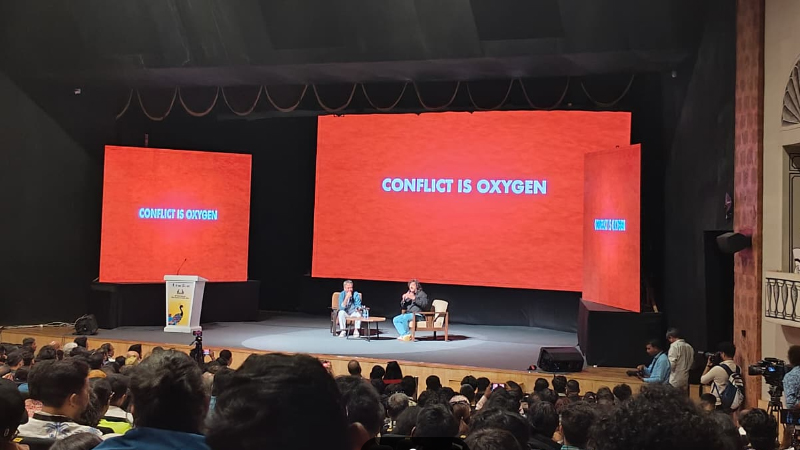
MUMBAI: Goa may be known for sunsets and susegad, but at the 56th International Film Festival of India (IFFI), the brightest moment arrived not from a red-carpet premiere but from a classroom. Filmmaker Rajkumar Hirani and screenwriter-director Abhijat Joshi took the stage for a masterclass titled Film is Made on Two Tables, and for two hours, the auditorium morphed into a crash course on storytelling, rhythm and the secret life of cinema. No drama, no theatrics, just two craftsmen unpacking decades of craft with the clarity of a lens pointed at truth.
Hirani opened with a deceptively simple hammer-blow: “A film begins only when a character wants something. If there is no want, the audience also doesn’t want it.” In his world, a story is not about plot but propulsion. Munna Bhai wants to become a doctor. PK wants to go home. Rancho wants real education. Virus wants to always be right. Chatur wants to win at any cost. These wants aren’t decorative; they collide like tectonic plates, creating the earthquakes that make stories breathe.
Joshi followed with what became the philosophical spine of the masterclass: “Conflict is oxygen.” In life, conflict is inconvenient. In cinema, it’s nourishment. And the conflicts that truly burn, he said, aren’t good versus evil, they’re clashing truths. He recalled Javed Akhtar explaining why Deewaar has such ferocious tension: every argument is unimpeachable, and the opposing argument is just as strong. “That argument exists somewhere in the universe,” Akhtar had said. “We just have to find it.”

From there, Hirani introduced the session’s core metaphor, the two tables where films are truly made. The first is the writing table, where worlds are conceived, character arcs sharpened and emotional engines built. The second is the editing table, where the film acquires rhythm, balance and breath. Writing is the birth. Editing is the heartbeat.
For Hirani, editing is practically spiritual. “Editing is like meditation for me,” he said, not surprising from a man who famously edits for hours, oblivious to clocks. Joshi, who has worked with the legendary Walter Murch, went further: “He is the greatest editor in the history of cinema.” A statement that earned a wave of applause, partly for its sincerity and partly for how plainly it explained the coherence of the Hirani–Joshi universe.
One of the sharpest sections of the session focused on exposition, the graveyard where many scripts go to die. Joshi unpacked the Billy Wilder rule: exposition should feel like the whistle of a pressure cooker tension first, information later. Hirani illustrated it with the opening of 3 Idiots. In the first draft, Farhan simply got a phone call. Functional but flat. Shifting the scene to an aeroplane instantly transformed it into a moment of panic, urgency and hilarity revealing how much Rancho means to Farhan without spelling anything out.
Then came a masterclass in turning exposition into theatre. Hirani explained the scene in Lage Raho Munna Bhai where Munna discovers Gandhiji is a hallucination. This could have been a dull psychological reveal. Instead, they added a countdown: “I’ll prove in 60 seconds that you’re hallucinating.” The audience leans in, the truth detonates, and exposition becomes revelation.
Theme, Joshi stressed, is the soul of a film. “The moment you find your theme, the film gains its soul.” He explained how Munna Bhai MBBS is fundamentally about compassion in healthcare, 3 Idiots about chasing excellence, and PK about questioning faith. To illustrate how theme can change a filmmaker’s life, he shared a deeply emotional memory: two decades ago, he sent Hirani an early scene that didn’t work. Hirani was kind but unimpressed. The second scene Joshi sent, rooted in a story about a French freedom fighter shouting “Bullets cannot kill ideas!”, moved Hirani so much that he called Joshi in Ohio, a call Joshi described as “the most important moment of my life.”
The duo also revealed how deeply their writing draws from real-life anecdotes that linger in memory. An electric shock device installed in an Ahmedabad neighbourhood to prevent public urination became a memorable gag in 3 Idiots. A woman scratching her back with a rolling pin while making rotis inspired the unforgettable black-and-white comedy sequence. A line overheard by Salim Khan, “If I had a match, I’d burn the world” became Jackie Shroff’s introduction in one of his films. For Hirani and Joshi, if a story stays in memory for 30 years, it deserves to be in a film.
Then came the sequence that had editors in the room grinning, the making of Pal Pal in PK. The song was never shot. Not even storyboarded. Hirani assembled it entirely from unused footage, filmed Vidya Balan’s lip-sync in two hours, and stitched together a full-length song in the editing room. It was, as Joshi put it, “a miracle unfolding before my eyes.”
Hirani also revealed how the song Bande Mein Tha Dum in Lage Raho Munna Bhai became the spiritual glue of the film. Because Gandhiji could not appear in every scene, the song became his presence, a thematic ghost haunting the narrative. This was an editing-room decision, not a writing-room one. Proof, again, that the second table is where the film truly matures.
Despite all the craft talk, the masterclass often drifted into tenderness. Joshi spoke about the generosity behind their collaboration. Hirani spoke about their hunger to improve drafts. Both spoke about criticism as a gift. “If someone points out a flaw and we agree, that’s gold. We get greedy for that,” Hirani said, a rare humility in an industry that often resists rewrites.
By the time the session wrapped, the audience had witnessed something rare: not just lessons in writing and editing, but a window into two minds who believe cinema is not made on set, but in the spaces where ideas are shaped and reshaped between the writing table and the editing table. Everything else, cameras, chaos, glamour is only the world in motion. The film, the real film, is created in the quiet hum of these two desks.



Hindi
Zee5 and Applause Entertainment team up for whodunnit ‘Everybody Loves Sohrab Handa’
Rajat Kapoor directs star-studded murder mystery streaming from 10 April.
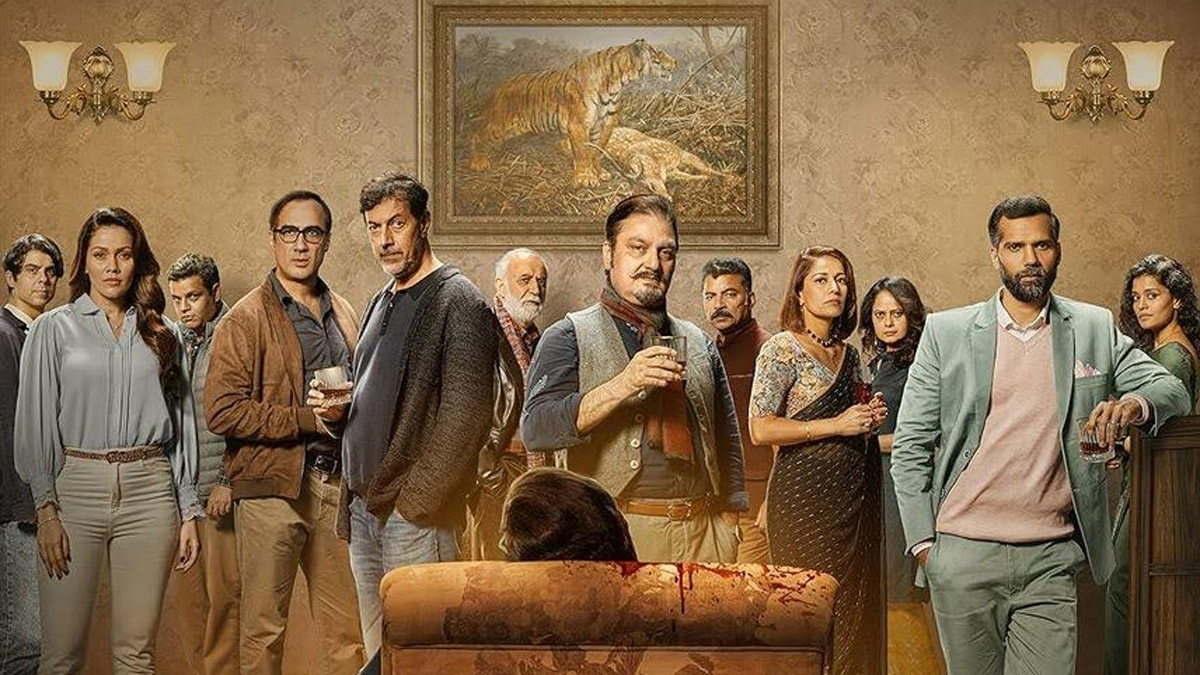
MUMBAI: Zee5 is serving up another killer collaboration and this time, the murder mystery comes with a generous side of dark humour and family dysfunction. The streaming platform has partnered with Applause Entertainment and Mithya Talkies to bring Everybody Loves Sohrab Handa, a fresh, twisted whodunnit written and directed by acclaimed filmmaker and actor Rajat Kapoor. The film will stream exclusively on Hindi Zee5 from 10 April.
The movie reimagines the classic murder mystery genre with a contemporary, darkly comic edge. It revolves around a group of friends and family who smile, drink, and celebrate together until the silence snaps and long-buried secrets spill out. The stellar ensemble cast includes Vinay Pathak, Ranvir Shorey, Waluscha De Sousa, Saurabh Shukla, Chandrachoor Rai, Neil Bhoopalam, Koel Purie, Palomi Ghosh, and Rajat Kapoor himself.
This latest offering continues the successful partnership between Zee5 and Applause Entertainment, which has previously delivered diverse hits such as Mithya, Bloody Brothers, and Jab Khuli Kitaab.
&TV Business Head of hindi Zee5 and chief channel officer Kaveri Das said, “Our collaboration with Applause Entertainment has consistently delivered distinct, high-impact storytelling. Everybody Loves Sohrab Handa is a natural progression, reinforcing our focus on genre-led content with a compelling whodunnit premise and a strong ensemble cast.”
Applause Entertainment business head for movies Sunil Chainani added, “This film adds yet another compelling layer to our slate with Rajat Kapoor’s unmistakable voice.”
Rajat Kapoor shared, “What interested me was not just the mechanics of a whodunnit, but the emotional violence that precedes physical violence. These are people who smile at each other, but there’s so much that is not said.”
The film promises razor-sharp writing, layered performances, and simmering tension, inviting viewers not just to solve the crime but to unravel the complex relationships at its heart.
If you love a good murder mystery served with wit and emotional depth, Everybody Loves Sohrab Handa looks set to be your next addictive watch. Mark your calendars, the whodunnit drops on Hindi Zee5 from 10 April.






