Hindi
Critic in the Mix experts unpack clicks clout and cinema’s changing compass

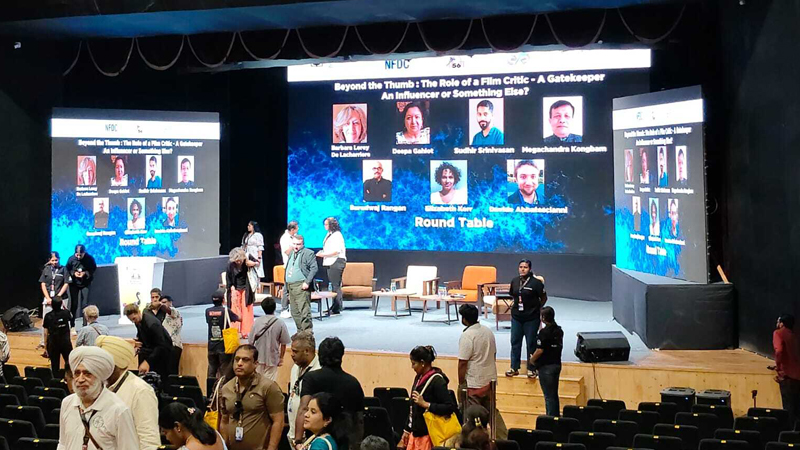
MUMBAI: If film criticism ever needed a reality check, Goa delivered one with the force of a director’s clapboard. At the 56th International Film Festival of India, a masterclass titled Beyond the Thumb – The Role of a Film Critic: A Gate Keeper, An Influencer or Something Else? turned into a sharp, spirited dissection of what it means to judge films in an era where everyone with a phone camera believes they’ve earned the right to declare something “the best ever” or “WTF”.
The session brought together Barbara Lorey de Lacharrière, Deepa Gahlot, Meghachandra Kongbam, Elizabeth Kerr, Baradwaj Rangan and Sudhir Srinivasan, with Davide Abbatescianni moderating, a line-up that offered more nuance than any star-rating system can handle.
Meghachandra Kongbam began by stressing the need to build appreciation, not noise. “Everyone is a critic now,” he noted, observing how unfiltered commentary often masquerades as informed judgement. He argued that workshops and education must become central to Indian film discourse because without understanding the language of cinema, the loudest voices risk drowning out the most meaningful ones.

From there, Baradwaj Rangan set the conversation ablaze with a subject few critics willingly tackle branding. In India, he said, employability often depends on the voice you’ve built and the trust you’ve earned. Like television anchors who draw followings not just for news, but personality, critics too accrue an identity over time. And that need not be a dirty word. “If your voice remains consistent,” he said, “and your criticism honest, the brand that forms around you is simply a by-product not a compromise.”
Sudhir Srinivasan agreed, arguing that identity isn’t vanity; it’s circulation. “Big organisations have machinery,” he said. “Individuals only have their voice.” And with that voice, he added, comes the responsibility of provoking thought rather than smothering it. For him, the ideal critic unsettles complacency not by imposing taste, but by sparking a dialogue in the reader’s mind.
When the conversation shifted to the generational churn in film criticism, Rangan was blunt: the fundamentals haven’t changed. Most serious critics still assess the same thing whether the film achieves what it sets out to do. But the content ecosystem around them has mutated wildly. Sensationalist thumbnails, exaggerated titles, and hyperbolic instant reactions have replaced measured reflection. “Everything is hysteria,” he said, adding that younger audiences often engage not with the review itself but with their own imagined version of it. The space for disagreement has shrunk; the appetite for argument has grown.
Elizabeth Kerr took the baton with humour and clarity. Transparency, she argued, is the critic’s North Star. Not objectivity because that does not exist but openness about one’s own perspective. To her, the most valuable review is one that reveals not just what the critic sees in the film, but where the critic stands while seeing it. Whether it is a queer romance from Hong Kong or a village drama from India, the critic’s task is not to mirror identity but to understand universality. “You don’t have to be those characters,” she said. “You just have to be open enough for the film to speak to you.”
Deepa Gahlot echoed this, adding that every film good or bad contains something worth noticing. The artistry of even a flawed work deserves acknowledgement. The role of the critic, she insisted, is not to moralise, nor to decide whether a film should exist, nor to judge its “usefulness”. Instead, it is to examine how well it expresses what it intends to. Violence, for instance, cannot be condemned in a vacuum; in Kill Bill, inventiveness is the point. The critic’s job is to evaluate craftsmanship, not to act as a cultural gatekeeper guarding society’s moral code.
Srinivasan returned to this theme with a warning against monocular criticism, especially criticism shaped solely through ideological lenses. He noted that films are increasingly being dismissed for a single “wrong” element, while their technical, emotional, or structural achievements are ignored. Specialists who write from feminist, caste, political or sociological perspectives play a vital role, he clarified but when such lenses dominate all discourse, they risk reducing cinema to a single checkbox.
Rangan, drawing from years of navigating audiences who demand a yes/no verdict, emphasised what he calls “subjective objectivity,” the attempt to root one’s personal taste within a rational framework. Ultimately, he said, readers must find their tribe: critics who watch films the way they do, who share their cinematic instincts. “This is a subjective profession,” he reminded. “Find the voices that resonate with your view of cinema.”
Barbara Lorey de Lacharrière’s reflections offered a gentle counterpoint. Critics, she said, are not arbiters but interpreters conduits between filmmaker and audience. What matters is sincerity: the filmmaker’s sincerity in telling a story, and the critic’s sincerity in receiving and reflecting it. A critic may dislike a film, she reminded the room, but they must always try to understand the desire that created it.
The masterclass closed the way great conversations do not with answers, but with apertures. No one, it turned out, believed in the old labels anymore. The critic is not a gatekeeper, not merely an influencer, and certainly not a subscriber-counting entertainer. Instead, as the panel collectively shaped it, the critic is a thinker, a translator, an irritant, a companion, a challenger, and sometimes, simply, a mirror held up to the cinema and its moment.
In an age where the loudest thumb rules the algorithm, this reminder felt like a breath of fresh air: criticism is not about noise, but nuance. And nuance, as Goa discovered, still has an audience.





Hindi
ZEE5, Applause announce new film Everybody Loves Sohrab Handa
Rajat Kapoor’s dark comedy thriller to stream on ZEE5 from April 10
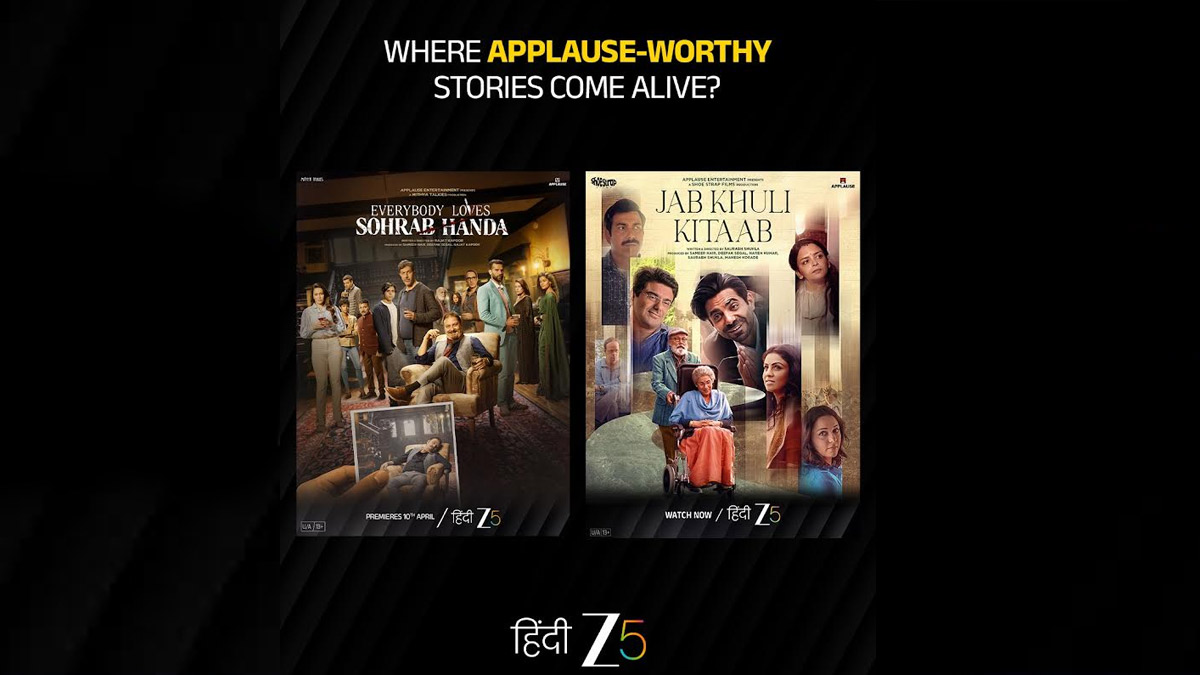
MUMBAI: ZEE5 and Applause Entertainment have announced their next direct-to-digital collaboration, Everybody Loves Sohrab Handa, a darkly comic whodunnit set to stream from April 10.
Produced in association with Mithya Talkies and written and directed by Rajat Kapoor, the film marks the latest addition to a growing slate of genre-diverse titles from the two partners. Their previous collaborations include dramas, psychological thrillers and dark comedies, with this outing leaning into a layered murder mystery.
The film features an ensemble cast including Vinay Pathak, Ranvir Shorey, Waluscha De Sousa and Saurabh Shukla, among others. The narrative promises a mix of satire, strained relationships and hidden tensions, inviting viewers to look beyond the crime to the dynamics that lead up to it.
ZEE5 business head hindi and chief channel officer Andtv Kaveri Das said, “Our collaboration with Applause Entertainment has been instrumental in building a strong slate with titles such as Bloody Brothers, Mithya and Jab Khuli Kitaab. Everybody Loves Sohrab Handa is a natural progression, aligning with our focus on genre-led content that resonates with audiences.”
Applause Entertainment business head movies Sunil Chainani said, “This collaboration with ZEE5 continues to stand out for its diversity of genres and narrative styles. Everybody Loves Sohrab Handa adds a sharp, darkly comic whodunnit to that mix, driven by Rajat Kapoor’s distinct voice.”
Sharing his creative approach, Rajat Kapoor said he was drawn to the emotional layers behind the genre. “I was interested not just in the mechanics of a whodunnit, but the emotional violence that precedes physical violence. These are people who appear close, yet carry unspoken tensions that eventually surface.”
The partnership between ZEE5 and Applause continues to build on a shared focus on distinctive storytelling, with each project exploring a different tone and genre.
With its mix of humour, tension and ensemble storytelling, the film aims to offer more than just a mystery. It promises a closer look at the secrets people keep, and the consequences when they finally come to light.






