News Broadcasting
Crisil risk evaluation service – important milestone


MUMBAI: Crisil risk evaluation for the Indian entertainment industry, a pioneering initiative undertaken by CII (Confederation of Indian Industry) would play a catalytic role in channelising institutional funding to the entertainment industry. Crisil evolved a framework for analysing film and television software producers.
The following is the transcript of the foreword written by Crisil CEO and MD R Ravimohan and CII Entertainment committee chairman (Western region) Biren Ghose to coincide with the launch of the Crisil service.
The Indian entertainment industry has been growing over the years and has attained prominence with the emergence of new technologies and delivery channels. The Indian film industry, which continues to dominate the domestic entertainment industry, is one of the largest and amongst the most vibrant film industries in the world producing over 850 films annually.

In terms of revenues, however, it represents a small fraction of developed markets such as the USA, where theatre ticket sales in 2002 were estimated at about $9 billion.
Nevertheless, with new creative talent and growing global aspirations, Indian films have started making their presence felt on the international stage. In the last few years, two important milestones have set the stage for the corporatisation of the Indian film industry.
In May 1998, the Ministry of Information and Broadcasting accorded “industry status” to the film industry and in October 2000, the ministry of finance announced that the entertainment industry would henceforth be recognised as an approved activity under “industrial concerns” as per the Industrial Development Bank of India Act, 1964.
With the changing environment, the Indian film industry is also undergoing a metamorphosis. Apart from corporatisation, some of the recent trends in the industry include access to institutional funding and the institution of risk mitigants such as insurance covers. But such efforts are few and far between.
It is estimated that currently, annual film production costs in India are in the region of Rs 25 billion and these have been growing at 15 per cent a year.
While the Industrial Development Bank of India (IDBI) started financing films in April 2001 and the Reserve Bank of India (RBI) also issued broad guidelines to commercial banks regarding bank finance for film production in May 2001, the total institutional funding to the Indian film industry is still estimated to be only around Rs 1 billion.
Given its size, growth, diversity and current funding practices, the industry offers huge lending potential for banks and institutions. But it is still hampered by issues such as the lack of transparency, piracy and high dependence on informal sources of funding.
Also, given the fragmented and unorganized nature of the industry as well as the lack of authentic data, risk assessment remains an onerous task. Hence, if the sector’s lending potential is to be tapped, appropriate risk assessment tools and risk mitigants need to be instituted to effectively manage the risks of lending to this sector.
Against this backdrop, the Confederation of Indian Industry (CII) has been actively working with the corporate, legal and government sectors to strengthen the entertainment industry. As part of this initiative, Crisil has evolved a framework for analysing film and television software producers. This analytical framework comprehensively assesses all the risks pertinent to these two segments.
Crisil believes that an objective and independent opinion on the risks involved would help both lenders and producers. Lenders, comprising banks, financial institutions and intermediaries, could avail of Crisil’s service in pricing their products and determining their exposure levels to entities in the entertainment industry.
As for producers, they have hitherto been borrowing funds at exorbitant interest rates from the informal market and this service would act as a key facilitator in accessing institutional funds. Both Crisil and CII believe that Crisil’s risk evaluation service would play a pioneering and catalytic role in channelising institutional funding to the entertainment industry.
Thus, Crisil’s risk evaluation service could well become the third important milestone in the entertainment industry’s evolution into a transparent and mature sector.







News Broadcasting
UDF poised to return to power in Kerala, says Manorama-CVoter survey
Massive opinion poll projects shift in Kerala politics ahead of 2026 Assembly elections.
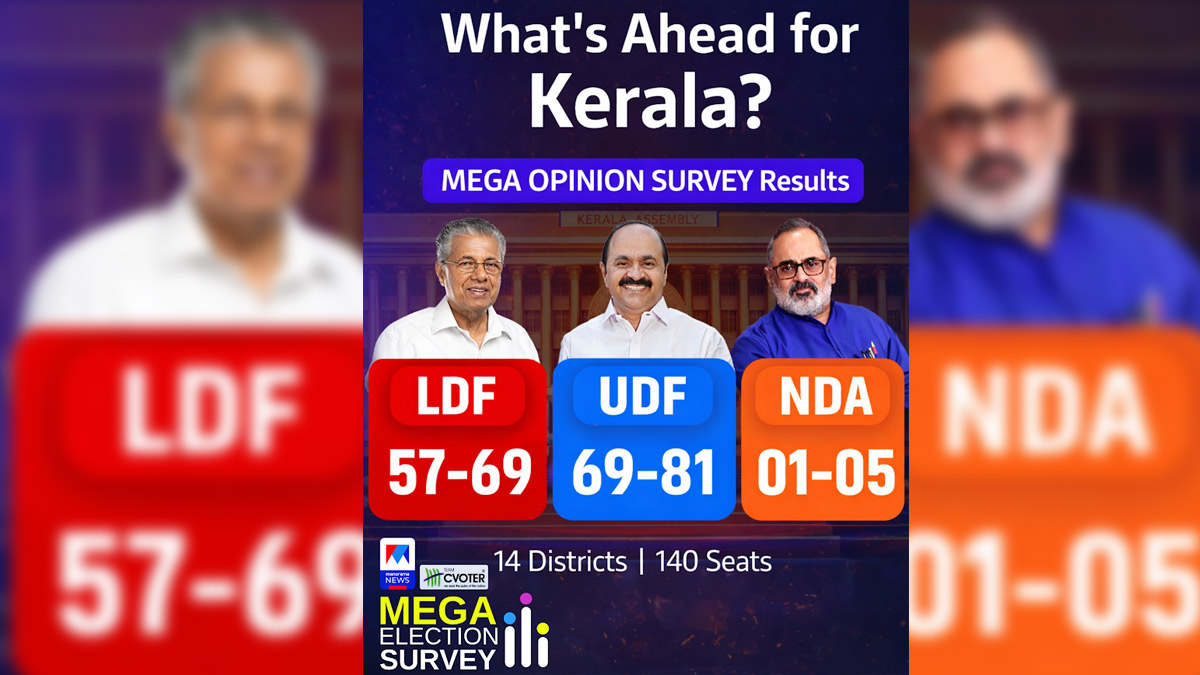
MUMBAI: The winds of change appear to be blowing through Kerala’s political landscape and this time, they seem to favour the United Democratic Front. A comprehensive mega opinion survey conducted by Manorama News in partnership with CVoter projects a potential comeback for the UDF in the upcoming Kerala Legislative Assembly Elections 2026. The survey, covering all 140 constituencies with a massive sample size of nearly 90,000 respondents, predicts the UDF could win between 69 and 81 seats.
The ruling Left Democratic Front (LDF) is expected to secure 57 to 69 seats, a significant drop from the 99 seats it won in the 2021 elections. This would mean the LDF losing 30 to 42 of its sitting seats. Meanwhile, the National Democratic Alliance (NDA), which drew a blank in 2021, is projected to open its account with 1 to 5 seats.
Region-wise, the UDF is expected to make strong gains in Malabar, winning 25 to 34 out of 48 seats, and in Central Kerala, where it could bag 29 to 33 out of 53 seats. In South Kerala, the LDF is likely to retain an edge with 21 to 25 seats, while the UDF may improve to 12 to 16 seats. The NDA could pick up 1 to 3 seats in the southern region.
The survey was conducted between 14 and 26 March 2026, with additional tracker and snap polls carried out from December 2025 to March 2026. A total of 89,693 respondents participated, ensuring representation across all demographics and social segments.
Manorama News has a strong track record of accuracy, with its previous projections closely matching the actual results of the 2019 and 2024 Lok Sabha elections as well as the 2021 Kerala Assembly polls.
In Kerala’s famously fierce political battles, this survey suggests the pendulum may be swinging back. Whether the final verdict matches these numbers or throws up another surprise, one thing is clear, the 2026 Assembly elections are shaping up to be one of the most keenly watched contests in the state’s history.






