News Broadcasting
‘Creative Futures’ to produce future editorial blue print for BBC

MUMBAI: BBC DG Mark Thompson has launched an extensive cross-media, audience-focussed project Creative Futures. This will produce an editorial blueprint for BBC programmes, content and services during the next Charter period.
The Creative Futures project will look at current and emerging audience needs, market trends and the potential of new technology. The aim is to shape strategies in six genres: journalism, drama, knowledge building, comedy, music and children and teens. Recent strategic work carried out in the sport and entertainment genres will feed into the project so that all editorial genres will be represented, as will thinking on what kind of guides, gateways and navigation the BBC may need to offer its audiences in the future.
Thompson said, “This project is designed to turn the purposes and objectives we set out in building public value and the challenges now laid out in the Green Paper into an inspiring editorial strategy. I want the team to come up with specific proposals to ensure that we are ready for the next chapter in the BBC’s history. We need to meet – and exceed – audiences’ rapidly changing expectations, make difficult choices and take calculated risks, while maintaining our commitment to excellence and innovation.”
Thompson will be sponsoring the project personally with the BBC’s Creative Director Alan Yentob. A report will go to the organisation’s creative board in December. Yentob said, “We want a wide-ranging, challenging debate and discussion that will yield ideas which bring the BBC’s purposes to life in a way audiences value and engage with. The conversation will embrace our staff, our audiences, talent inside and outside the BBC and the independent production sector.”

The initiative will be led by Susan Spindler and Richard Halton. Spindler has been a senior Science and Drama executive and was launch director of the BBC’s Making it Happen culture change project. She also becomes deputy director of the Drama, Entertainment and Children’s division. Halton is BBC Television’s controller of strategy and played a major role in developing the BBC’s digital TV portfolio and interactive strategy. BBC deputy DG Mark Byford will head the journalism genre team.






News Broadcasting
Network18 channels lead YouTube news viewership in March 2026
CNN-News18, News18 India and CNBC channels top categories with record views
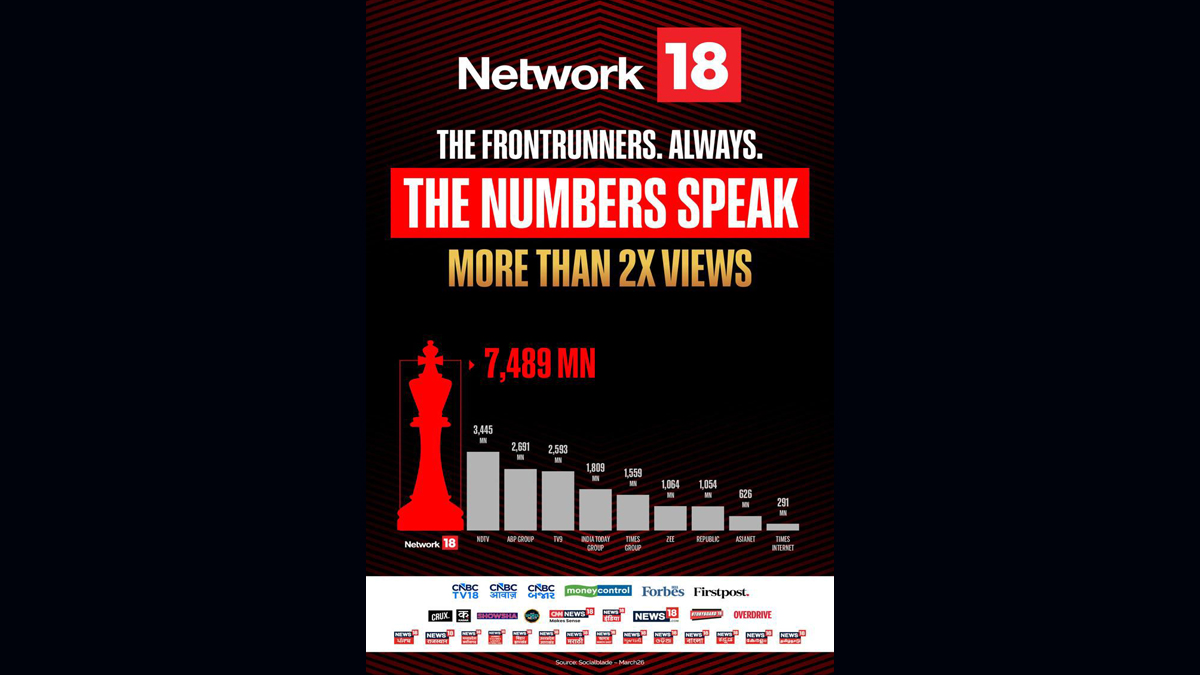
MUMBAI: When the world hit refresh on breaking news, Network18’s channels were already streaming ahead. As geopolitical tensions and war-driven headlines fuelled a surge in global news consumption, the network’s digital playbook delivered big clocking record Youtube viewership across English, Hindi and business news categories in March 2026.
At the forefront was CNN-News18, which emerged as the clear leader in the English news segment with 130 million live and video-on-demand views. The channel edged past competitors such as Times of India (126.5 million), Times Now (101.1 million), India Today (88.2 million) and NDTV (77.5 million), according to Databeings data for March.
In the Hindi news arena, News18 India delivered a commanding performance, racking up a staggering 3,297 million views on YouTube. The channel comfortably outpaced NDTV India, which recorded 3,119 million views, underlining its deep reach and consistent engagement with mass audiences, as per Playboard data.
The network’s dominance wasn’t confined to general news. In the Hindi business segment, CNBC Awaaz topped the charts with 92 million views, narrowly ahead of Zee Business (90 million) and well ahead of ET Now Swadesh (57 million). Meanwhile, its English counterpart CNBC-TV18 posted a strong 58 million views, reinforcing the network’s cross-category strength.
The spike in viewership reflects a broader shift in audience behaviour, with viewers increasingly turning to digital platforms particularly Youtube for real-time updates and in-depth coverage during high-intensity news cycles. For Network18, the numbers signal more than just scale; they underline the effectiveness of a multi-platform strategy that blends speed, credibility and continuous coverage.
In a month where the news never paused, it seems viewers chose to stay tuned where the stream never stopped.






