News Broadcasting
Consumer groups say CAS still not consumer friendly


NEW DELHI: Consumer Coordination Council to information and broadcasting ministry: the conditional access system (CAS) is still not consumer friendly and should be implemented only after key consumer issues are addressed and a regulatory mechanism is in place.
The Consumer Coordination Council (CCC), an umbrella organisation of about 50 consumer groups, still has a hope that the government would put in a regulatory authority in place before CAS is implemented.
A high-level delegation led by CCC vice-chairman Bejon Misra met the information and broadcasting minister Ravi Shankar Prasad yesterday to convey that despite his public assurances and the recent notifications, the proposed implementation of CAS is still not consumer friendly.

The delegation consisted of representatives from Consumer Forum Voluntary organisation in the Interest of Consumer Education (VOICE), Indian Federation Of Consumer Organisations (IFCO) along with CCC director S Krishnan.
“CAS should be implemented only after all the key consumer issues are addressed and a regulatory mechanism is in place,” quoted Bejon Misra in an official statement to the minister.
He also informed Prasad that if these issues were not sorted out before 14 July 2003, the member organisations of CCC would be left with no option but to consider direct action such as Public Interest Litigation (PIL).
Misra, along with the delegates of various consumer organisations, told the minister that the consumer is the worst hit in the current form of CAS regulation. According to CCC, the consumers will have to invest a lot of money, pay more by way of monthly fees, but receive lesser channels without an option to choose either free-to-air (FTA), or pay channels. He would also not be able to choose the cable operator; there would be no service quality assurance and no redressal system in place in case of consumer complaints either.
CCC has been claiming to network within its member organisations in the four metros on the issue of CAS. It aims to protect the interests of millions of cable television consumers especially the poor residents in slum areas, the middle & lower income group colonies and save billions of rupees that would be wasted through thoughtless implementation of CAS as proposed by the I&B ministry. In its statement, CCC has said that though the government has stated that CAS is being introduced to protect consumer interest, the fact seems to be otherwise.
The consumer organisations wanted to know from the minister why the issue of under- declaration of subscribers by cable operators should result in consumers having to pay more for seeing less. They felt that consumers were being made scapegoats in the process.
Representatives of consumer organisations also asked the I&B Minister to resolve several other key issues before hasty implementation of the anti-consumer CAS legislation.
The statement stated: “The right of a consumer to choose as regards FTA channels and the government has failed to specify in the notification the FTA channels that can be shown in the four Metros. It has notified only three DD channels as “must carry channels” and the choice of any 27 other channels is left to the cable operators. The position will be no different even if the number of FTA channels is increased.”
CCC has pointed out that even after investing anywhere between Rs 3,000 to Rs 10,000 for the set-top-box, the consumer will still have no choice to ‘ask and pay’ for the pay channels he wishes to view. He will have to choose among the channels ‘provided’ by the monopoly cable operator and the MSO in his area
“The broadcaster will be offering bouquets, which means a consumer will pay more for viewing the channels of his choice out of a bouquet of channels. Again such a policy is opposed to the basic reason for calling in this amendment,” CCC has said, adding, “Why has government failed to address the issue of cable monopolies?”
The key issue faced by the consumers today is the issue of choice of cable operator. The consumer has absolutely no choice to choose the cable operator and is forced to take the service from a single cable operator operating in their respective areas, says CCC.
In the CATV Act 2002, the government has stated that one of the objectives of the amendments is to address the issue of ‘area-specific monopolistic distribution system’. However, it has failed completely to address this key issue facing the consumers. Instead of making more than one cable operator available in each area, by cracking down on the cable operators’ monopolies, the policy if implied will kill all the cable operators and create huge MSO monopoly, argues CCC.
Pointing out that the government has not protected the consumers’ interests by specifying the service quality parameters, the CCC has said that most consumer complaints against the cable operators today are relating to the poor quality of service provided. The government has failed to provide any service quality parameters to assure a certain basic standard quality of service to the consumer.
Now, with the purchase or rental of STBs, this aspect has emerged most critical because the consumers have to be assured of the quality of the STBs and its performance criteria. The question is: are these imported boxes brand new, second hand or refurbished? “Who will determine the component of import duty, rental fees or purchase price?” the CCC has asked, though seemingly slightly out of tune as lot of these issues as of today have been clarified.
Though in a recent interview to indiantelevision.com, Prasad has ruled out an immediate introduction of a regulatory authority, CCC delegation stressed on the need for setting up such an authority before the CAS system is implemented.
The minister, in turn, reiterated to the CCC delegation what he had told indiantelevision.com that he was in favour of a regulatory authority, but that will be considered as part of the Convergence Bill.
However, when the members of the delegation stressed the importance of the regulatory mechanism being in position before the scheme is implemented, the minister, according to the CCC statement, assured that he had an open mind on the issue and would not be averse to it. He also welcomed concrete suggestions in this regard.
Responding to the points made by the delegation, the minister assured that every effort was being made to make the system consumer friendly and transparent and that most of the important ticklish issues put forth by the CCC would be sorted out well before 14 July.
Referring to another aspect, Prasad invited suggestions from consumer groups on various safeguards to be provided for ensuring proper warranty, repair and maintenance of STBs.





News Broadcasting
News18 India launches Command Centre war explainer with Arya
New show shifts from debates to decoding global conflicts and impacts
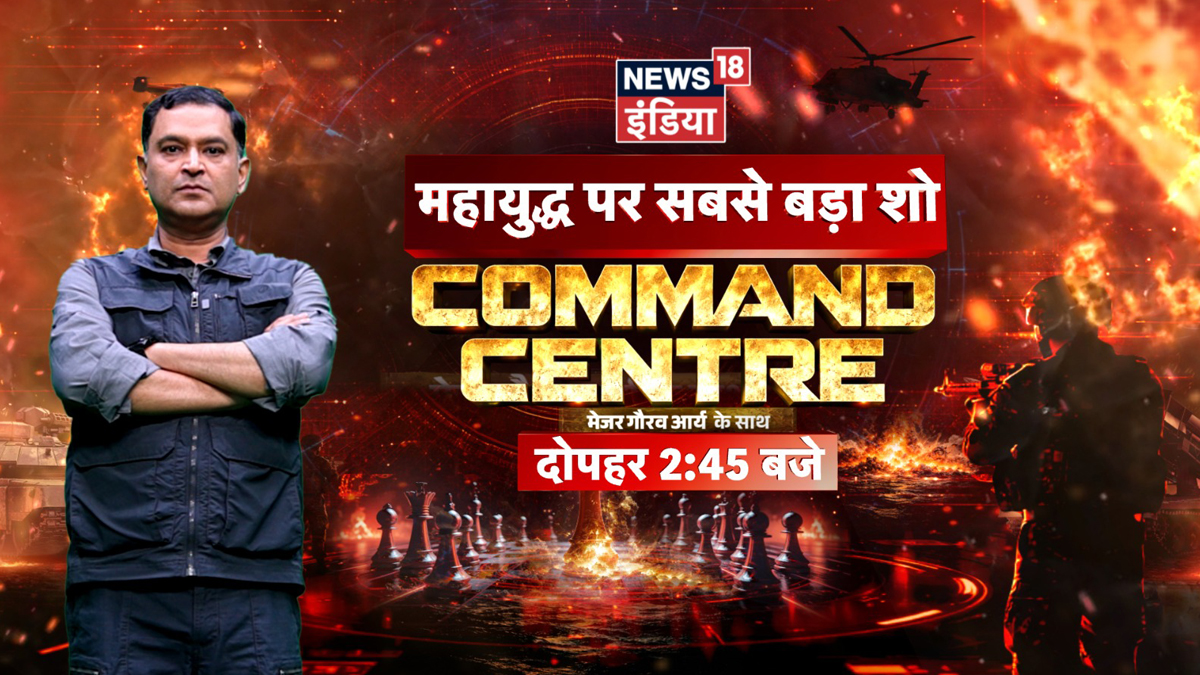
MUMBAI: News18 India has rolled out a new war-focused programme, Command Centre, featuring Gaurav Arya, as it looks to offer viewers a sharper, more grounded take on global conflicts amid rising tensions in West Asia.
Positioned as an “insider war room”, the show moves away from conventional panel debates and instead focuses on explaining military developments, decoding strategy and connecting global events to their everyday impact, from fuel prices to economic shifts.
The format leans heavily on visuals and data. The studio has been designed like a command hub, complete with large LED war maps, real-time graphics and an alert system to track developments as they unfold.
At the centre of it all is Arya, who brings his military background to simplify complex war strategies for viewers. His signature line, “Seedhi baat samjhiye”, anchors the show’s promise of clarity over noise.
News18 India managing editor Jyoti Kamal said, “Command Centre, featuring Major Gaurav Arya is designed to deliver accurate insights and a clear perspective on how evolving conflicts impact everyday life, from household budgets to national security. With expert voices analysing every development in real time, the show goes beyond headlines to decode what’s happening now, what it means, and what could come next.”
Echoing the intent, Gaurav Arya added, “In times of war, confusion is the biggest threat. With News18 India’s Command Centre, we are bringing viewers inside the war room, decoding strategies, tracking every escalation, and explaining, in the simplest terms, what it means for India and for every household. Seedhi baat samjhiye, this is where you understand not just what is happening, but what happens next.”
The weekday show will air in the afternoon slot and will also feature Gaurav Shukla, adding to its editorial depth.
With its mix of analysis, visuals and a clear focus on impact, the show reflects a broader shift in news consumption. Viewers are no longer just watching events unfold, they are looking to understand what those events mean for them.






