News Broadcasting
Conditional access gets the thumbs up in indiantelevision.com poll


The government seems to have the mandate of the people in the matter of conditional access.
The latest indiantelevision.com poll that queried if conditional access is the solution for the ills facing the Indian cable and satellite industry, had a whopping 71 per cent endorsing CAS. Those who answered in the negative were a mere 17 per cent, while 13 per cent were unable to decide either way.
Information and broadcasting minister Sushma Swaraj does seem to be inclined to push in conditional access, a move that is likely to ring in some cheer for the cable industry. The broadcaster community has not been quite so enthusiastic though .

Star Group CEO James Murdoch, in Mumbai last month, made no bones about his displeasure with the cable op fraternity, which he blamed for the mess the industry is in. According to Murdoch, the whole call by the cable industry for CAS systems to be introduced was no more than a delaying tactics was reacting to what was potentially a major threat to his business interests in India. The government task force’s report on the introduction of conditional access has not been too helpful to the broadcaster either.
Among other recommendations, the report stipulates that CAS should be mandated under the Cable Television Networks (Regulations) Act, 1995, that a set top box be required only for pay channels (premium tier) while FTA channels continue to be receivable by subscribers in the current mode. While the government does not intend to interfere in the pricing of the pay channels or the pricing of set top boxes, leaving both to market forces, it would still retain the right to regulate the price of the ‘basic tier’ of FTA channels, the report says.
The report is also of the view that consumer interest needs to be protected by providing efficient and responsive service through a transparent and accurate billing and collection system to ensure that the revenue accruable to the government is determined in a fair manner. The report envisages that eventually the set top would permit migration by the subscriber across various delivery media – satellite, cable and terrestrial. The user will have the capability to migrate to various delivery media, simply by changing the “network interface module”.
However, even if legislation is to come in the next few months, implementation will take three to five years, according to the industry.
Although the poll result offers a clear inclination towards CAS, there is no doubt that there is a real problem on the cards for the general entertainment pay channels. This is because if the decision is left to consumers, the majority would go in for the basic tier. The resultant picking and choosing among channels will mean that the bottom will fall out of all that has been achieved in the last few years. The leader, Star naturally has the most to lose. However, all pay bouquets will take a hit, although niche channels need not be as worried by the introduction of CAS.
Some or all of these issues are likely to come up for debate at a seminar on CAS scheduled for next week in the capital. The seminar is being organised by the Swiss-based Consumer Action Network, according to Deepa Mistry of the PR firm Euro RSEG.
The government, meanwhile, has not really moved forward on this issue. Whether it is the political uncertainties prevailing that have virtually paralysed the government or whether it is due to some heavy duty behind the scenes lobbying is still to be ascertained.





News Broadcasting
Network18 channels lead YouTube news viewership in March 2026
CNN-News18, News18 India and CNBC channels top categories with record views
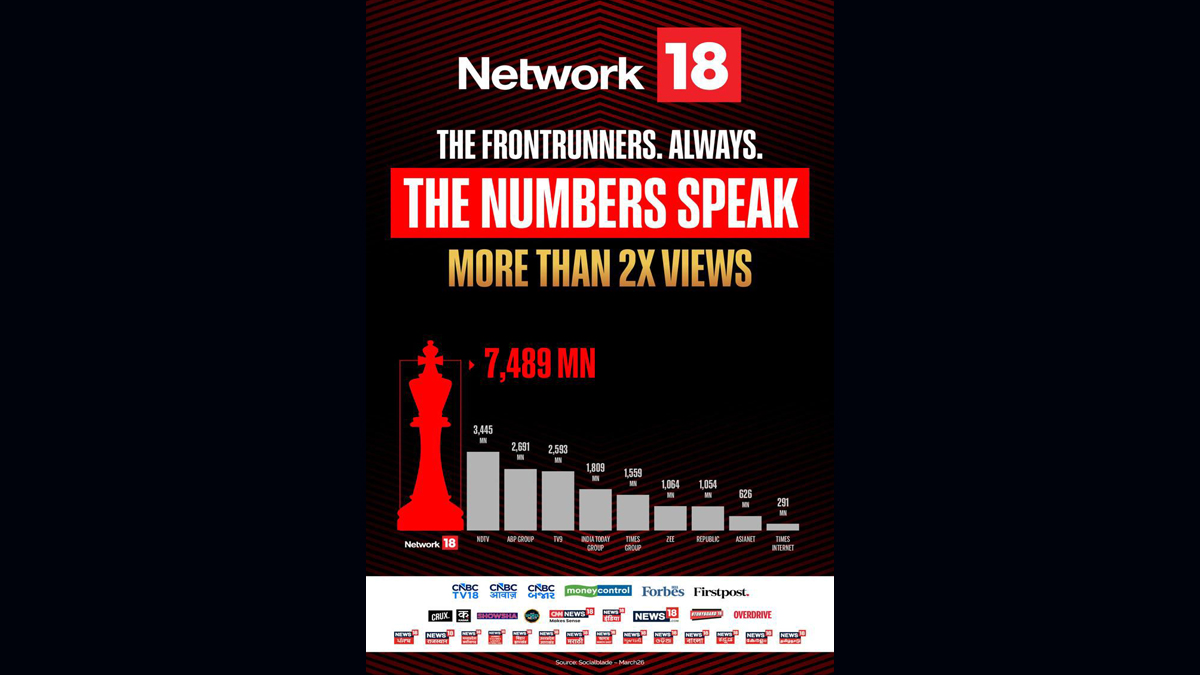
MUMBAI: When the world hit refresh on breaking news, Network18’s channels were already streaming ahead. As geopolitical tensions and war-driven headlines fuelled a surge in global news consumption, the network’s digital playbook delivered big clocking record Youtube viewership across English, Hindi and business news categories in March 2026.
At the forefront was CNN-News18, which emerged as the clear leader in the English news segment with 130 million live and video-on-demand views. The channel edged past competitors such as Times of India (126.5 million), Times Now (101.1 million), India Today (88.2 million) and NDTV (77.5 million), according to Databeings data for March.
In the Hindi news arena, News18 India delivered a commanding performance, racking up a staggering 3,297 million views on YouTube. The channel comfortably outpaced NDTV India, which recorded 3,119 million views, underlining its deep reach and consistent engagement with mass audiences, as per Playboard data.
The network’s dominance wasn’t confined to general news. In the Hindi business segment, CNBC Awaaz topped the charts with 92 million views, narrowly ahead of Zee Business (90 million) and well ahead of ET Now Swadesh (57 million). Meanwhile, its English counterpart CNBC-TV18 posted a strong 58 million views, reinforcing the network’s cross-category strength.
The spike in viewership reflects a broader shift in audience behaviour, with viewers increasingly turning to digital platforms particularly Youtube for real-time updates and in-depth coverage during high-intensity news cycles. For Network18, the numbers signal more than just scale; they underline the effectiveness of a multi-platform strategy that blends speed, credibility and continuous coverage.
In a month where the news never paused, it seems viewers chose to stay tuned where the stream never stopped.






