Cable TV
Conditional access gets the thumbs up in indiantelevision.com poll

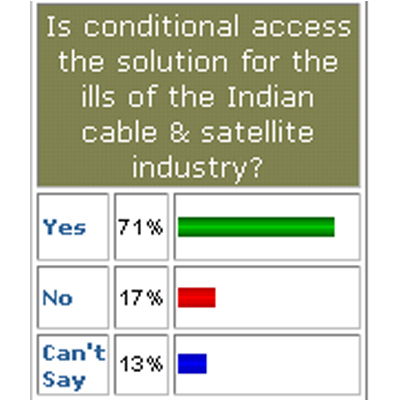
The government seems to have the mandate of the people in the matter of conditional access.
The latest indiantelevision.com poll that queried if conditional access is the solution for the ills facing the Indian cable and satellite industry, had a whopping 71 per cent endorsing CAS. Those who answered in the negative were a mere 17 per cent, while 13 per cent were unable to decide either way.

Information and broadcasting minister Sushma Swaraj does seem to be inclined to push in conditional access, a move that is likely to ring in some cheer for the cable industry. The broadcaster community has not been quite so enthusiastic though .
Star Group CEO James Murdoch, in Mumbai last month, made no bones about his displeasure with the cable op fraternity, which he blamed for the mess the industry is in. According to Murdoch, the whole call by the cable industry for CAS systems to be introduced was no more than a delaying tactics was reacting to what was potentially a major threat to his business interests in India. The government task force’s report on the introduction of conditional access has not been too helpful to the broadcaster either.
Among other recommendations, the report stipulates that CAS should be mandated under the Cable Television Networks (Regulations) Act, 1995, that a set top box be required only for pay channels (premium tier) while FTA channels continue to be receivable by subscribers in the current mode. While the government does not intend to interfere in the pricing of the pay channels or the pricing of set top boxes, leaving both to market forces, it would still retain the right to regulate the price of the ‘basic tier’ of FTA channels, the report says.
The report is also of the view that consumer interest needs to be protected by providing efficient and responsive service through a transparent and accurate billing and collection system to ensure that the revenue accruable to the government is determined in a fair manner. The report envisages that eventually the set top would permit migration by the subscriber across various delivery media – satellite, cable and terrestrial. The user will have the capability to migrate to various delivery media, simply by changing the “network interface module”.
However, even if legislation is to come in the next few months, implementation will take three to five years, according to the industry.
Although the poll result offers a clear inclination towards CAS, there is no doubt that there is a real problem on the cards for the general entertainment pay channels. This is because if the decision is left to consumers, the majority would go in for the basic tier. The resultant picking and choosing among channels will mean that the bottom will fall out of all that has been achieved in the last few years. The leader, Star naturally has the most to lose. However, all pay bouquets will take a hit, although niche channels need not be as worried by the introduction of CAS.
Some or all of these issues are likely to come up for debate at a seminar on CAS scheduled for next week in the capital. The seminar is being organised by the Swiss-based Consumer Action Network, according to Deepa Mistry of the PR firm Euro RSEG.
The government, meanwhile, has not really moved forward on this issue. Whether it is the political uncertainties prevailing that have virtually paralysed the government or whether it is due to some heavy duty behind the scenes lobbying is still to be ascertained.



MUMBAI: When margins wobble, liquidity talks and in Q3 FY25-26, cash did most of the talking. Den Networks Limited closed the December quarter with consolidated revenue of Rs.251 crore, marginally higher than the previous quarter but down 4 per cent year-on-year, even as profitability stayed resilient on the back of strong cash reserves and disciplined cost control.
Subscription income softened to Rs.98 crore, slipping 3 per cent sequentially and 14 per cent from last year, while placement and marketing income offered some cheer, rising 15 per cent quarter-on-quarter to Rs.148 crore. Total costs climbed faster than revenue, up 7 per cent QoQ to Rs.238 crore, driven largely by higher content costs and operating expenses. As a result, EBITDA dropped sharply to Rs.13 crore from Rs.19 crore in Q2 and Rs.28 crore a year ago, pulling margins down to 5 per cent.
Yet, the bottom line refused to blink. Profit after tax stood at Rs.40 crore, up 15 per cent sequentially and only marginally lower than last year’s Rs.42 crore. A healthy Rs.57 crore in other income helped cushion operating pressure, keeping profit before tax at Rs.48 crore, broadly stable quarter-on-quarter despite the tougher cost environment.
The real headline-grabber, however, sits on the balance sheet. The company remains debt-free, with cash and cash equivalents swelling to Rs.3,279 crore as of December 31, 2025. Net worth rose to Rs.3,748 crore, while online collections accounted for 97 per cent of total receipts, underscoring strong cash discipline across operations, including subsidiaries.
In short, while Q3 showed signs of operating strain, the financial backbone remains solid. With zero gross debt, steady profits and a formidable cash war chest, the company enters the next quarter with flexibility firmly on its side proving that in uncertain markets, balance sheet strength can be the best growth strategy.






