GECs
Conditional Access: A basic guide

MUMBAI: What is conditional access? How does it work? Is it prevalent globally? What should India do? Is the CAS Amendment a good enough framework?
These are among many more questions that are plaguing industry, planners and the viewer. To make CAS simpler and understandable for both the technophile and the technophobe, Indiantelevision.com scoured the net and came up with a list of resources on the WWW. We hope these will help clear out some of the cobwebs and haze around CAS. Happy Reading!!

Conditional access (CA) is a technology used to control access to digital television (DTV) services to authorized users by encrypting the transmitted programming. CA has been used for years for pay-TV services. There are numerous ATSC and DVB-compliant CA systems available for a broadcaster to choose from. The CA system provider provides the equipment and software to the broadcaster who then integrates the CA system into his equipment.
The following describes the conditional access process:
*The receiver receives the digital data stream.
*The data flows into the conditional access module, which contains the content provider’s unscrambling algorithms.
*The conditional access module verifies the existence of a smart card that contains the subscriber’s authorization code.
*If the authorization code is accepted, the conditional access module unscrambles the data and returns the data to the receiver. If the code is not accepted, the data remains scrambled restricting access.
*The receiver then decodes the data and outputs it for viewing.
A CA system consists of several basic components: Subscriber Management System (SMS): The SMS is a subsystem of the CA system that manages the subscriber’s information and requests entitlement management messages (EMM) from the Subscriber Authorization System (SAS). An EMM provides general information about the subscriber and the status of the subscription. The EMM is sent with the ECM. The ECM is a data unit that contains the key for decrypting the transmitted programs.
Subscriber Authorization System (SAS): The SAS is a subsystem of the CA system that translates the information about the subscriber into an EMM at the request of the SMS. The SAS also ensures that the subscriber’s security module receives the authorization needed to view the programs, and the SAS acts as a backup system in case of failure.
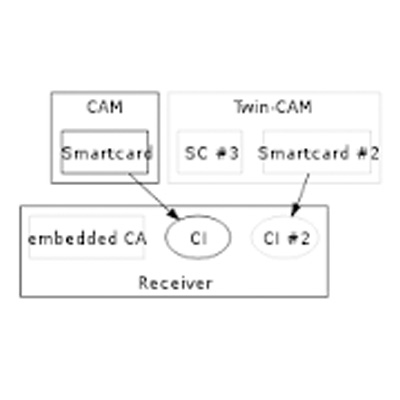
Security module: The security module, usually in the form of a smart card, extracts the EMM and ECM necessary for decrypting the transmitted programs. The security module is either embedded within the set-top box or in a PC Card that plugs into the set-top box.
Set-top box: The set-top box houses the security module that gives authorization for decrypting the transmitted programs. The set-top box also converts the digital signal to an analogue signal so an older television can display the programs. .
Smart Cards: For years, smart cards have been used for pay TV programming. Smart cards are inexpensive, allowing the content provider to issue updated smart cards periodically to prevent piracy. Detachable PC cards allow subscribers to use DVB services anywhere DVB technology is supported.
There are two DVB protocols used by CA systems: SimulCrypt and MultiCrypt. SimulCrypt uses multiple set-top boxes, each using a different CA system, to authorize the programs for display. The different ECMs and EMMs required by each CA system are transmitted simultaneously. Each set-top box recognizes and uses the appropriate ECM and EMM needed for authorization. The ATSC standard uses SimulCrypt. MultiCrypt allows multiple CA systems to be used with one set-top box by using a PC card with an embedded smart card for each CA system used. Each card is then plugged into a slot in the set-top box. Each card recognizes the ECM and EMM needed for authorization.
A typical CA process involves three basic elements: the broadcast equipment, the set-top box, and the security module. The broadcast equipment generates the encrypted programs that are transmitted to the subscriber. When these are transmitted, the set-top box filters out the signals and passes them to the security module. The security module then authorizes these programs for decryption. The programs are then descrypted in real time and sent back to the set-top box for display


MUMBAI: Lights, camera… connection because this time, the game isn’t just about winning, it’s about who’s with you. Sony Pictures Networks India is gearing up to launch a new reality game show, Tum Ho Naa, expanding its unscripted slate with a format that promises both emotion and engagement.
The show will premiere soon on Sony Entertainment Television and stream on Sony LIV, with Rajeev Khandelwal stepping in as host. Known for his measured screen presence and selective choices, Khandelwal’s return to television adds a layer of familiarity and credibility to the upcoming format.
While specific details of the gameplay remain under wraps, the positioning suggests a reality format that leans as much on emotional resonance as it does on competition, an increasingly popular blend in Indian television, where audiences are gravitating towards content that offers both stakes and storytelling.
Khandelwal, reflecting on his return, noted that his choices have often been guided by instinct rather than convention, describing Tum Ho Naa as a project that feels “close to the heart”. His association also signals Sony’s continued focus on anchoring new formats with recognisable faces who bring both relatability and depth.
The launch comes at a time when broadcasters are doubling down on original non-fiction formats to drive appointment viewing, even as digital platforms expand parallel reach. By placing the show across both linear television and OTT, Sony appears to be aiming for a dual-audience strategy capturing traditional viewers while engaging digital-first consumers.
As the countdown to premiere begins, Tum Ho Naa positions itself not just as another game show, but as a reminder that sometimes, the biggest prize on screen isn’t the jackpot, it’s the journey shared along the way.






