I&B Ministry
Communication is critical tool to ensure last mile connectivity: Naidu

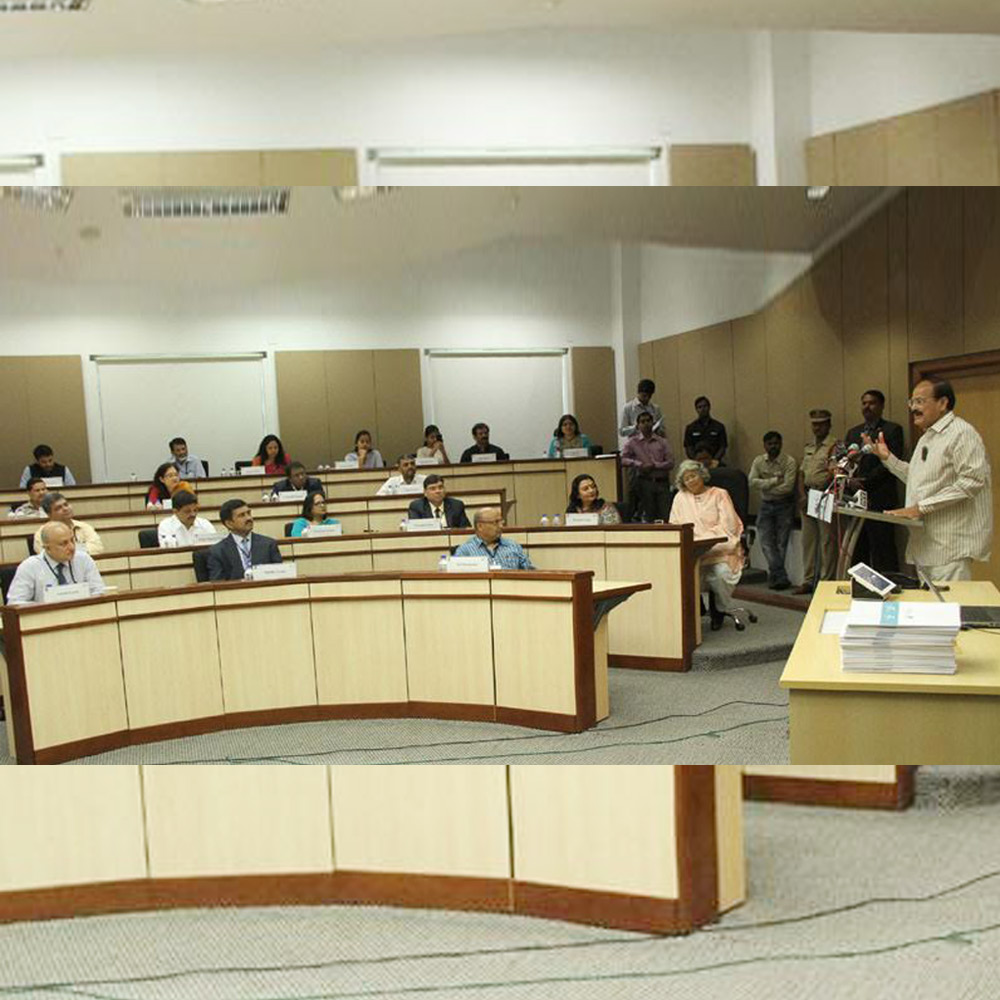
NEW DELHI: Information and Broadcasting Minister M Venkaiah Naidu said today that the Government had placed communication as a critical cog in the wheel of change and it had been woven into a policy matrix which aims at maximum governance, minimum government.
Speaking at the valedictory function of Mid Career Training Programme for Senior Indian Information Service officers (IIS) at Indian School of Business, in Hyderabad today, Naidu said,“Today, we live in an age of instant communication, the images and tools of the media landscape influence our thought process on a continuous basis. The need to constantly re-invent our understanding and perception through an institutionalised skill upgradation program which includes a re-examination of our approach towards the communication process”, he stated.
Naidu said that the government in the past two years had embarked on a programme of communication innovation – adopting methods, seeking spaces to ensure last mile connectivity to the people. “Our approach has attempted to weave different platforms, varied contents through a focussed 360 degree approach. While we have succeeded in adopting a new communication philosophy which incorporates the Citizens concerns, there are areas which still reflect chinks in the armour of government communication”, he said.

He said the ministry had taken up the initiative of providing Information Service Officers skill upgradation through an institutionalised training policy. The objective is to plug the gaps in the Government’s communication approach in areas of content design, social marketing, branding, impact assessment and weaving technologies in the digital age. To bring about a change always creates a dissonance in the government process. He said that the two weeks training program is aimed to offer a fresh perspective, clarity on the nuances of communication management and gave tools and ideas to keep pace with the digital communication world to the IIS officers. He informed the officers that they would be going to the University of Berkeley for a further one week program training programme on the contemporary changes in the communication discourse.
Naidu said recent advances in technology and communication space have completely overhauled the way the Government interacts with the citizens. This change being led by Social Media has ushered in a new era of Governance. it is absolutely necessary for constant upgradation of skills of officers in light of development of new technologies, he added.
He said that in the last two years the present government has taken a lot of Citizen centric initiatives but communicating the benefits remains a challenge. Social and behaviour change communication is a critical factor in the success of Swachh Bharat Abhiyan which is a major flagship scheme of the government. “I am hopeful that the Media Strategy and Planning in the changing scenario of social advertising, a course module taught at ISB during the training of the officers, would benefit in defining the communication roadmap for the government social sector schemes and to ensure last mile reach”, he said.
As the digital media continues to influence the communication and media landscape, social and digital media planning has to be an integral part of the government’s communication strategy. “I am sure the exposure to the officers about the best practises in digital media planning around various organisations across the world would have provided the required skillset and tools to address the challenges in the public domain”, he said.
He added that the old mediums of communication have not become irrelevant. Radio still holds its relevance considering the mass outreach it has. Even the Government’s Mann ki baat Programme has become an excellent communication platform where the Prime Minister of our country not only directly communicates his views on diverse topics/ issues but also takes feedback from people through ‘myGov’ platform and Phone in services. In the current scenario, training in specific domains is incomplete without case studies and practical exposure. Case studies have proven to be an excellent way of practicing and applying new concepts. As such, they’re very useful tools in learning and implementation.
The different phase wise training for the IIS Officers have been designed keeping in mind the broad objective of the Government’s Communications needs as well as changing communication and technology paradigm.







I&B Ministry
Digital radio, D2M tech set to reshape broadcasting and public messaging
Govt pushes next-gen delivery while TRAI tightens grip on spam ecosystem
NEW DELHI: India’s broadcasting and telecom landscape is undergoing a quiet but significant upgrade, with digital radio and Direct-to-Mobile (D2M) technologies emerging as powerful tools for mass communication, while regulators step up efforts to tackle spam calls.
According to the Ministry of Information and Broadcasting, digital radio and D2M are poised to transform how content reaches audiences by making more efficient use of spectrum. In simple terms, multiple channels can now be delivered over a single frequency, opening the door to a wider range of free-to-air content.
D2M technology takes this a step further by enabling video, audio and data to be broadcast directly to mobile handsets without relying on SIM cards or mobile data. The result is a resilient and cost-effective data pipe that can deliver everything from entertainment and education to critical emergency alerts, even in low-connectivity scenarios.
At the same time, the Telecom Regulatory Authority of India is tightening its grip on unsolicited commercial communication, better known as spam calls. The regulator has deployed a distributed ledger technology platform to bring transparency and accountability into the system.
Through this blockchain-based setup, consumers can register their preferences on receiving promotional messages, while businesses and telemarketers must also sign up and operate within defined rules. The platform also includes a complaint mechanism that allows users to report spam, with complaints shared across telecom operators for coordinated action.
The government’s broader push is being supported by infrastructure upgrades under the Broadcasting Infrastructure and Network Development scheme. Implemented through Prasar Bharati, the initiative focuses on modernising networks such as Akashvani and Doordarshan, including digitisation and adoption of next-generation broadcast equipment.
In a written reply in the Lok Sabha, Ministry of Information and Broadcasting minister of state for information and broadcasting L. Murugan said these steps are part of a larger effort to promote emerging technologies and strengthen the country’s broadcasting backbone. The response came to a query raised by member of Parliament Rao Rajendra Singh.
Together, these developments point to a dual-track strategy: expanding access to reliable, low-cost content while cleaning up the communication ecosystem. As digital pipes get smarter and spam filters sharper, India’s airwaves may soon feel a lot less noisy and far more useful.






