News Broadcasting
CNBC’s new series ‘That’s Entertainment’ launches 19 February


MUMBAI: “Where is the BIG idea?” That was the topic of debate when CNBC-TV18 launched their new programme titled That’s Entertainment, in Mumbai on 11 February.
The show, which will make its debut on 19 February, will provide viewers with a deep and insightful look at the business of entertainment in India in the areas of films, television, radio and more.
Eminent personalities like lyricist Javed Akhtar, Sony Entertainment business head and executive vice president programming and response Tarun Katiyal, advertising guru and theatre personality Alyque Padamsee, McCann-Erickson national creative director Prasoon Joshi and film maker Ashutosh Gowarikar discussed the need for the ‘Big Idea’ in the entertainment industry. This was a first of its kind exclusive discussion, which revolved around the entertainment industry’s survival through the nurturing of original ideas that have become money-spinners. The debate brought out the intricacies of ‘inspired’ films, ‘lifted’ music and internationally tried and tested television shows increasingly characterising the so-called creative industry.

CNBC-TV18 has closely tracked the Indian entertainment industry, which at more than $ 4 billion has outperformed the rest of the Indian economy. The channel has covered this Indian growth story, through its series That’s Entertainment. Through this series, the best minds in the entertainment and media will jointly ideate on how original and clutter-breaking thinking can become the rule, rather than an exception.
That’s Entertainment will run across the channel through February and March 2005 as six half hour episodes, which will be aired every Saturday at 1.30 pm with repeats on Sunday at 10 pm.
At the forum, Gowarikar spoke about how big ideas were all around and that the questions – where, when, how, why, who and what were the sources of big ideas. Citing what a big idea was, he said, “The ‘Big’ of the big idea is not about size and a big idea was nothing new as it was timeless.” He went on to say that a big idea was universal and wasn’t about right or wrong, it is just inspiring and comes from insight. Gowarikar also pointed out that big ideas don’t exist without vision.
Akhtar, on the other hand, said, “There is no big idea around until the society decides what is its collective morality and what are its collective dreams! Katial on the other hand said that a big idea was something that is clutter breaking, distinct, well executed, communicated and promoted accordingly. “Big ideas bucks the trends and two such big ideas from Sony’s kitty have been Jassi Jaisi Koi Nahi and Indian Idol, which have worked very well with the audiences. A popular belief is that what is not born here won’t work here but these two shows have proved that belief wrong,” he said.
Padamsee, spoke about the big ideas he has been instrumental in giving shape – that of Surf lady Lalita ji, who was a housewife who spoke back, knew what she wanted and demanded it unlike the ‘typical’ Indian housewife. Another big idea was the Liril girl under the waterfall, who has lived in the hearts of the people since the last 30 odd years. “A big idea is something that goes beyond its time, age and human desire. There is no fixed formula for a big idea. Detective series Karamchand on DD was another big idea, which defied the typical James Bond image of a private detective. A big idea should impact the emotional retina and hence you never forget them,” said Padamsee.
Speaking about the big idea in advertising, Joshi on the other hand said, “Why do we borrow stuff from the West? The biggest thing, which is missing today in the creative business is that we don’t have people who can smell ideas. We look for what has worked before and that leads to idea infanticide.” He went on to say that if products like Jassi and Indian Idol were born in India then they wouldn’t have seen the light of the day! “One should not always look for originality but the definition of originality has to change,” he stressed.
Commenting at the forum CNBC-TV18 vice president sales and marketing B Sai Kumar said, “The discussion on the Big Idea aimed at bringing out the fact that original creativity is on its way out and is being replaced by mediocre imitations of creativity that previously characterised the world’s largest entertainment industry. This year CNBC-TV18 aims at putting India back into its role as the entertainment hub of the world through the highly popular show That’s Entertainment, which aims to bring out what the next big trend in India’s entertainment industry will be.”





News Broadcasting
Induction cooktop demand spikes 30× amid LPG supply concerns
Supply worries linked to West Asia tensions push households and restaurants to turn to electric cooking alternatives
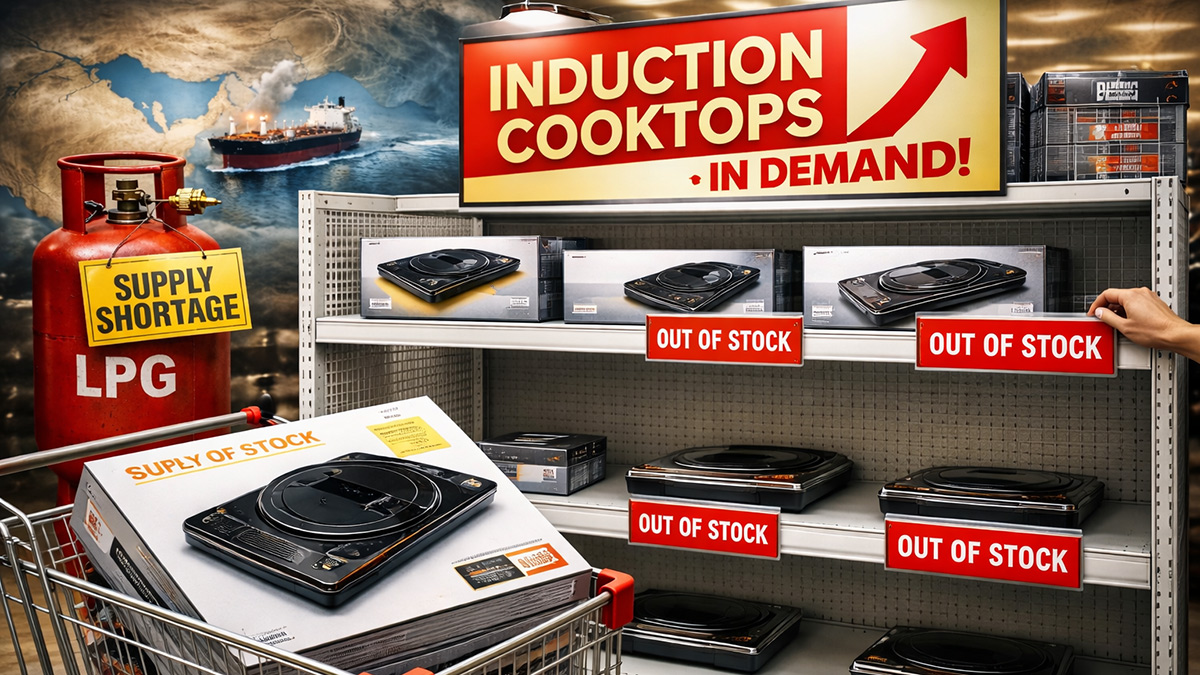
MUMBAI: As geopolitical tensions in West Asia ripple through global energy supply chains, the familiar blue flame in Indian kitchens is facing an unexpected challenger: electricity.
What began as concerns over the availability of liquefied petroleum gas (LPG) has quickly evolved into a technology-driven shift in cooking habits. Households across India are increasingly turning to induction cooktops and other electric appliances, initially as a backup but now, for many, a necessity.
A sudden surge in demand
Recent data from quick-commerce and grocery platform BigBasket highlights the scale of the shift. According to Seshu Kumar Tirumala, the company’s chief buying and merchandising officer, demand for induction cooktops has risen dramatically.
“Induction cooktops have seen a significant surge in demand, recording a fivefold jump on 10 March and a thirtyfold spike on 11 March,” Tirumala said.
The increase stands out sharply when compared with broader kitchen appliance trends. Most appliance categories are growing within 10 per cent of their typical demand levels, while induction cooktops have witnessed explosive growth as households rush to secure an alternative cooking option.
Major e-commerce platforms including Amazon and Flipkart have reported rising searches and orders for induction stoves. Quick-commerce apps such as Blinkit and Zepto have also witnessed stock shortages in major metropolitan areas including Delhi, Mumbai and Bengaluru.
What was once considered a convenient appliance for hostels, small kitchens or occasional use has suddenly become an essential addition in many homes.
A crisis thousands of miles away
The trigger for this shift lies far beyond India’s kitchens.
Escalating conflict in the Middle East has disrupted shipping routes through the Strait of Hormuz, one of the world’s most critical energy corridors. Nearly 85 to 90 per cent of India’s LPG imports pass through this narrow waterway, making the country particularly vulnerable to supply disruptions.
The ripple effects have been swift.
India currently meets roughly 60 per cent of its LPG demand through imports, and tightening global supply has already begun to affect domestic availability and prices.
Earlier this month, the price of domestic LPG cylinders increased by Rs 60, while commercial cylinders rose by more than Rs 114.
To discourage panic buying and hoarding, the government has also extended the mandatory waiting period between domestic refill bookings from 21 days to 25 days.
Restaurants feel the pressure
The strain is not limited to households. Restaurants, hotels and roadside eateries are also grappling with supply constraints as commercial LPG availability tightens under restrictions imposed through the Essential Commodities Act.
In cities such as Bengaluru and Chennai, restaurant associations report that commercial LPG availability has dropped by as much as 75 per cent, forcing many establishments to rethink their kitchen operations.
Some restaurants have reduced menu offerings, while others are rapidly installing high-efficiency induction systems, creating hybrid kitchens where electricity now shares the workload with gas.
For smaller eateries and roadside dhabas, the shift is less about sustainability and more about survival.
A potential structural shift
The government has maintained that there is no nationwide LPG crisis and has directed refineries to increase production to stabilise supply.
Nevertheless, the developments of March 2026 may already be triggering a longer-term behavioural shift.
For decades, LPG has been the backbone of cooking in Indian households. However, recent disruptions have highlighted the risks of relying on a single fuel source.
Increasingly, households appear to be hedging against uncertainty by adopting electric cooking options to guard against price volatility and delivery delays.
If the current trend continues, the induction cooktop, once viewed as a niche appliance, could emerge as a quiet symbol of India’s evolving kitchen economy.