News Broadcasting
CNBC-TV18’s Future. Female. Forward. Season 3 puts spotlight on ‘Broken Rung’ in India’s gender equity journey


MUMBAI: CNBC-TV18 successfully hosted the Bengaluru edition of HSBC presents Future. Female. Forward. Season 3, co-presented by Cognizant India, to a packed house of policymakers, industry leaders, and DEI advocates. Following its impactful national launch in Mumbai, the Bengaluru chapter zeroed in on a critical, and often under discussed barrier to achieving gender parity: the ‘broken rung’ that can hold women back from progressing into leadership roles.
Opening the evening, CNBC-TV18 managing editor Shereen Bhan, delivered a compelling call to action that set the tone for the discussions ahead. “We created CNBC-TV18 Future. Female. Forward. —to build a space where women in full flow could speak, challenge, and lead. Today, women founders still receive only 2.3 per cent of total capital, globally under three per cent, and in India, just six per cent in H1 2025. That’s not a pipeline problem; that’s a design flaw. From AI to public infrastructure, this city sits at the edge of innovation, yet the blueprint remains exclusionary. Equity must be the earliest principle, not a late-stage correction. And that’s the conversation we’re committed to pushing forward—with facts, with courage, and with community.”
The evening began with HSBC India CEO Hitendra Dave reflecting on Embedding Equity: The HSBC India Inclusion Playbook. He emphasized the need for strong institutional frameworks and measurable outcomes to build truly inclusive cultures.

He said, “Over the last three years, we’ve started a conversation—one that challenges us to rethink how we approach inclusion, not as a multi-decadal aspiration, but as a series of deliberate, incremental actions. Each season, each dialogue, and each story reminds us that looking away is not an option and while the journey is complex and nuanced, what matters is that we are moving in the right direction. At HSBC, we take pride in playing a small but meaningful role in fostering these conversations that bring us closer to a future where equity is not just an ideal, but a reality.”
Taking the stage next, Shobana Kamineni, executive chairperson of Apollo HealthCo, delivered a compelling fireside chat titled Prescription for Disruption: The Kamineni Code.
She shared: “Women aren’t short on ideas, intelligence, or ambition, but they’re funded like they are. Globally, women-led businesses raised just $108 billion last year, and India accounted for a mere ₹25 crore. You can’t talk about scale without real capital. If we want more women in leadership, we need to back them not just with applause, but with board seats, and belief in their ability to lead mainstream, high-impact ventures, not just niche ones.”
The evening also featured a case‑led session by Pooja Sharma Goyal, founding CEO of The Udaiti Foundation, titled Leading with Purpose, Building with Equity. Drawing on lived experience, she outlined practical frameworks that turn inclusive‑growth theory into action.
A high-impact panel discussion titled Purpose, Parity & Performance brought together an esteemed lineup of leaders, including Bhawna Agarwal (SVP & MD, HPE India), Rajesh Varrier (President – global operations and chairman & managing director, Cognizant India), Jaya Jagadish (country head & SVP, AMD India), Meena Ganesh (co-founder & chairperson, Portea; Trustee, Bahaar Foundation), and Sunita Naik (SVP & country lead – India, State Street Investment Management).
During the panel discussion, Rajesh Varrier, president – global operations and chairman & managing director, Cognizant India, offered a large-enterprise perspective on building inclusive workforce strategies.“Inclusion isn’t just about hiring; it’s about building systems and structural interventions that support a woman’s entire career journey. That’s why we created Shakti —a unified framework of programs and policies designed to empower women from college to corporate leadership, enabling them to realise their full potential. Also, we know that progress is most powerful when supported by allies—those who advocate, amplify, and help open doors,” he noted.
From a global capital lens, Sunita Naik, senior managing director & India lead of State Street Investment Management, illustrated how inclusion is being hardwired into investment decisions and organizational culture, moving beyond token gestures to measurable accountability. Sunita said, “At State Street Investment Management, we didn’t just advocate for inclusion; we built it into our leadership. Our CEO is an Asian-American woman, our operating group is majority women, and our board is 50 per cent women. This isn’t about eliminating men; it’s about proving that diverse teams outperform. Real change happens when women lead at every level, not just entry level. From the iconic Fearless Girl to our own boardroom, we’re showing that inclusion drives performance, not just perception.”
The evening saw the signature “FFF ICONS” segment where a remarkable group of individuals whose contributions span sport, science, social change, and national service were honoured. Among the honorees were Shreyasi Joshi and Swarali Joshi – Skater Sisters; Alina Alam – Founder & CEO, Mitti Café; Sonal Holland – Founder & Director, SoHo Wines; Savithri H. S – Former Professor, Department of Biochemistry, Indian Institute of Science, Bengaluru; Lt Commander Roopa Alagirisamy and Lt Commander Dilna K – Indian Navy; India’s first all-women mine rescue unit, SMART-191, Singareni Mahila Active Rescue Team; Sandhya Puchalapalli – Founder & President, Aarti for Girls; Roshni Devi – National-Level Weightlifter; and Meena Ganesh – Co-founder & Chairperson, Portea, and Trustee, Bahaar Foundation.
Lt commander Dilna K, a commissioned officer in the Indian Navy, spoke about her life journey navigating a male-dominated force with resilience and clarity. Reflecting on her partnership with fellow officer Lt Commander Roopa Alagirisamy, she shared: “Roopa and I trained together, went through life and death situations, and spent more time at sea than on land. You get to know everything about the other person; there’s no space to be enemies. When I wasn’t okay, she was there to take over, and when she wasn’t, I stepped in. That teamwork was the real success of this journey.”
The evening closed with a clear message: fixing the broken rung isn’t a side issue, it’s central to building stronger institutions. From rethinking how promotions work to ensuring fairness in performance evaluations, the conversations throughout this pivotal event called on organizations to act with intent, not just awareness. Parity, the room agreed, must be designed into the system, not added as an afterthought.






News Broadcasting
News18 India launches Command Centre war explainer with Arya
New show shifts from debates to decoding global conflicts and impacts
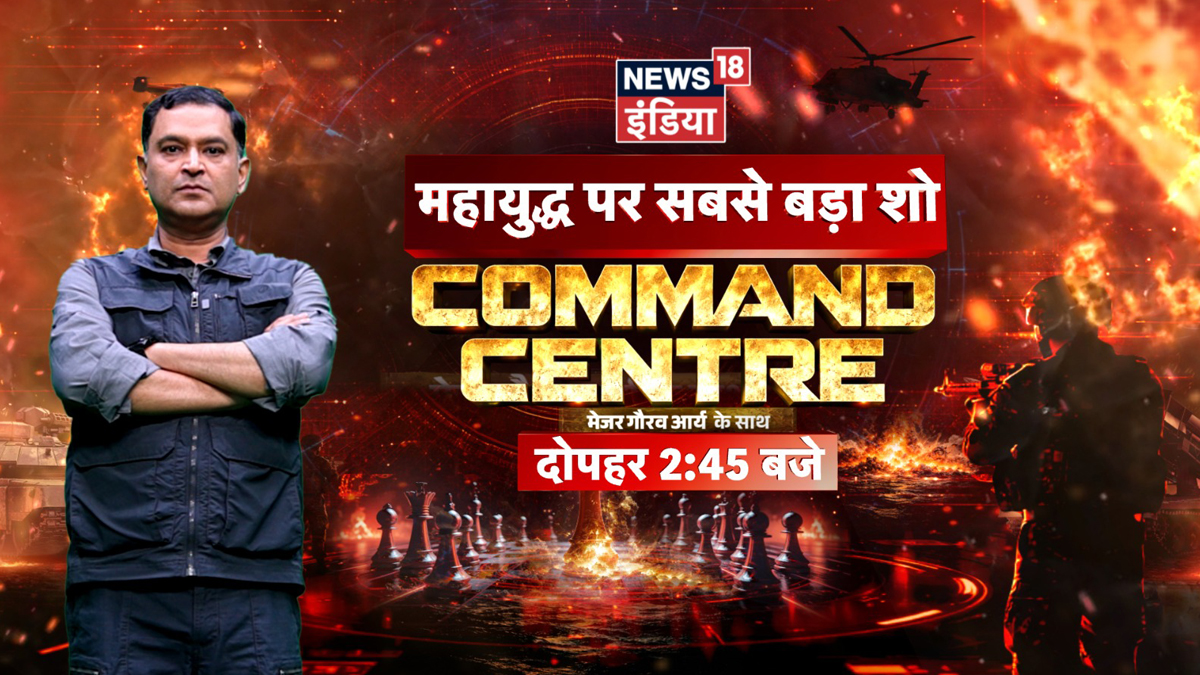
MUMBAI: News18 India has rolled out a new war-focused programme, Command Centre, featuring Gaurav Arya, as it looks to offer viewers a sharper, more grounded take on global conflicts amid rising tensions in West Asia.
Positioned as an “insider war room”, the show moves away from conventional panel debates and instead focuses on explaining military developments, decoding strategy and connecting global events to their everyday impact, from fuel prices to economic shifts.
The format leans heavily on visuals and data. The studio has been designed like a command hub, complete with large LED war maps, real-time graphics and an alert system to track developments as they unfold.
At the centre of it all is Arya, who brings his military background to simplify complex war strategies for viewers. His signature line, “Seedhi baat samjhiye”, anchors the show’s promise of clarity over noise.
News18 India managing editor Jyoti Kamal said, “Command Centre, featuring Major Gaurav Arya is designed to deliver accurate insights and a clear perspective on how evolving conflicts impact everyday life, from household budgets to national security. With expert voices analysing every development in real time, the show goes beyond headlines to decode what’s happening now, what it means, and what could come next.”
Echoing the intent, Gaurav Arya added, “In times of war, confusion is the biggest threat. With News18 India’s Command Centre, we are bringing viewers inside the war room, decoding strategies, tracking every escalation, and explaining, in the simplest terms, what it means for India and for every household. Seedhi baat samjhiye, this is where you understand not just what is happening, but what happens next.”
The weekday show will air in the afternoon slot and will also feature Gaurav Shukla, adding to its editorial depth.
With its mix of analysis, visuals and a clear focus on impact, the show reflects a broader shift in news consumption. Viewers are no longer just watching events unfold, they are looking to understand what those events mean for them.






