News Broadcasting
CNBC-TV18’s 25th anniversary inspires new business horizons at Global Leadership Summit

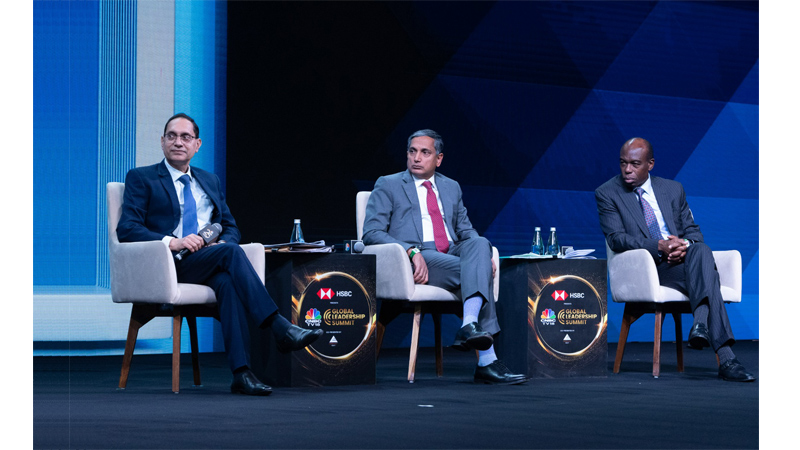
Mumbai: As CNBC-TV18 marked 25 years of excellence in business journalism, the Global Leadership Summit presented by HSBC India and co-presented by Embassy REIT, unfolded as a landmark event, showcasing the channel’s profound impact on India’s economic and business landscape. Held at Jio World Centre, the summit brought together visionaries from across industries, policymakers, and thought leaders to deliberate on pressing global challenges, emerging opportunities, and India’s ascent on the world stage.
The summit opened with an address by CNBC-TV18 managing editor Shereen Bhan, who underlined India’s journey in the global economic narrative. She remarked “As CNBC-TV18 marks 25 years of excellence, the Global Leadership Summit brought together the most influential thinkers to chart out the roadmap for what India needs to focus on over the next quarter century to achieve high performance. From the policy priorities to the role of the Private sector, from manufacturing to services, from infrastructure to Artificial Intelligence, the Global Leadership Summit was the stage for insightful and transformative discussions. As we look ahead, we hope This summit will continue to reflect our commitment to providing thought leadership and an execution strategy to deliver on India’s promise and potential”
Minister of Commerce & Industry, Government Of India, Piyush Goyal initiated the day’s conversations with a thought-provoking fireside chat, stating, “I was reviewing the numbers of a major automobile company that recently went public. It’s remarkable to note that an initial investment of $200 million made 25 years ago has yielded dividends and royalties exceeding $12 to $13 billion in just the last decade. Even with such extraordinary returns, the company’s current market capitalization remains at approximately $15 billion. This highlights the significant competitive edge that companies manufacturing in India possess. As they continue to offer better pricing and greater value, I’m confident they are poised for even greater growth. Ultimately, companies must decide whether to maintain high margins in a softening market or to become more aggressive, capture a larger market share, and drive growth through competitive pricing. The answer lies in how they leverage their strengths in this evolving landscape.”

The summit’s agenda was packed with discussions and thought-provoking dialogues. RBI Governor Shaktikanta Das delivered a compelling keynote titled “Sailing Through Turbulence: India’s Tryst with Financial Stability”. He said, “Central banks worldwide are navigating an increasingly complex financial environment, and the Reserve Bank of India is no exception. The trade-off between supporting growth and controlling inflation remains challenging, especially in a time of high global volatility. We have witnessed the repercussions of moving ‘too early’ or ‘too late,’ particularly in the banking sector issues that emerged in advanced economies earlier this year. At the Reserve Bank, our response has been measured and timely, maintaining the flexibility to act in sync with evolving conditions. By balancing growth and inflation priorities, we aim to build resilience into India’s financial system. As we shift towards a neutral stance, we remain focused on achieving a durable alignment of inflation within target while supporting growth, underscoring our commitment to a stable and thriving economy.”
A special segment at the event was devoted to honour Dr. C Rangarajan, Dr. Bimal Jalan, and Dr. Y. V. Reddy, former Governors of the Reserve Bank of India, for their monumental contributions to India’s economic stability. This tribute was followed by the unveiling of “5/25 Transformative Ideas for the Next Quarter Century,” where Uday Kotak, Founder of Kotak Mahindra Bank, shared a visionary roadmap for India’s future.
Global Leader, Esi Eggleston Bracey, Global Chief Growth & Marketing Officer, Unilever, took centre stage during the session “Boost Brands, Boost Business” where she delved into strategies for driving brand growth in competitive markets. Another highlight was the panel discussion “Investing in India’s Today & Tomorrow,” featuring insights from leading investors such as Ramesh Damani, Owner, Ramesh Damani Finance Pvt Ltd., Manish Chokhani, Director, Enam Holdings, Raamdeo Agrawal, Chairman & Co-founder, Motilal Oswal Financial Services and Ashishkumar Chauhan, MD & CEO, NSE who explored India’s economic potential and sustainable growth strategies.
The afternoon sessions kicked off with a dynamic panel discussion on ‘Managing Markets: Is it Time to be Bullish or Bearish?’ where Ridham Desai, Managing Director, Morgan Stanley India, Rama Bijapurkar, Author & Independent Director, India Blue-Chip Companies, V. Vaidyanathan, MD & CEO, IDFC First Bank, Nilesh Shah, MD, Kotak Mahindra Asset Management Company Ltd. and Samir Arora, Founder & Fund Manager, Helios Capital, shared perspectives on market trends and investment strategies. The subsequent panel, ‘India: The Outlier, ’discussed India’s position amid global economic changes, with insights from Auguste Tano Kouame, Country Director, World Bank, Krishna Srinivasan, Director, Asia & Pacific Department, International Monetary Fund and Tuhin Kanta Pandey, Finance Secretary & Secretary (DIPAM).
An engaging discussion titled, ‘Legacy, Longevity, Leadership: The Playbook for the Future,’ which brought together Rishad Premji, Executive Chairman of Wipro, and Rajiv Bajaj, Managing Director of Bajaj Auto, who shared their insights on sustaining leadership in rapidly evolving industries.
The summit continued with a fireside chat with Hitendra Dave, CEO of HSBC India who spoke about ‘The Next Superpower: India’s Growth Blueprint,’ and he explored strategies that could propel India to global superpower status. He commented, “India’s optimism for the next 25 years is rooted in its young demographics and unmatched digital infrastructure. With 1.4 billion people, most under 28, the potential for transformation is staggering. Strategic investments in digital payments and unified lending systems can redefine credit access, unleashing growth across sectors. By harnessing this opportunity, India can pave its way to becoming a developed economy with a per capita income of $13,000–$15,000—a bold but achievable vision.”
The event also featured notable sessions on entrepreneurship, innovation, and India’s competitive edge. A discussion titled ‘Startup Dreams to Wealth Creation,’ where Rajan Anandan, MD, Peak XV, Amrit Acharya, Co-founder & CEO, Zetwerk, Kunal Shah, Founder, CRED and Kapil Makhija, MD & CEO, Unicommerce eSolutions discussed the challenges and successes of building thriving startups in India. Meanwhile, ‘The Promise of Phygital India: From Bricks to Broadband’ underlined the seamless integration of digital and physical spaces, with insights from Ari Sarker, President, Asia Pacific, Mastercard, Jitu Virwani, Chairman and Managing Director, Embassy Group, and Ankur Gupta, Head, Asia & Middle East Rela Estate, Brookfield.
As the evening unfolded, Sajjan Jindal, Chairman & MD, JSW Group of Companies led a session titled ‘India’s Manufacturing Moment: Breakout Ready?’ discussing India’s potential as a global manufacturing leader. The event also witnessed the felicitation of Deepak Parekh, Former Chairman of HDFC, as an Icon of The Indian Economy who also delivered an insightful TED Talk on ‘Transforming the Financial Sector for a New Generation’.
Further discussions explored India’s global leadership potential with a segment on –‘From The Foreign Investors Lens’ where the speakers Prem Watsa, Chairman & CEO, Fairfax Financial Holdings Limited, and John Chambers, Chairman, USISPF and Founder & CEO, J2C Ventures shared their insights. The discussion ‘India’s Right to Win,’ featuring Dr. Anish Shah, Group CEO & MD, Mahindra Group, and Falguni Nayar, Founder & CEO, Nykaa further highlighted India’s competitive edge in global markets.
In one of the summit’s most engaging fireside chats, Adar Poonawalla, CEO, Serum Institute Of India and Karan Johar, Film Director discussed the evolution of India’s entertainment industry in ‘Cinema: Magic to Monetisation.’ Another captivating fireside chat was with Sriharsha Majety, Co-founder and Group CEO, Swiggy, who shared Swiggy’s journey leading upto IPO on “Let’s Swiggy with it”.
The summit also honoured N.R. Narayana Murthy, Co-founder & Former Chairman, Infosys as ‘Icon of The Indian Economy’ followed by a powerful fireside chat with him titled ‘India The Next 25: Notes from N.R. Narayana Murthy,’ which reflected on India’s future in the Global Landscape. He shared his views and said, “Over the last 30 years, India has made remarkable progress. A new wave of confidence and energy is driving growth, visible in everything from local businesses and street vendors to fitness centres. Yet, while urban middle-class incomes are rising, a vast segment of the population remains untouched by globalisation. The challenge ahead is creating jobs, especially for those who cannot access high-skill industries like software. The solution lies in exports, countries like China and Vietnam have shown how global demand can drive large-scale job creation. To succeed, India must move faster in decision-making, adopt global best practices, and raise its standards of excellence. India’s potential is limitless, but realising it requires swift, competitive, and decisive action.”
The summit had an interesting fireside chat with Leo Varadkar, former Taoiseach of Ireland, in conversation with Navtej Sarna, former Ambassador of India to the US, discussing global leadership challenges in “Finding Leadership in a Fractured World.” CNBC-TV18 Global Leadership Summit concluded with a power-packed performance by Ajay Bijli, Managing Director, PVR INOX Limited.
CNBC-TV18 Global Leadership Summit was presented by HSBC India, and co-presented by Embassy REIT, along with Destination Partner- Saudi Tourism Authority, Associate Sponsor – ITC, AI Partner- AWS, Exchange Partner – NSE, Associate Partner – Reliance Industries





News Broadcasting
UDF poised to return to power in Kerala, says Manorama-CVoter survey
Massive opinion poll projects shift in Kerala politics ahead of 2026 Assembly elections.
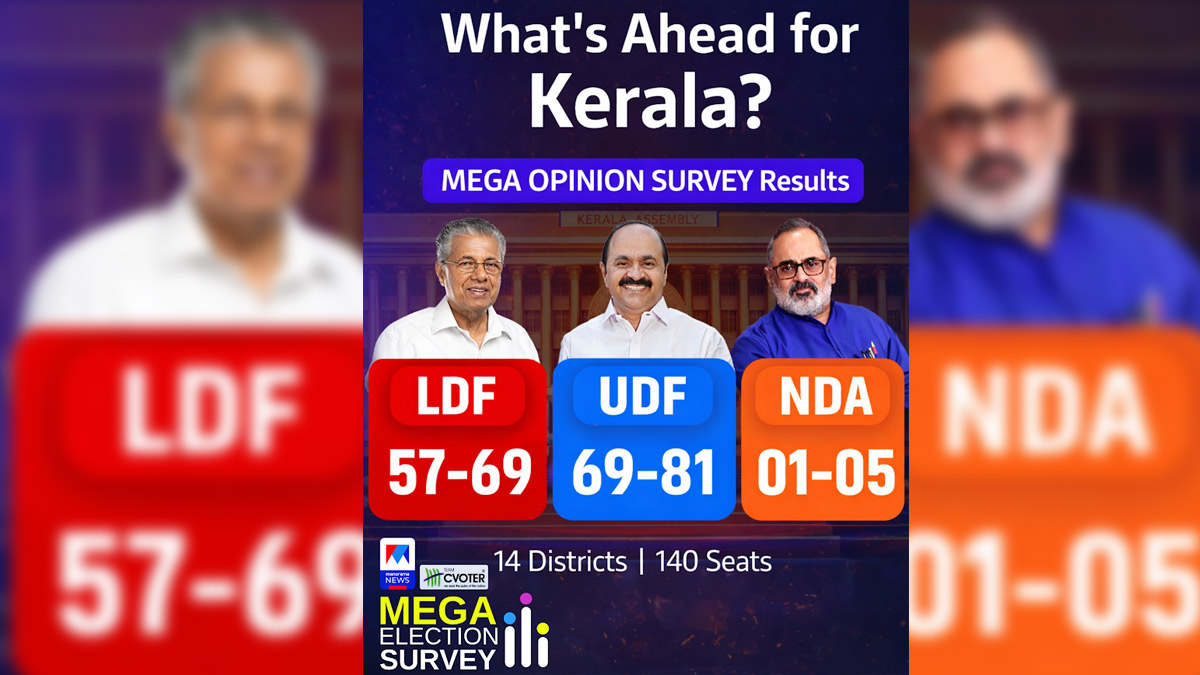
MUMBAI: The winds of change appear to be blowing through Kerala’s political landscape and this time, they seem to favour the United Democratic Front. A comprehensive mega opinion survey conducted by Manorama News in partnership with CVoter projects a potential comeback for the UDF in the upcoming Kerala Legislative Assembly Elections 2026. The survey, covering all 140 constituencies with a massive sample size of nearly 90,000 respondents, predicts the UDF could win between 69 and 81 seats.
The ruling Left Democratic Front (LDF) is expected to secure 57 to 69 seats, a significant drop from the 99 seats it won in the 2021 elections. This would mean the LDF losing 30 to 42 of its sitting seats. Meanwhile, the National Democratic Alliance (NDA), which drew a blank in 2021, is projected to open its account with 1 to 5 seats.
Region-wise, the UDF is expected to make strong gains in Malabar, winning 25 to 34 out of 48 seats, and in Central Kerala, where it could bag 29 to 33 out of 53 seats. In South Kerala, the LDF is likely to retain an edge with 21 to 25 seats, while the UDF may improve to 12 to 16 seats. The NDA could pick up 1 to 3 seats in the southern region.
The survey was conducted between 14 and 26 March 2026, with additional tracker and snap polls carried out from December 2025 to March 2026. A total of 89,693 respondents participated, ensuring representation across all demographics and social segments.
Manorama News has a strong track record of accuracy, with its previous projections closely matching the actual results of the 2019 and 2024 Lok Sabha elections as well as the 2021 Kerala Assembly polls.
In Kerala’s famously fierce political battles, this survey suggests the pendulum may be swinging back. Whether the final verdict matches these numbers or throws up another surprise, one thing is clear, the 2026 Assembly elections are shaping up to be one of the most keenly watched contests in the state’s history.






