News Broadcasting
CNBC TV-18’s expertise and specialization on tracking, analyzing and decoding the Budget has consistently evolved over the past 25 years: Shereen Bhan


Mumbai: Finance minister Nirmala Sitharaman’s seventh budget is anticipated to navigate delicately between stimulating consumption and boosting investment. While there might be a focus on immediate results through consumption-driven economic growth, achieving sustainable long-term prosperity demands a prioritization of investment. Investment not only fosters innovation and enhances infrastructure but also generates lasting employment opportunities, thereby fortifying economic resilience.
CNBC-TV18, India’s leading English Business news brand, under their Budget special “Go For Growth” theme and campaign, launched a special initiative called the ‘CNBC-TV18 Budget Box – Share Your Budget Wishlist for the FM’, that aims to resonates with the nation’s sentiment, providing a platform for citizens to express their expectations leading up to Budget 2024.
The Budget Box journeyed to multiple locations across Mumbai and Delhi, including various PVR cinema venues, prominent colleges such as KJ Somaiya Institute, Welingkar Institute of Management, New Delhi Institute of Management, JIMS, New Delhi, and 7/11 convenience stores. This extensive outreach also aims to engage with viewers in real-time, encouraging them to voice their budget wishlist.

Additionally, their virtual budget box on the website allowed their social media followers to participate by sharing their wishlist for this budget. People also had the opportunity to interact with CNBC-TV18 by using an interactive AR filter, thus enhancing their engagement. Through these efforts, they have successfully garnered over 3000 responses as part of the audiences’ budget wishlist from diverse demographics across cities.
Indiantelevision.com reached out to CNBC-TV18’s Managing Editor Shereen Bhan where she shared her insights, excerpts, and details on what one can expect from the upcoming union budget.
Edited excerpts
On CNBC-TV18 preparing for the upcoming budget and witnessing any significant changes in terms of tax policies or fiscal measures
Our preparation remains the same, ensuring we deliver timely and comprehensive analysis to our viewers in real-time. We decode the fine print and its implications with top voices and expert analysis, which continues to be our unique selling proposition (USP). We also ensure a diverse range of influential opinion makers from industry, policy, and politics contribute to our platform.
Regarding the upcoming budget, I do not anticipate any significant deviation in terms of fiscal math present during the interim budget. If anything, the government may improve the fiscal deficit number, buoyed by robust tax collections and substantial RBI dividends. While there’s speculation about populist schemes, we believe this expectation is somewhat exaggerated. Instead, the government is likely to introduce measures aimed at alleviating sector-specific challenges. Overall, we do not foresee a deviation presented during the interim budget by the government.
Key portfolios remain in the hands of the same ministers, signaling a consistent direction. This theme of continuity is expected to extend into the upcoming budget. Specific states like Andhra Pradesh and Bihar, crucial allies seeking assistance, may receive special considerations. With important elections in Maharashtra and Haryana looming, political factors could also influence budgetary decisions. Moreover, enhancing manufacturing and improving the ease of doing business are likely focal points for this budget.
On sectors you think will receive the most allocation in the budget
In recent years, the government has notably been specific with the investment in infrastructure through increased public spending, reaching historic highs. Expectations are high for this trend to continue, with calls from bodies like CII for even more substantial allocations than those in the interim budget. Manufacturing remains a key focus area, especially with existing PLI schemes in place. Anticipations include potential new policies aimed at attracting investments, particularly in sectors like medical device manufacturing. Overall, the government is set to prioritize further developments in the manufacturing sector.
Regarding consumption, industry stakeholders are urging the government to increase disposable income for consumers, possibly through tax relief—a move not recently seen. Whether such measures will feature in this post-election budget remains uncertain. Overall, stability and continuity are expected, with a renewed focus on established priority sectors such as semiconductors and initiatives like the AI roadmap. The allocation for electric vehicle mobility is eagerly awaited, highlighting key areas to watch in the upcoming budget.
On the budget addressing the common citizen’s concerns related to inflation and cost of living
The prices of goods, which are now more influenced by GST rather than the budget. However, expectations are high for the government to provide tax relief or revise tax slabs, offering benefits to taxpayers. Industry recommendations include increasing installments under schemes like PM Kisan Yojna for farmers. Overall, there is consensus that the budget must address the overarching issue of stimulating growth. A robust growth rate of 8-8 per cent or higher is seen as pivotal in addressing various economic challenges. Both industry and government messages emphasize a commitment to fostering growth, encapsulated within CNBC-TV18’s Budget special theme of “Go for Growth.” It is hoped that the budget will sustain and enhance the current growth momentum, leveraging India’s relative economic strength amidst global uncertainties.
On salaried class keeping high expectations from the budget over the years since last few budgets have been quite disappointing in terms of opportunities to optimise tax and potential for long term savings with higher returns
Considering historical trends, expectations for substantial tax relief should be moderated. The government has highlighted a shift away from exemptions towards a cleaner and simpler tax regime, possibly with lower tax rates. However, the challenge lies in convincing taxpayers to embrace these new schemes enthusiastically. The upcoming budget may aim to address this by introducing measures that make the new tax regime more appealing. This strategic approach reflects the government’s goal of encouraging widespread adoption of the revamped tax framework.
On the budget addressing issues related to foreign investment and global market integration
Once more, the government aims for continuity, particularly through initiatives like the PLI scheme, to integrate Indian industries into the global supply chain. The objective is to attract foreign direct investment, capitalising on the global trend of diversifying away from China. India seeks to position itself as a viable alternative, appealing to global companies looking to mitigate risks. Efforts will likely focus on bolstering specific industries based on recommendations, reinforcing India’s attractiveness for both manufacturing and servicing, and emphasising its role in global supply chains.
On the evolution of CNBC TV18′ approach to analysing critical areas of the budget
Our expertise and specialisation on the Budget have consistently evolved over the past 25 years, I think we have institutionalised the Budget coverage in the country. With vast experience garnered and muscle memory developed from covering numerous budgets, we bring real-time analysis that adds immediate value to our viewers. While others may publish insights hours later, our ability to provide timely perspective sets us apart. With our team collectively amassing hundreds of years of experience in live event tracking, particularly in budget analysis, we offer a unique and comprehensive perspective.
Every year we try to do something different. Every time we try to scale up our efforts. So through innovation, even the look and feel of our budget coverage has also evolved and transformed over the years. We don’t want to be another channel that covers the budget. We want to be the nation’s Budget Headquarters and we have been. If you look at our ratings in the last many years, you can see an unprecedented 90 per cent+ kind of dominance share and so we continue to take that job of bringing the budget headquarters to our audience very seriously and put our best put forward on air as well as off air.






News Broadcasting
Induction cooktop demand spikes 30× amid LPG supply concerns
Supply worries linked to West Asia tensions push households and restaurants to turn to electric cooking alternatives
MUMBAI: As geopolitical tensions in West Asia ripple through global energy supply chains, the familiar blue flame in Indian kitchens is facing an unexpected challenger: electricity.
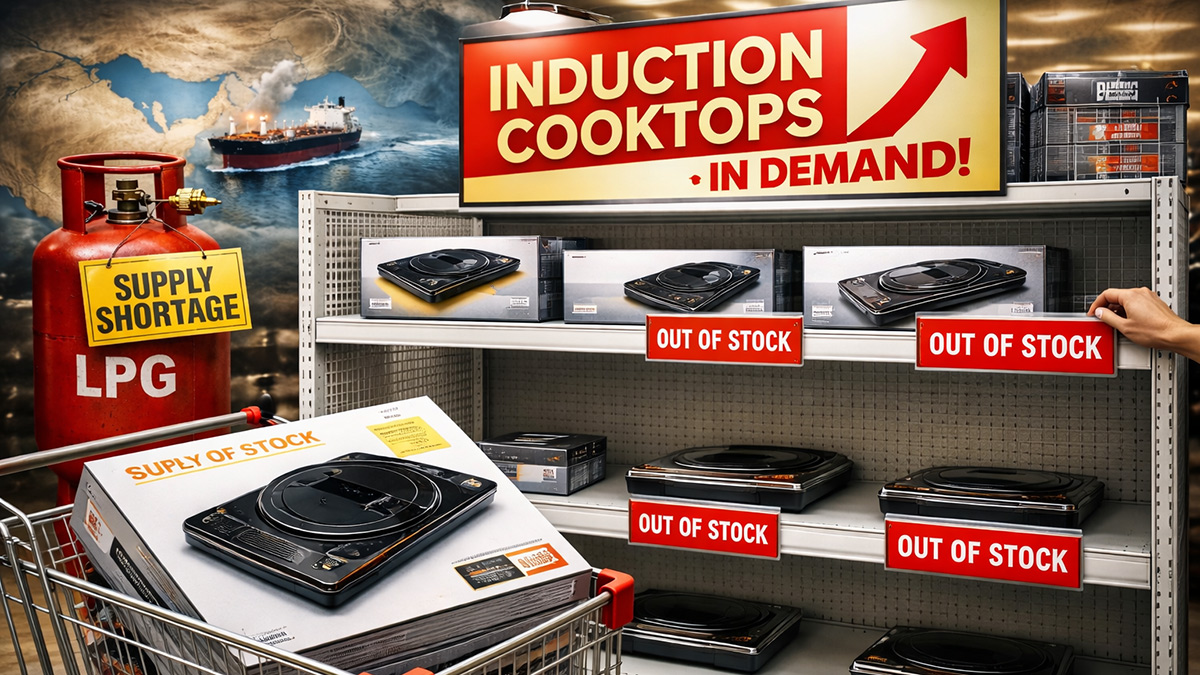
What began as concerns over the availability of liquefied petroleum gas (LPG) has quickly evolved into a technology-driven shift in cooking habits. Households across India are increasingly turning to induction cooktops and other electric appliances, initially as a backup but now, for many, a necessity.
A sudden surge in demand
Recent data from quick-commerce and grocery platform BigBasket highlights the scale of the shift. According to Seshu Kumar Tirumala, the company’s chief buying and merchandising officer, demand for induction cooktops has risen dramatically.
“Induction cooktops have seen a significant surge in demand, recording a fivefold jump on 10 March and a thirtyfold spike on 11 March,” Tirumala said.
The increase stands out sharply when compared with broader kitchen appliance trends. Most appliance categories are growing within 10 per cent of their typical demand levels, while induction cooktops have witnessed explosive growth as households rush to secure an alternative cooking option.
Major e-commerce platforms including Amazon and Flipkart have reported rising searches and orders for induction stoves. Quick-commerce apps such as Blinkit and Zepto have also witnessed stock shortages in major metropolitan areas including Delhi, Mumbai and Bengaluru.
What was once considered a convenient appliance for hostels, small kitchens or occasional use has suddenly become an essential addition in many homes.
A crisis thousands of miles away
The trigger for this shift lies far beyond India’s kitchens.
Escalating conflict in the Middle East has disrupted shipping routes through the Strait of Hormuz, one of the world’s most critical energy corridors. Nearly 85 to 90 per cent of India’s LPG imports pass through this narrow waterway, making the country particularly vulnerable to supply disruptions.
The ripple effects have been swift.
India currently meets roughly 60 per cent of its LPG demand through imports, and tightening global supply has already begun to affect domestic availability and prices.
Earlier this month, the price of domestic LPG cylinders increased by Rs 60, while commercial cylinders rose by more than Rs 114.
To discourage panic buying and hoarding, the government has also extended the mandatory waiting period between domestic refill bookings from 21 days to 25 days.
Restaurants feel the pressure
The strain is not limited to households. Restaurants, hotels and roadside eateries are also grappling with supply constraints as commercial LPG availability tightens under restrictions imposed through the Essential Commodities Act.
In cities such as Bengaluru and Chennai, restaurant associations report that commercial LPG availability has dropped by as much as 75 per cent, forcing many establishments to rethink their kitchen operations.
Some restaurants have reduced menu offerings, while others are rapidly installing high-efficiency induction systems, creating hybrid kitchens where electricity now shares the workload with gas.
For smaller eateries and roadside dhabas, the shift is less about sustainability and more about survival.
A potential structural shift
The government has maintained that there is no nationwide LPG crisis and has directed refineries to increase production to stabilise supply.
Nevertheless, the developments of March 2026 may already be triggering a longer-term behavioural shift.
For decades, LPG has been the backbone of cooking in Indian households. However, recent disruptions have highlighted the risks of relying on a single fuel source.
Increasingly, households appear to be hedging against uncertainty by adopting electric cooking options to guard against price volatility and delivery delays.
If the current trend continues, the induction cooktop, once viewed as a niche appliance, could emerge as a quiet symbol of India’s evolving kitchen economy.