News Broadcasting
CNBC questions INCablenet stand


NEW DELHI: Television Eighteen Ltd, the Indian joint venture partner for CNBC India, has questioned the Hinduja Group MSO INCablenet’s stand on the black out of the business news channel on the INCablenet owned or affiliate cable networks in Mumbai. It has also written a letter to the Indian Broadcasters’ Foundation (IBF) requesting that the apex body should come out strongly against such incidents of “armtwisting.”
The IBF is the apex body of broadcasting companies operating in India.
“If we have not signed up with INCablenet as per the Cable TV Act, something which is being claimed to be the reason behind the blackout, I would ask has INCablenet ever written to us asking us to do so?” was the question Haresh Chawla, chief executive of TV18, put before indiantelevision today.

Chawla said if the case was that of the channel not signing up with the MSO, as per the law, then the channel should not be on air in other parts of the country also. “But in other parts of the country CNBC India is on air and is being shown by cable operators, some of whom may be also franchisees of INCablenet.”
INCablenet president Rajiv Vyas, however, had told indiantelevision.com yesterday that the business channel was off the network because it had failed to provide “an official undertaking that it was complying with all terms and conditions of the Cable Act.”
But Chawla has dared INCablenet to come out and give proof that other channels have signed up with INCablenet as per the rules and regulations, which are being cited by the MSO.
Chawla further said the poser should be put to INCablenet as to whether business channel Bloomberg, which is what has replaced CNBC India on the bouquet, had given any such undertaking.
INCablenet had taken CNBC India feed off its networks in Mumbai since Tuesday allegedly in retaliation for a report carried by the channel on the Hindujas and Bofors case earlier this week.
In a counter move, CNBC India has decided to stop covering the Hinduja group’s business activities and has also deleted the Hinduja group’s scrip price movement from its ticker service, which comes at the bottom of the TV screen.






News Broadcasting
Network18 channels lead YouTube news viewership in March 2026
CNN-News18, News18 India and CNBC channels top categories with record views
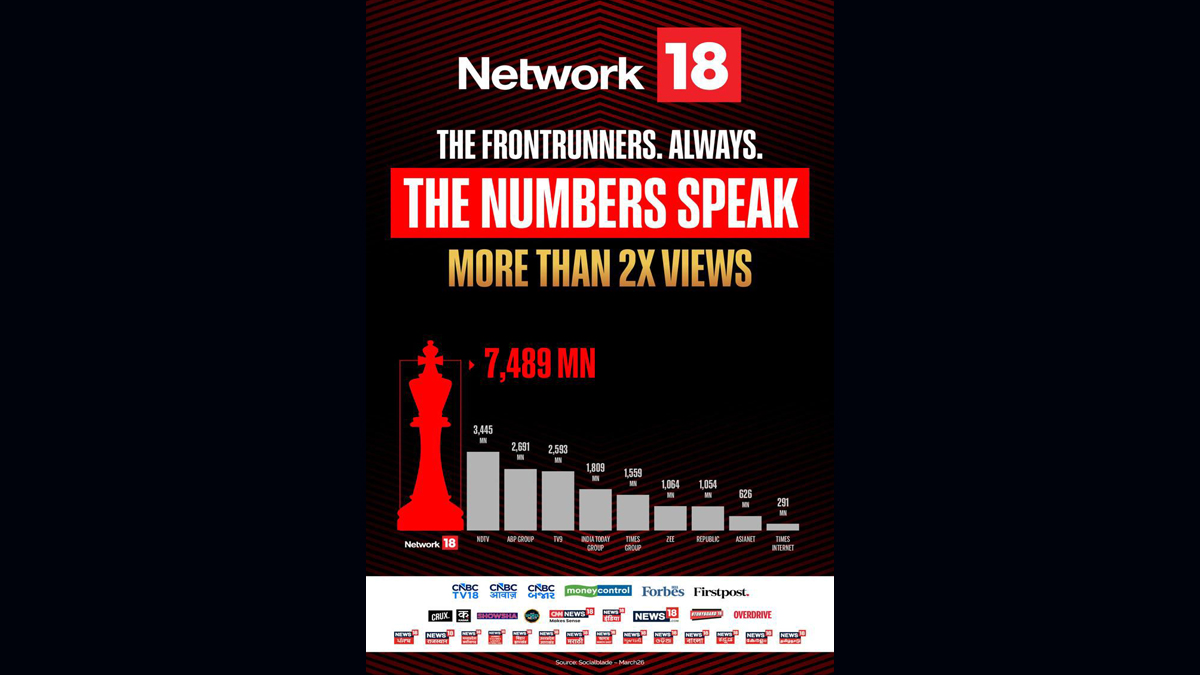
MUMBAI: When the world hit refresh on breaking news, Network18’s channels were already streaming ahead. As geopolitical tensions and war-driven headlines fuelled a surge in global news consumption, the network’s digital playbook delivered big clocking record Youtube viewership across English, Hindi and business news categories in March 2026.
At the forefront was CNN-News18, which emerged as the clear leader in the English news segment with 130 million live and video-on-demand views. The channel edged past competitors such as Times of India (126.5 million), Times Now (101.1 million), India Today (88.2 million) and NDTV (77.5 million), according to Databeings data for March.
In the Hindi news arena, News18 India delivered a commanding performance, racking up a staggering 3,297 million views on YouTube. The channel comfortably outpaced NDTV India, which recorded 3,119 million views, underlining its deep reach and consistent engagement with mass audiences, as per Playboard data.
The network’s dominance wasn’t confined to general news. In the Hindi business segment, CNBC Awaaz topped the charts with 92 million views, narrowly ahead of Zee Business (90 million) and well ahead of ET Now Swadesh (57 million). Meanwhile, its English counterpart CNBC-TV18 posted a strong 58 million views, reinforcing the network’s cross-category strength.
The spike in viewership reflects a broader shift in audience behaviour, with viewers increasingly turning to digital platforms particularly Youtube for real-time updates and in-depth coverage during high-intensity news cycles. For Network18, the numbers signal more than just scale; they underline the effectiveness of a multi-platform strategy that blends speed, credibility and continuous coverage.
In a month where the news never paused, it seems viewers chose to stay tuned where the stream never stopped.






