Hindi
Cinematic content should have desirable impact on social behaviour: Pranab Mukherjee

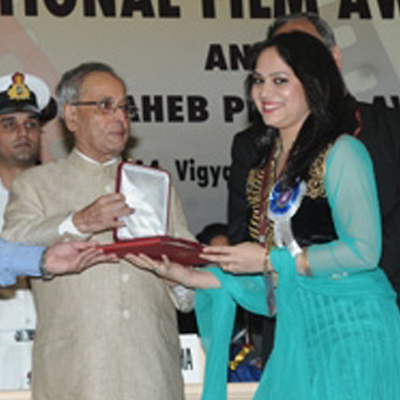
NEW DELHI: President Pranab Mukherjee has said filmmakers should make a concerted effort to distinguish between what clearly is an art form and what is not and the cinematic content of films should have a desirable impact on the social behaviour of people, especially the new generation.
He said, “I take this opportunity to reflect upon an important aspect of cinema. Besides being a strong medium of expression, cinema is a vehicle of influence and persuasion for the youth. When our children witness scenes depicting violence and bloodshed, it does affect their psyche.”

Speaking after presenting the Dadasaheb Phalke award to poet-lyricist-filmmaker Gulzar and the 61st National Film Awards for 2013 over the weekend, Mukherjee said: “Faced with erosion of values in today’s context, cinema should play a catalytic role in resetting our moral compass. Our filmmakers should deploy their creative efforts to present and propagate core values such as patriotism, respect for women, compassion and tolerance, honesty and discipline. I am hopeful that everyone associated with the film industry will use their talent and artistic pursuits to create meaningful and socially relevant cinema.”
Cinema has played a critical role in highlighting social and political issues of concern as well as exposing the deficiencies in our political system. It is an industry which has provided opportunities for many to rise from rag to riches. He called upon the film industry to nurture and strengthen its openness, pluralism and inclusiveness and disseminate the same throughout the country.
He added: “India’s media and entertainment industry is today at the cusp of a transformation. It is poised to leapfrog into a completely digital landscape. Indian cinema connects with millions of people – within the country and abroad, directly through theatres, close to 2,000 multiplexes and through TV as well as the internet. In 2013, the Indian Media and Entertainment (M&E) industry registered a growth of 11.8 per cent over 2012 and did a gross business of around Rs 92,000 crore. The industry is expected to register a compound annual growth rate of 14.2 per cent to touch Rs 1.8 lakh crore by 2018.”
Earlier, Gulzar who is turning 80 later this year was given a standing ovation as he went up to the dais of the tastefully decorated Vigyan Bhavan to receive his award for outstanding contribution to the growth and development of Indian cinema. The presentation was preceded by a short showreel into his work, and included tributes paid to him by several cine artistes. The award consists of a Swarn Kamal (Golden Lotus), a cash prize of Rs 10 lakh and a shawl.
Speaking after receiving the award, Gulzar paid a tribute when he described the film field as the only industry after the Armed Forces which was totally secular and welcomed all.
He said his honour belonged to scores of film personalities like the late Bimal Roy and Sachin Dev Barman who had given him the right chances at the right times and even younger talent like Shankar Ehsaan Loy and A R Rahman. “Many like R D Burman, Madan Mohan, and Laxmikant are no more. But one could not always live in nostalgia had to move on,” he said.
Information and Broadcasting Minister Manish Tewari agreed with Gulzar and said cinema was the great unifier. He said the National Film Awards were reflective of the heterogeneity of the film industry which was a confluence of many Indian languages. These awards were truly a tribute to the diversity of thought, and recognition of excellence.
The report of the feature jury was presented by Manju Borah on behalf of chairman Saeed Akhtar Mirza, while the non-feature book jury were presented by chairpersons Reena Mohan and Sharad Dutt respectively.
A total of 41 awards were given by the President in the non-feature film category while 40 were given for feature films. Three awards were given to Best Writing on Cinema, including one for the best film critic.
The winners of the Best Male playback singer – Rupankar – and Best Female Playback singer Bela Shende renderd their award winning songs ‘E Tumi Kemon Tumi’ from the film Jaatishwar (Bengali) and ‘Khura Khura’ from the film ‘Tuhya Dharma Koncha (Marathi)’ respectively.
The award for the best feature film was conferred on Ship of Theseus (English-Hindi) produced by Recyclewala Films and directed by Anand Gandhi. In the non-feature film category, the award for the Best Film was conferred to Rangbhoomi (Hindi) produced by Films Division and directed by Kamal Swaroop. In the category of Best Writing on Cinema section, the book Cinema Ga Cinema (Telugu)written by Nandagopal and published by Praga India, Hyderabad bagged the top honour, while Alaka Sahani (English) was conferred the award for the Best film Critic.
Hindi films once again dominated the National Film Awards by getting as many as 15 awards among feature films. Marathi came next with 10 awards followed by Bengali with six and Tamil and Kannada with five each and Malayalam with four.






Hindi
YRF Entertainment appoints Saugata Mukherjee as head of content
Former SonyLIV content head to steer films and series at streaming arm

MUMBAI: YRF Entertainment, the streaming arm of Yash Raj Films, has appointed Saugata Mukherjee as head of content, signalling a strong push to scale its original films and series slate.
Mukherjee joins the company following a successful three-and-a-half-year stint at SonyLIV, where he served as executive vice president and head of content. In his new role, he will report to CEO Akshaye Widhani and lead the creative direction and commissioning strategy for YRF Entertainment’s growing slate.
The appointment comes on the back of YRF Entertainment’s recent global success with titles such as The Romantics, The Railway Men and Mandala Murders, which have helped position the studio as a serious player in the streaming space.
At SonyLIV, Mukherjee played a key role in shaping the platform’s identity as a premium content destination. Under his leadership, the service delivered acclaimed originals across genres, building a reputation for storytelling depth and creative risk-taking. His exit was described as “one of the harder goodbyes”, reflecting both the impact of his tenure and the strength of the team he leaves behind.
Mukherjee brings with him a wide-ranging career that spans publishing, television and streaming. Before SonyLIV, he led content initiatives at HBO Max under Warner Bros. Discovery, where he was instrumental in shaping the platform’s India strategy. His earlier roles include senior leadership positions at Hotstar and Star TV, where he worked on building original content pipelines and collaborating with top creative talent.
With a career that began in publishing at firms like HarperCollins and Pan Macmillan, Mukherjee’s journey reflects a deep-rooted understanding of storytelling across formats and platforms.
His move to YRF Entertainment comes at a time when the battle for streaming audiences is intensifying, with studios doubling down on high-quality originals to stand out in a crowded market.
For YRF, the appointment is more than just a leadership hire. It is a clear signal that the studio is ready to scale its streaming ambitions, with Mukherjee expected to play a central role in shaping its next chapter.






