News Broadcasting
Chrome DM data validates RepublicTV’s leadership claims


Mumbai: “Opportunity To See” or OTS is a measure in advertising media that denotes the number of times the viewer is most likely to see the brand (In the below table brands denote TV channels). This term is used by marketers and analysts to differentiate between the total audience in the universe and the percentage of the total audience that has access to see your brand/ channel. The larger the percentage the higher is the availability of the channel converting into consumption/reach.
The following OTS analysis over the last four years (2017-2020) within the Indian television market points at
• As seen the Republic TV OTS in urban homes has been higher than Times since 2019 making it the largest available English brand in Urban Homes in India.
• Republic TV OTS has been higher than Times NOW since 2018. The distribution and availability of the channel has been extremely high in comparison to any other channel in the genre.
• The gap has widened into “Reach” in 2019 and 2020 as the TRAI implemented the new tariff order (NTO) making sure Republic TV’s free to air offering in English increased its footprint across homes through India.
• The share of news genre got expanded from 2017, post the entry of Republic TV.
• The channel was launched in 2017 and since then its growth trajectory has always been on the rise. The other channels have also either grown albeit slowly vis-à-vis Republic or remained semi stagnant.

OTS (Opportunity to See) – India Urban – Avg. of 2016 to 2020
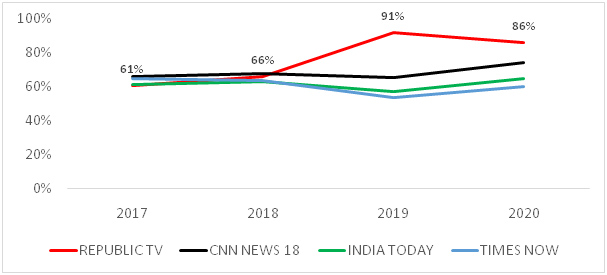
Source: Chrome Live, Mkt- All India Urban, 2017-2020
|
Year |
Republic |
Times Now |
Difference |
|
Avg. of 2017 |
61% |
65% |
-4% |
|
Avg. of 2018 |
66% |
63% |
3% |
|
Avg. of 2019 |
91% |
53% |
38% |
|
Avg. of 2020 |
86% |
60% |
26% |
Source: Chrome Live, Mkt- All India Urban, 2017-2020
Speaking to Republic World, ChromeDM founder and CEO Pankaj Krishna said, “After a point and irrespective of genre, the key differentiator amongst players within the genre boils down to the availability of content. Considering the fact that distribution is still contingent on a 1000+ variables (DPOs/ CNOs) and is one of the biggest cost centres for running a linear TV channel – unless of course, it is a hugely appointment-led genre, for instance for Hindi GEC.
Most of the genres – be it news (Hindi and English), music, infotainment, the time spent per viewer limits to less than ten minutes a week and is mostly driven by channel surfing or flirting, if I may call it. A differentiator of 15-20 per cent on distribution between any two-three players within a genre would probably be the factor deciding the lead in the consumption / viewership / ratings within the genre.
LCN (logical channel number), placement (where your channel falls), neighbourhood (the channel that precedes you), the packages that you are on (whether your channel reaches 100 per cent audiences and the penetrations of the packages that your channel is a part of) – all of these factors determine the OTS (Opportunity to See) or the availability of a channel which is the primary key factor in determining the dominance of one over the other.
I don't have any inclination to any channel or newsroom or point of view- but after a certain level and with the proliferation of content, it does become a commodity – where-in the availability of content plays a bigger role than the content itself…"
Republic Media Network group CEO Vikas Khanchandani said, “Republic Network has focused and delivered the largest reach platforms in its respective genres. The above data from Chrome is yet another data point that reflects on the growth and leadership that our brand enjoys. There are multiple data points like the engagement of Republic TV on social media which is also highest within its genre reflecting the stickiness of our brand and reflective of high TSV that the brand enjoys. We have similar data points for our humongous consumption on OTT as our brand has very wide availability on connected devices and I am more than confident that we will continue to bring the largest English and Hindi news platforms for consumers and advertisers.”
The data for analysis was provided by Chrome DM.
Chrome DM is a technology-driven market research firm with a pan-India on-ground presence. As of September 2017, the organization had a team of 650+ field staff, 150+ managerial staff and 450 tele-callers speaking over 22 languages to gather data from 3300+ towns. With a presence in over six lakh villages, Chrome DM also has an unprecedented reach into rural India.






News Broadcasting
Network18 channels lead YouTube news viewership in March 2026
CNN-News18, News18 India and CNBC channels top categories with record views
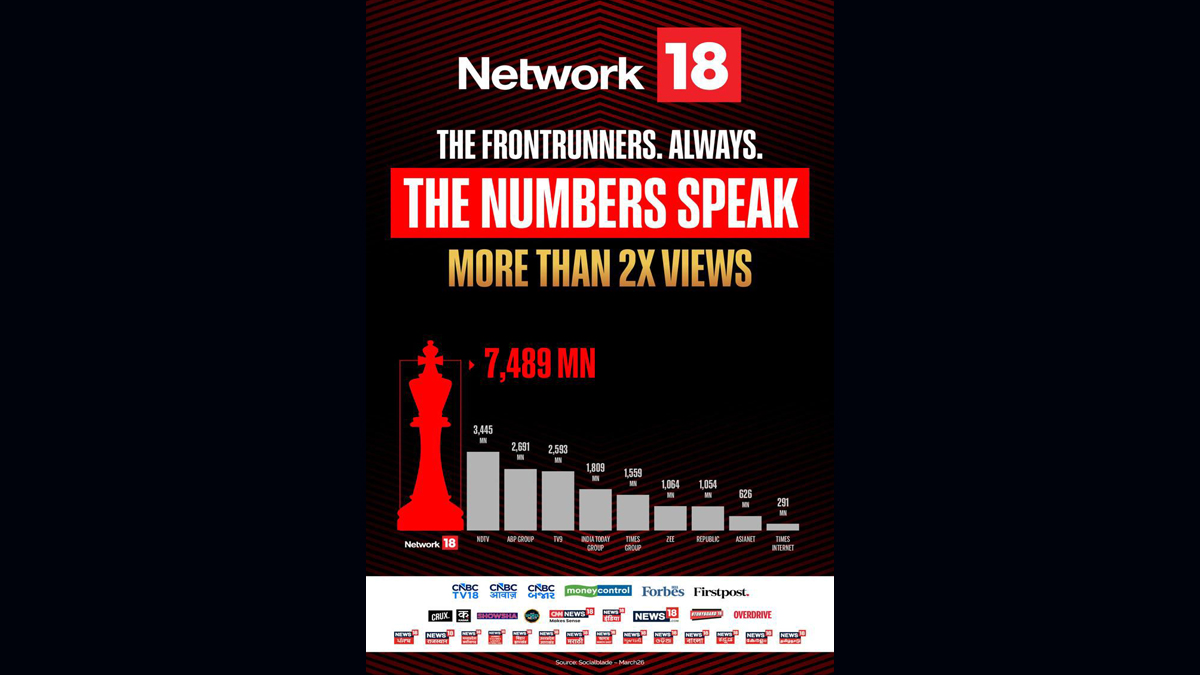
MUMBAI: When the world hit refresh on breaking news, Network18’s channels were already streaming ahead. As geopolitical tensions and war-driven headlines fuelled a surge in global news consumption, the network’s digital playbook delivered big clocking record Youtube viewership across English, Hindi and business news categories in March 2026.
At the forefront was CNN-News18, which emerged as the clear leader in the English news segment with 130 million live and video-on-demand views. The channel edged past competitors such as Times of India (126.5 million), Times Now (101.1 million), India Today (88.2 million) and NDTV (77.5 million), according to Databeings data for March.
In the Hindi news arena, News18 India delivered a commanding performance, racking up a staggering 3,297 million views on YouTube. The channel comfortably outpaced NDTV India, which recorded 3,119 million views, underlining its deep reach and consistent engagement with mass audiences, as per Playboard data.
The network’s dominance wasn’t confined to general news. In the Hindi business segment, CNBC Awaaz topped the charts with 92 million views, narrowly ahead of Zee Business (90 million) and well ahead of ET Now Swadesh (57 million). Meanwhile, its English counterpart CNBC-TV18 posted a strong 58 million views, reinforcing the network’s cross-category strength.
The spike in viewership reflects a broader shift in audience behaviour, with viewers increasingly turning to digital platforms particularly Youtube for real-time updates and in-depth coverage during high-intensity news cycles. For Network18, the numbers signal more than just scale; they underline the effectiveness of a multi-platform strategy that blends speed, credibility and continuous coverage.
In a month where the news never paused, it seems viewers chose to stay tuned where the stream never stopped.






